

Tl;dr
- Document verification is the process of checking if a document is real and correct. It makes sure IDs, certificates, or other proofs are genuine and haven’t been changed.
- It helps organizations prevent fraud, meet compliance requirements, and build trust.
- Today, document verification is mostly done using technology like OCR, QR codes, databases, and AI. This lets documents be checked quickly, often in just a few seconds.
- Commonly verified documents include government IDs, educational certificates, address proofs, and income records.
- As document fraud rises globally, strong verification systems are no longer optional.
Fake documents are no longer easy to spot.
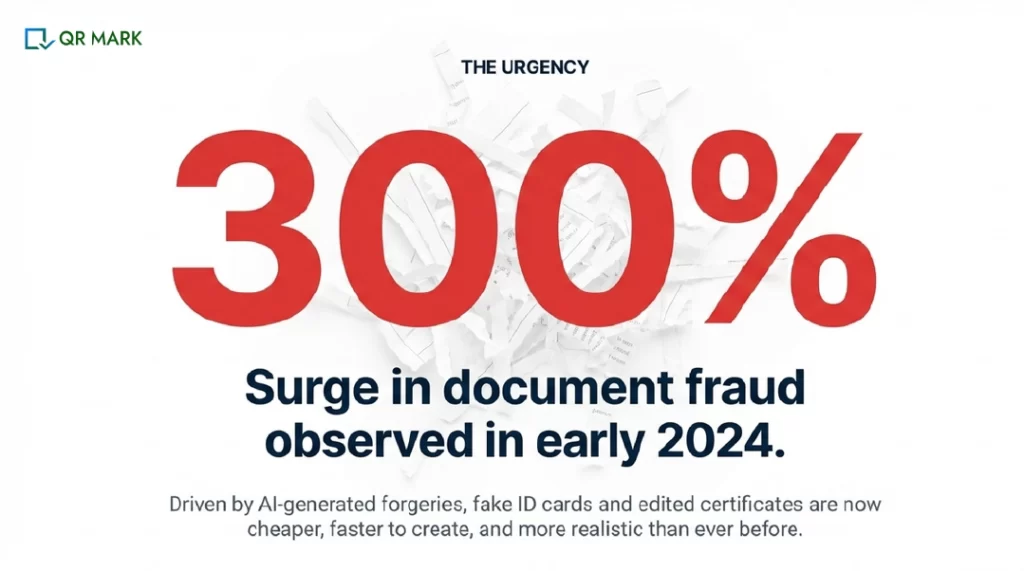
Document fraud has become easier and more advanced than before. Fake ID cards and edited certificates now look more real and are cheaper and faster to create.
In early 2024 alone, document fraud surged by over 300%, largely driven by AI-generated forgeries.
This is why document verification has become critical for businesses, governments, and institutions. It plays a central role in fraud prevention, compliance, and identity assurance.
In this blog, I will be explaining:
- What is Document Verification?
- How Does Document Verification Works?
- What are the challenges, and How long does it take to verify documents?
Let’s get started.
A.What does document verification actually mean in simple terms?
Document verification is checking if a document is real and correct. It answers one simple question: Can we trust this document?
For example, if you give your degree certificate to an employer, they will check:
- The date your degree was issued
- The name of your college or university
- The certificate number
- The course you completed
- Your name and credentials
This process ensures the document is genuine, the information is correct, and it hasn’t been faked or tampered with.
1.Why do businesses need document verification?
Businesses check documents to stop document fraud and mistakes.
Why?
If a company accepts a fake document, it can lose money or even get in legal trouble. For example:
- Banks must verify IDs to follow anti-fraud laws and prevent money laundering.
- Employers check diplomas and resumes to make sure people have the skills they claim.
Document verification keeps companies and customers safe and follows the rules.
B.How does document verification work(step-by-step)?
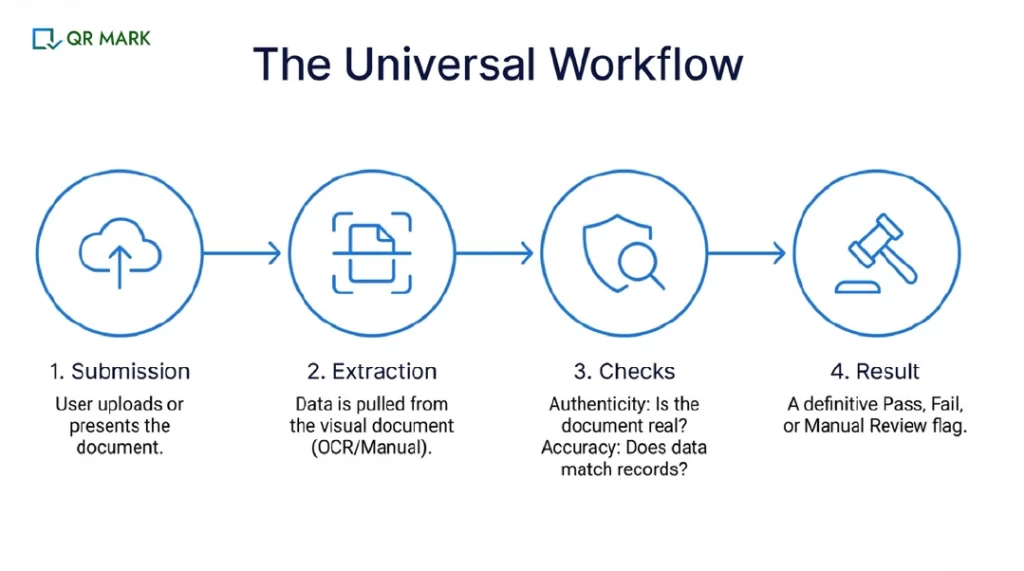
Document verification works on a simple workflow. The method you pick, online or offline document verification, needs some changes. Each choice has different adjustments. However, the overall process stays the same.
Following are the steps of document verification regardless of the medium.
Step 1: Document Submission
Step 2: Information Extraction
Step 3: Authenticity and Accuracy checks
Step 4: Verification result
The mind-map provided below, can help you understand the process better.
Now, based on the medium there are usually two ways to verify documents, depending on the verifier:
- Online Document Verification
- Offline Document Verification
1. Understanding Online Document Verification
Online document verification is checking documents digitally. It’s faster, saves paperwork, and you don’t have to be there in person.
When it’s used:
- When users are remote
- When decisions depend on identity or credentials
- When documents need to be verified quickly or repeatedly
- When physical verification is too slow or expensive
You’ve probably seen this when opening a bank account online. You submit your ID (like Aadhar or PAN card), and the bank verifies it digitally. This is part of KYC (Know Your Customer).
Common documents verified online:
- IDs (passport, driver’s license, national ID)
- Educational certificates (degrees, diplomas)
- Employment letters
- Address proofs (utility bills, bank statements)
- Income proofs (pay slips, tax forms)
- Insurance documents
- Event tickets and digital passes
Online verification is faster, but it requires rules and regulations to protect your data. Companies follow laws like GDPR, ISO, or SOC to make sure your information is collected safely, stored securely, and shared carefully.
2. Offline Document Verification
Offline document verification is when a trained person checks the physical document. When verifying documents offline, they look for stamps, signatures, seals, and proper formatting.
When it’s used:
- Face-to-face banking and financial services
- Legal documents and notarizations
- Government applications
- Employment verification for certain roles
- Property and real-estate transactions
How it works:
- Staff inspect the document
- Check security features like stamps and seals
- Match the details with the person presenting it
- Approve the document if everything looks correct
Offline verification is slower and can’t handle large volumes easily. Humans can make mistakes, so it’s often used only when needed.
Here are few use cases where still offline document verification is preferred:
Where offline document verification is still used?
-
Banking:
When you visit a bank to open an account, update KYC, or apply for certain services. It adds extra trust, especially for big or sensitive accounts. -
Legal matters:
Contracts, affidavits, and other legal papers are checked to make sure they can be trusted. -
Government services:
Some public services require you to show original documents in person. -
Employment verification:
Employers may check ID proofs, educational certificates, and work letters face-to-face before hiring. -
Property and real estate deals:
Original ownership papers and IDs are checked to prevent fraud and reduce disputes.
Offline document verification hasn’t disappeared because it solves a very specific need:
- it works when digital systems cannot
- it provides assurance through direct human review
- it satisfies situations where physical presence is required
However, it is slower, harder to scale, and depends heavily on human accuracy. That’s why many organizations now use offline verification only when necessary.
We have deeply talked about document verification till now. But, I think you should also know about Identity Verification as document verification is a cluster of it. Learning about identity verification makes it clear why document checks matter.
C.What is identity verification and how is it different from document verification?
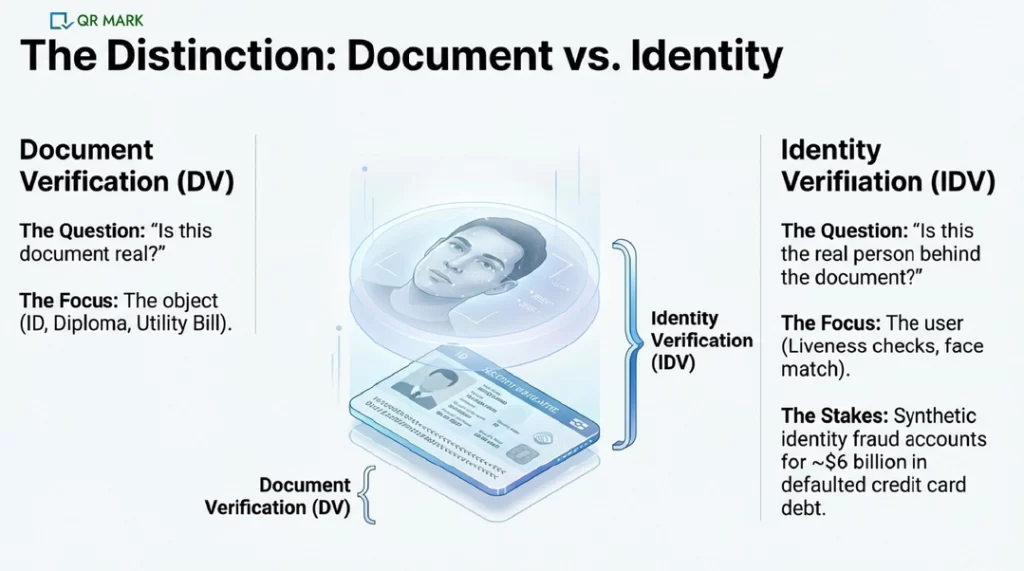
An identity check is the process of confirming that a person is who they claim to be. It usually starts by verifying an identity document. Further, it may include additional steps. For example, answering security questions or checking trusted databases.
Identity checks are required whenever secure proof of identity is needed. For example, banks and financial institutions must perform identity checks on new customers as part of KYC. (“Know Your Customer”)
Document verification plays a key role within this process. It focuses on the document itself. Identity verification acts as a final stamp on it. In simple terms, it declares that the person having the document is its rightful owner.
For example, an identity check may include a face match, where a live selfie is compared with the photo on the identity document. This ensures that a genuine document is not being used by the wrong person.
1. How do identity checks reduce fraud and impersonation?
Identity checks make it much harder for criminals to pretend to be someone else. When done thoroughly, they catch fake identities and stop fraud at the door.
For example, synthetic identity fraud can cause huge losses. One study found that it accounted for about 20% of defaulted credit card debt in the U.S. (~$6 billion).
By verifying both documents and the person, many of these fake accounts are flagged. Good identity checks (including document verification and biometrics) greatly reduce impersonation. They ensure that the person presenting the document is the legitimate owner.
D.How long does document verification usually take?
Verification time can range from seconds to days. If the process is automated, it can be almost instant or just a few minutes once you submit the document.
Factors that slow it down include:
- poor image quality (blurry or incomplete scans),
- missing information, or
- extra steps like database lookups.
If any issue is raised, a human reviewer may need to get involved, which adds time. In general, high-quality submissions and automated systems lead to very fast verification.
1. Why does document verification get delayed?
Delays happen for several reasons. If the uploaded document is unclear or cut off, the system will reject it and ask for a better copy.
If the system flags something as suspicious, it will trigger a manual check.
High volume or limited staff can also cause delays. For example, verifying official transcripts might involve contacting another institution. This process can last upto many days.
2.What happens after a document fails verification?
If a document fails verification, it means the document could not be confirmed. When this happens, the verification process is paused, and the document is not accepted.
3.Why do documents fail verification?
A document may fail verification for several common reasons, such as:
- the document is expired or incomplete
- the uploaded copy is unclear, cropped, or low quality
- details on the document do not match the submitted information.
- required security features are missing or look altered
The document type is not accepted for that use case
In some cases, the document may be genuine, but the submission might not meet the requirements.
4.What happens next after a failure?
In most cases, the person is not immediately rejected.
Instead:
- the user is informed that verification failed
- they are asked to re-upload a clearer copy or submit a different document
- the document may be reviewed manually if the issue is unclear
This helps resolve simple errors without blocking the process.
5. Are there consequences if a document fails verification?
For most routine cases, there are no legal consequences. The process simply cannot move forward until a valid document is provided.
However, if a document fails because it appears to be fake or misused, the organization may:
- deny the application or service
- block further attempts or, in serious cases,
- report the issue under applicable laws
E.What are the challenges in document verification today?
The challenges in document verification today is the rise of realistic fake documents. With improved technology, their detection is getting difficult day by day.
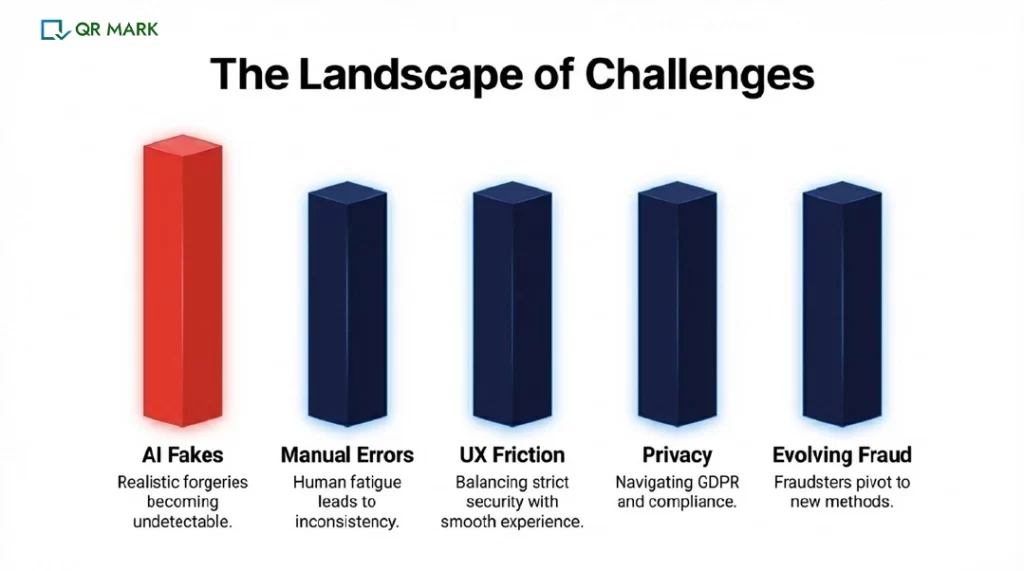
Here are the top 5 challenges that document verification faces today:
1.Fake documents are becoming harder to spot
Modern tools make it easy to create realistic fake IDs, certificates, and records. Even trained reviewers can miss small details. Which in turn, increases the risk of fraud slipping through.
2.Manual verification is slow and error-prone
Relying on people to check documents takes time and doesn’t scale well. Human fatigue and inconsistency can lead to mistakes. It is more common when large volumes need to be verified.
3.Balancing security with user experience is difficult
Strong verification is necessary, but too many steps can frustrate users. Businesses want their checks to stay secure. They also don’t want the process to feel complicated or intrusive.
4.Data privacy and compliance requirements are strict
Document verification involves sensitive personal data. Organizations must follow privacy laws(like GDPR)and security standards. This adds complexity to how documents are collected, stored, and accessed.
5.Fraud methods keep evolving
As verification systems improve, fraudsters adapt. New techniques, including AI-generated documents and identity misuse, require verification processes.
Final Thoughts
Document verification is no longer a background process. It is a frontline defense against fraud.
As fake documents become more advanced and AI-generated forgeries rise, businesses cannot rely on manual checks alone. Strong verification systems protect revenue, ensure compliance, and build long-term trust. Whether it’s verifying an ID, a degree certificate, or a financial record, the goal remains the same confirm that the document is real, accurate, and untampered.
Modern verification combines technology like OCR, AI, QR codes, and secure databases to deliver fast and reliable results. At the same time, organizations must balance security with user experience and data privacy.
In today’s digital world, document verification is not optional. It is essential for preventing fraud, meeting regulations, and protecting both institutions and individuals.
FAQs
1. What is document verification in simple words?
Document verification simply means checking that a document (like an ID, certificate or contract) is real and correct. It’s like double-checking a passport or diploma to make sure it’s not forged and that all the details match reality.
2. Can scanned or digital copies be used for verification?
Yes, in most cases scanned or digital copies are accepted if they are clear. Many companies allow you to upload a PDF or photo of a document. The key is quality: the document must be legible and complete. (Some places have rules – for instance, one bank requires a PDF of an address proof and will not accept a blurry photo.) If the copy is good, it will be treated the same as the original for verification.
3. Is document verification legally required?
Sometimes. In regulated industries (like banking, finance, and government), laws often require verification. For example, U.S. banking regulations mandate identity verification using government IDs. Many countries have KYC/AML laws that make banks and other businesses verify documents. In other cases (like employment), it’s not a law but a standard business practice or policy.
4. Who performs document verification checks?
Checks can be done by companies’ own staff or by third-party providers. For example, banks, employers, universities, and government agencies have teams or systems for it. There are also specialized tech companies (like Onfido, Jumio, ID.me) that handle online document verification services for businesses. Often it’s a mix: a company might use a third-party system to automate the checks.
5. What are the requirements for the document verification process?
To verify a document, you need a clear and complete document, some proof that it is genuine (like a digital signature, official seal, or QR code), and a way to check it online. Sometimes, you may also need to confirm the identity of the person using the document.

Leave a Reply