

TL;DR
A certificate of translation accuracy is a signed statement from a translator confirming that a translation is complete and faithful to the original document. Courts, universities, and agencies like USCIS require it before they accept any foreign-language document. This guide covers what the certificate must contain, how it differs from a notarized translation, how to create and obtain one, and how to check that a certificate you have received is genuine rather than forged.
A university admissions officer opens a file from an overseas applicant. The transcript is in Portuguese. Stapled behind it is an English translation and a one-page letter signed by a translator.
The officer has to decide, in the next two minutes, whether that letter is enough to treat the translation as real. That single page is a certificate of translation accuracy, and it is doing more work than most people realize.
This comes up constantly in immigration filings. Under federal regulation 8 CFR 103.2(b)(3), any foreign-language document submitted to USCIS must arrive with a full English translation that the translator has certified as complete and accurate, along with a statement that the translator is competent to translate from that language into English.
No certificate, no acceptance. The translation can be flawless and still get rejected if that signed statement is missing.
So the certificate is not a formality. It is the thing that makes a translation usable in a legal or institutional setting. Below is what it contains, how to get one, how to create one, and how to tell a real certificate from a fake.
What is a certificate of translation accuracy?
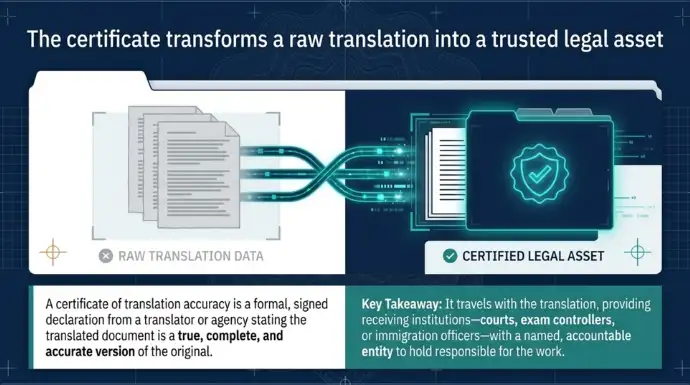
A certificate of translation accuracy is a signed declaration in which a translator or translation agency formally states that the translated document is a true, complete, and accurate version of the original. It travels with the translation and gives the receiving institution a named, accountable person to hold responsible for the work.
Think of it as the difference between a translation and a trusted translation. Anyone can produce the first. The certificate is what turns it into the second, because it attaches a real identity and a formal attestation to the output. When a court clerk, an exam controller, or an immigration officer accepts a translated document, they are relying on that attestation, not re-reading the source language themselves.
What does a certificate of translation accuracy need to include?
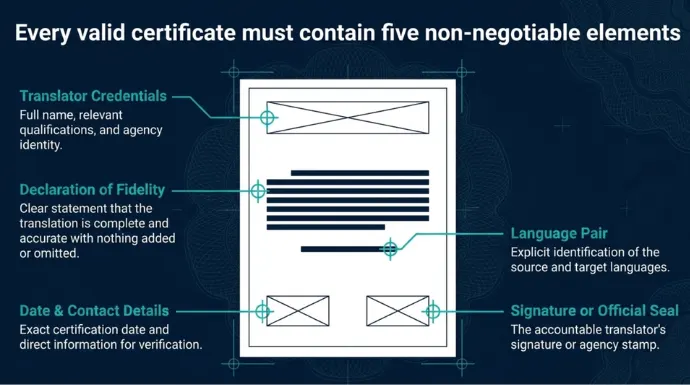
To be accepted by courts, universities, and government agencies, the certificate has to carry a specific set of elements. Leave one out and the receiving body can reject the whole submission.
- Translator or agency credentials: the full name, relevant qualifications, and signature of the translator or the agency representative who stands behind the work.
- Declaration of fidelity: a clear statement that the translation is a complete and accurate rendering of the original document, with nothing added or left out.
- Language pair: explicit identification of the source language and the target language, so there is no ambiguity about what was translated into what.
- Date and contact details: the exact date of certification and direct contact information the verifier can use to reach the issuer.
- Signature or official seal: the translator’s signature, or the agency’s stamp or seal, depending on the issuer and the receiving body’s expectations.
For USCIS specifically, the wording does not need fancy seals. The agency does not supply a mandatory template and does not require notarization. What it requires is the signed declaration of completeness, accuracy, and translator competence, with the name, signature, and date attached.
When do you actually need a certificate of translation accuracy?
You need one any time an institution has to trust a translated document it cannot read in the original. That is most often immigration, academic admissions, courts, and civil registration.
Common triggers include green card and visa filings, university applications using foreign transcripts, court proceedings involving foreign-language evidence, and civil records like birth, marriage, and death certificates submitted to a government body. In each case the receiving party needs accountability, and the certificate supplies it.
How is a certificate of translation accuracy different from a notarized translation?
A certificate of accuracy is the translator vouching for the translation. A notarized translation adds a notary public who confirms the identity of the person signing, not the quality of the translation itself. They answer two different questions, and many people pay for the wrong one.
This distinction matters because requirements vary by receiving body. USCIS, for example, requires certification but does not require notarization. Some embassies, consulates, and foreign universities ask for notarization or even an apostille on top of certification. Knowing which you need saves both money and a rejected filing.
| Question | Certificate of accuracy | Notarized translation |
| What does it confirm? | The translation is complete and accurate | The identity of the person who signed |
| Who signs it? | The translator or agency | A notary public, witnessing the signer |
| Does it judge translation quality? | Yes, that is its whole purpose | No, the notary never reads the translation |
| Required by USCIS? | Yes | No, notarization is optional |
| When is it added? | Always, for official use | When an embassy, court, or university asks |
The practical rule: start with the certificate of accuracy, because it is almost always required. Add notarization only when the specific receiving body asks for it.
How do you get a certificate of translation accuracy?
You get one from whoever performs the translation, and you have three realistic options: a professional translation agency, a qualified independent translator, or in limited cases, yourself or another bilingual person. The right choice depends on how much risk you can carry if the document is questioned.
A professional agency is the safest route for high-stakes filings. Agencies know the formatting that bodies like USCIS expect, they sign the certificate as a named, reachable entity, and most stand behind their work if an officer raises a question. Independent translators with recognized credentials, such as American Translators Association (ATA) certification, work well too, especially for single documents.
The third option needs a warning. USCIS technically permits you or a family member to translate and certify your own documents if you are fluent in both languages. In practice, self-translations and family translations get flagged at a much higher rate, because an officer can question the obvious conflict of interest.
If that happens, USCIS issues a Request for Evidence demanding a third-party translation, which adds weeks or months to the case. For a document that decides an immigration outcome, that is a poor trade.
How do you create a certificate of translation accuracy?
If you are the translator, you create the certificate as a short signed statement that sits with the finished translation. It does not need elaborate design. It needs the required elements, accurate information, and a real signature.
A workable certificate of translation accuracy template follows a simple structure:
- Heading: label the document clearly, for example “Certification of Translation Accuracy.”
- Statement of competence: state that you are competent to translate between the named source and target languages.
- Statement of accuracy: declare that the attached translation is complete and accurate to the best of your knowledge and ability.
- Document identification: name the document translated and the language pair.
- Translator details: your full name, and your credentials or agency name where relevant.
- Signature block: signature, date, and contact details, plus a seal if your receiving body expects one.
A widely accepted phrasing reads along the lines of: “I, [name], certify that I am competent to translate from [language] into English, and that the above is a complete and accurate translation of the attached document.” You then sign and date beneath it. For USCIS, a typed name, signature, and date are enough; no notarization is needed.
The certificate is only as trustworthy as the process behind it. A clean template with no way to confirm the issuer is exactly what a forger copies. That gap is where authentication comes in.
How do you authenticate a certificate of translation accuracy?
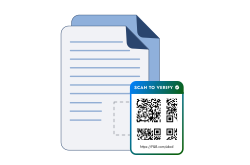
Authentication means adding a feature to the certificate that a verifier can check independently, so a copied or altered certificate fails the check. The common methods are physical seals, holograms, handwritten signatures, scanned digital signatures, unique reference IDs, and QR Codes that link to a verification record.
Each method has a weakness when used alone. Physical seals and holograms can be photographed and reproduced. A reference ID is only useful if the verifier has a database to check it against. Digital PDF signatures are strong, but only when the verifier knows to open the file in software that validates the signature, and many do not. The most reliable setups combine a quick visual cue with a live check against a record the issuer controls.
A QR Code is attractive because it is fast and works from any phone. But a bare QR Code has the same flaw as a seal: a forger can copy the image and paste it onto a fake certificate.
A QR Code only adds real security when scanning it lands the verifier on a page hosted by the genuine issuer, showing details that have to match the document in hand. That is the specific gap the next section addresses.
How do you authenticate a certificate of translation accuracy using QR Mark?
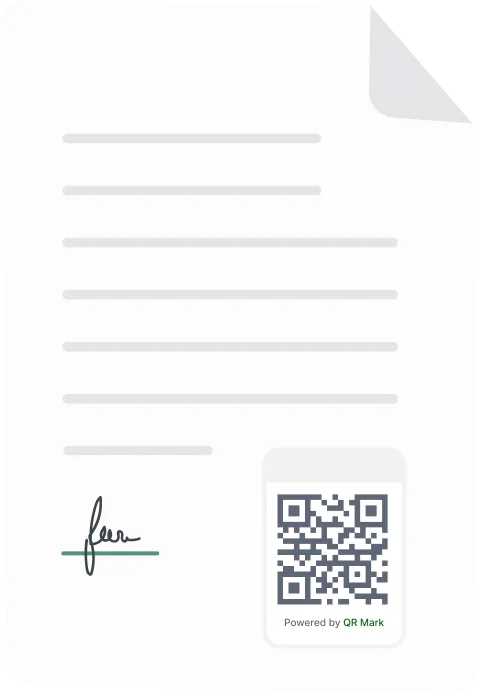
QR Mark adds a Verification Image, a combined QR Code and verification URL, to the certificate, and that image resolves to a verification page on the issuer’s own domain. The verifier scans, lands on the agency’s real domain, and matches the displayed details against the certificate in front of them. The loop is Embed, Scan, Verify.
The reason this defeats a copied QR Code is the Custom Domain. Anyone can generate a QR Code. What a forger cannot do is make that code resolve on the translation agency’s verified domain.
When the verification page loads on the agency’s own address and the translator name, language pair, and document reference match what is printed, the verifier has two independent signals lining up. When a forger reuses an image, the domain or the details break the match.
For agencies issuing translations at volume, Bulk Verification through the dashboard generates unique Verification Images across a whole batch at once, so a firm certifying hundreds of documents a month is not placing codes one by one. Larger organizations can add SSO so authorized staff log in through their existing identity provider.
One limit worth stating plainly: QR Mark verifies that a document is authentic and issued by the claimed agency. It does not encrypt the document, prevent edits to the underlying file, or judge whether the translation itself is linguistically correct. It is a verification layer, and that is exactly what the certificate problem needs.
See how the Embed, Scan, Verify loop works on your own domain.
How do you verify a certificate of translation accuracy you have received?
To verify a certificate you have received, audit the issuer’s identity, test the document’s digital and physical integrity, and match the translated text against the source. Government agencies, courts, and universities use a multi-step process to catch fraudulent certificates, and you can apply the same checks.
1: Audit the translator or agency credentials
A certificate is only as valid as the entity behind it. If it shows a credential number, run it through the official database, such as the ATA Certified Translator Verification tool or the NAATI Online Directory for Australian-accredited translators. Cross-check that the address, website, and phone number match public listings, since scammers often clone a real agency’s branding but swap in a fake contact line. When in doubt, contact the issuer directly using publicly listed details and give them the certificate reference number to confirm they completed the work.
2: Test digital and physical integrity
Open a digital PDF certificate in standard software like Adobe Acrobat Reader and check the signature banner. A valid secured certificate shows confirmation that the digital seal is valid and untampered; if it reads “Signature Invalid” or “Modified since signed,” reject it.
Scan the QR Code present on it on a second device and confirm the URL goes to the issuer’s official domain and shows the matching record. For paper, feel for a raised embossed seal and inspect any hologram under direct light.
3: Match the text against the source document
A certified translation package should attach a clean copy of the original source text behind the translated pages. Cross-reference exact names, dates, serial numbers, and figures across both. Arbitrary changes or mismatches point to a fabricated or machine-bypassed translation.
This three-step process is also the clearest answer to a question reviewers ask constantly.
How can I verify the accuracy of a translation?
You verify accuracy by confirming the issuer is real and credentialed, testing the document for tampering, and matching the translation against the original line by line. The certificate of accuracy gives you the issuer’s identity and contact details; the credential databases confirm they are who they claim; and a side-by-side check against the source catches altered names, dates, or figures. If the certificate also carries a domain-backed QR Code, scanning it gives you a fourth, independent confirmation.
Which industries require a certificate of translation accuracy?
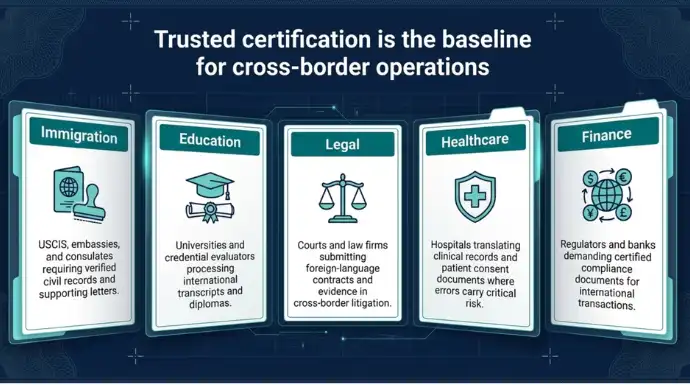
Any sector that has to act on a foreign-language document it cannot read in the original relies on these certificates. The heaviest users are immigration, education, legal, healthcare, and finance.
- Immigration: USCIS, embassies, and consulates require certified translations for civil records, transcripts, and supporting letters before a filing is accepted.
- Education: universities and credential evaluators need certified translations of transcripts, degrees, and diplomas from international applicants.
- Legal: courts and law firms require certified translations of contracts, evidence, and filings in cross-border matters, where an inaccurate rendering can change a case.
- Healthcare: hospitals and regulators rely on accurate translations of records and consent documents, where an error carries clinical risk.
- Finance: banks and regulators require certified translations of statements, contracts, and compliance documents in cross-border transactions.
Closing
A certificate of translation accuracy is a small document carrying a large amount of trust. It turns a translation into something a court, a university, or USCIS can act on, and the entire system depends on the receiving party being able to confirm it is real. The certificate names the issuer; authentication proves the certificate.
If your team issues certified translations, the fastest way to make them verifiable is to attach a Verification Image that resolves on your own domain, so any recipient can confirm authenticity in seconds.
Frequently asked questions
Does USCIS require certified translations to be notarized?
No. USCIS requires certification, a signed statement of completeness, accuracy, and translator competence, but notarization is optional. Some embassies, consulates, and foreign universities ask for notarization or an apostille separately, so check the specific receiving body’s rules.
Is certified translation legitimate, or is it a marketing term?
It is legitimate and, in many cases, legally required. For USCIS, federal regulation 8 CFR 103.2(b)(3) requires a certified complete and accurate translation for any foreign-language document. The certification is the signed accountability statement, not an upsell.
Can I certify my own translation for USCIS?
Technically yes, if you are fluent in both languages, but it is risky. Officers can flag the conflict of interest and issue a Request for Evidence demanding a neutral third-party translation, which delays your case. Using an independent translator or agency from the start avoids this.
What happens if a translation is submitted without a certificate of accuracy?
The receiving body can reject it regardless of how good the translation is. For USCIS, a missing certification is a common trigger for a Request for Evidence, which can add weeks or months to processing.
How do I confirm a certificate of translation accuracy is genuine?
Check the translator’s credential against an official database like ATA or NAATI, confirm the contact details match public listings, validate any digital signature in a PDF reader, and scan any QR code to confirm it resolves to the issuer’s official domain with matching details.
