


TL;DR
Managing risks in document fraud requires prevention at issuance, tamper-proof verification, real-time validation, audit trails, and staff training. Organizations that rely only on manual review remain vulnerable. Secure digital issuance with QR Code based authentication reduces fraud exposure.
Digital forgeries rose 244% in 2024 and now account for 57% of all document fraud cases, according to Keepnet Labs.
That number should give every HR manager, compliance officer, and finance team pause. We see this reality every day in conversations with our customers at QR Mark.
In this article, I’ll walk you through:
- What risk management in document fraud actually means
- Why document fraud is getting harder to catch
- Which documents carry the most organizational risk
- 6 ways to manage that risk effectively
What Is Managing Risks in Document Fraud?
Managing risks in document fraud is the process of identifying which documents carry the most harm if faked, deciding what level of verification each one needs, and building controls that prevent, detect, and respond to fraud across the document lifecycle.
It’s not just about catching a fake degree certificate after someone has already been hired. It’s about having a system that flags risk before it becomes a problem.
The documents that matter most in this context are:
- Identity documents (passports, national IDs)
- Educational credentials (degrees, transcripts, certifications)
- Employment documents (offer letters, experience certificates, pay slips)
- Financial documents (bank statements, invoices, tax records)
- Government and regulatory documents (licenses, compliance certificates)
- Healthcare records (medical reports, insurance claims)
These documents are the ones with the most risk associated with them because they influence access to jobs, financial services, government permissions, healthcare benefits and legal privileges.
What Are the Risks Associated with Document Fraud?
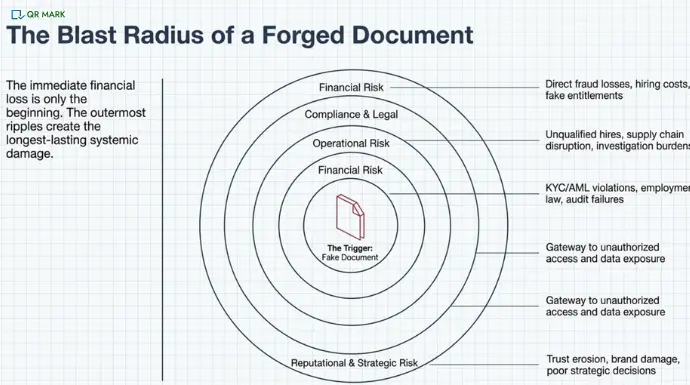
When documents get forged, it creates ripple effects across your organization that are financial, operational, legal, and reputational.
Let us understand them in a bit more detail.
What financial losses can document fraud cause?
The most immediate and measurable consequence of document fraud is direct financial loss. This includes the full cost of a fraudulent hire (recruitment, onboarding, and eventual termination). Fraudulent claims against insurance or benefit programmes, and outright financial fraud enabled by fake identity or income documents.
How does document fraud disrupt day-to-day operations?
Document fraud disrupts operations by placing unqualified or fraudulent actors inside your processes.
A person hired on false credentials may not perform the role they were evaluated for. A vendor verified with fake compliance documents may create supply chain liability. When fraud is discovered, the remediation burden like investigation, legal review, rehiring adds another cost.
What legal exposure does document fraud create for organisations?
If your KYC or AML process accepted a fraudulent identity document, the failure is yours to answer for regardless of intent.
Employment law violations can arise when unverified credentials lead to unqualified hires in regulated roles. Failed audits due to document irregularities can cost contracts and certifications.
How does document fraud damage an organisation’s reputation?
Reputational damage from document fraud is often underestimated because it surfaces slowly. It can outlast the financial and legal fallout. It leads to consequences such as:
- Loss of trust with clients and partners who question your verification rigour
- Reduced credibility of all documents you issue (not just the fraudulent ones)
- Employer brand damage when credential fraud by hires becomes public
What security and data risks does document fraud enable?
Document fraud is frequently a gateway to deeper security breaches. Fraudsters who gain access using fake identity documents rarely stop there. They leverage that access to extract data, compromise systems, or escalate privileges within an organisation.
What strategic risks does document fraud create?
Strategic risk from document fraud is the least visible category but can have the longest-lasting consequences.
Decisions made on the basis of false data. For example: a false financial report or a fabricated compliance certificate can lead the organisation in the wrong direction before anyone notices.
Why Is Document Fraud Getting Harder to Catch?
Document fraud isn’t new. What’s changed is how accessible the tools to commit it have become and how fast those tools are improving. Here are the key factors driving the risk higher.
1. How has generative AI made document forgery more accessible?
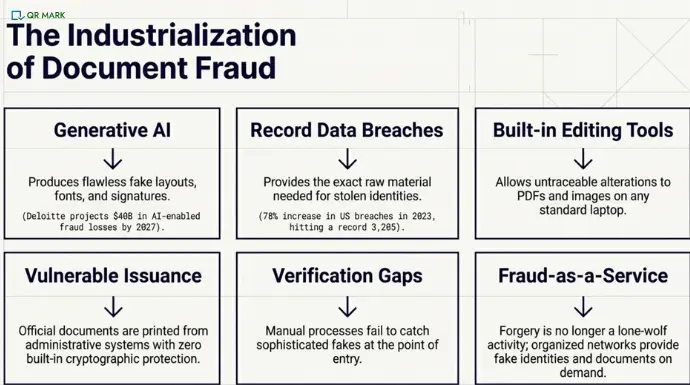
In 2026, generative AI tools can produce realistic layouts, matching fonts, fake signatures, and complete document templates that closely resemble official originals.
“Deepfake financial fraud is rising, with bad actors increasingly leveraging illicit synthetic information like falsified invoices and customer service interactions to access sensitive financial data and even manipulate organizations’ AI models to wreak havoc on financial reports,” – says Mike Weil, digital forensics leader and a managing director, Deloitte Financial Advisory Services LLP.
2. How do data breaches give fraudsters what they need to create convincing fakes?
When an organization suffers a data breach, personal and organizational data spills into the wrong hands.
The Identity Theft Resource Center recorded 3,205 data breaches in the United States in 2023—a 78% increase from 2022, and the highest number ever recorded.
3. Why do everyday editing tools make document alteration easy to miss?
Most document editing software tools that sit on every office laptop can now alter names, dates, figures, and addresses in a PDF or image without leaving obvious traces.
4. Why are most document issuance processes not built with fraud in mind?
Many organizations generate official documents through internal administrative systems with little to no fraud prevention built in.
A degree certificate printed from a university’s internal system, for example, typically looks identical whether it’s issued legitimately or generated by someone with the right access.
5. How do verification gaps allow document fraud to succeed?
Fraud often succeeds not because the document was perfect but because the verification was weak.
In 2024, scammers exploited weaknesses in the California community college system’s admission process, stealing approximately $8.4 million in federal financial aid and $2.7 million in state aid. The documents weren’t undetectable. The process just wasn’t looking hard enough.
6. What is Fraud-as-a-Service and why does it matter?
In many cases, document fraud is no longer committed by individuals acting alone.
Organized networks now offer what is effectively Fraud-as-a-Service: fake documents on demand, forged identity records, fabricated financial statements.
How Can Your Organization Manage Risks in Document Fraud?
The goal here is simple: make fraud harder to commit, easier to detect, and faster to prove.
Below are 6 practical approaches that reduce document fraud risk across your organization.
1. Verify documents against official records
The most direct way to catch a fake is to check whether the information in a submitted document actually matches the original record held by the issuing authority.
If a job applicant submits a university degree, the employer should verify the degree with the university directly or through an official verification platform. The same principle applies to financial documents, employment records, and identity papers.
2. Add tamper-resistant security features to the documents you issue
A document shouldn’t just look official. It should be hard to copy, hard to edit, and easy to verify. This is where tamper-resistant features come in like QR codes, digital signatures, unique identifiers, or verification watermarks.
At QR Mark, this is the core of what we do. When you add a QR Code to a document whether it’s an offer letter in Word, a degree certificate in Google Docs, or a compliance certificate in PDF.
The QR Code and the verification URL is tied to an official record. When a recipient scans it, they see the verified data instantly redirected on your domain.
If someone edits the printed document, changes a name, a date, a salary figure—the QR code still points to the original record. The discrepancy is immediately visible.
No phone calls to HR. No waiting for a reply email. Fraud is caught at the point of verification.
Make every document you issue instantly provable.
3. Build a structured verification process
A structured verification process defines which documents are high risk, what checks are mandatory for each, and when a document must be escalated.
It makes fraud detection consistent rather than dependent on individual judgment.
A practical way to start is to classify documents by risk:
- Low risk: Simple internal reference letters, general correspondence
- Medium risk: General education or employment records for non-sensitive roles
- High risk: Identity documents, financial proofs, licenses, compliance certificates, documents for senior or regulated roles
4. Use automated document fraud detection tools
Manual review is slow and unreliable at scale. When you’re processing hundreds of documents, software can detect patterns that a human reviewer would miss or not have time to check.
For example, if 500 applications are submitted to an institution with slightly different names but the same underlying contact pattern, IP behavior, or document layout. In such cases, an automated system can surface that pattern far faster than a human team.
These tools can flag things like mismatched fonts, inconsistent spacing, altered PDF metadata, image editing traces, duplicate submissions, and repeated use of the same identity details across multiple applications.
5. Train employees to recognize document fraud
Even the best systems can fail if employees do not know what to look for.
HR teams, admissions teams, finance teams, operations teams, and customer onboarding teams should all know the basic warning signs.
For example, HR should know that a salary slip with inconsistent alignment, vague company details, or unrealistic salary jumps may need closer review. Admissions teams should know that transcripts with unusual formatting, missing roll numbers, or unverifiable seals should be escalated.
Training also helps staff understand when not to trust appearances. A document can look polished and still be fake.
You can create basic fraud training around:
- Common red flags
- When to escalate
- How to use verification tools
- What not to accept without source checks
- What are things to look for when doing the verification such as digital signatures and QR Codes.
6. Make verification instant and self-service wherever possible
The most durable way to manage document fraud risk is to shift from reactive checking to proactive design.
When the documents your organization issues are built to be instantly verifiable by anyone, from anywhere, without calling you—fraud becomes much harder to sustain.
| Approach | What It Means | Why It Works |
| Verify against official records | Match document data with issuer or database | Catches fake or altered documents at the source |
| Add tamper-resistant features | Use QR codes, digital signatures, unique IDs | Makes documents hard to edit and easy to verify |
| Build structured processes | Define risk levels and verification rules | Removes inconsistency and human judgement errors |
| Use automated detection tools | Detect anomalies in format, metadata, patterns | Scales verification and surfaces hidden fraud patterns |
| Train employees | Teach teams to spot red flags and escalate | Reduces human error and improves early detection |
| Enable instant verification | Let anyone verify documents in real time | Eliminates delays and closes verification gaps |
Why Is Shifting from Reactive to Proactive Verification the Most Effective Strategy?
Fraud doesn’t grow because documents are perfect. It grows because verification is weak.
You can’t stop people from attempting to fake documents. But you can make fraud harder to commit and easier to catch by closing the verification gaps that fraud exploits.
The organizations doing this well have made one critical shift in how they think about every document they issue:
Stop asking “Does this look real?” Start asking “Can this be proven real instantly?”
At QR Mark, we help organizations do exactly this. a document issuance process where authenticity isn’t assumed.
Frequently Asked Questions
What is the difference between document fraud and identity fraud?
Document fraud is the creation, alteration, or misuse of a document to deceive. Identity fraud is the broader act of assuming someone else’s identity. Identity fraud frequently uses document fraud as its mechanism: a fraudster steals personal data, creates a fraudulent identity document, and uses it to open accounts, access services, or gain employment.
Can small and mid-sized organisations afford to manage document fraud risk properly?
Yes — and the cost of not doing so is typically higher than the cost of basic controls. Most foundational steps cost very little: classifying documents by risk level, defining mandatory verification steps for high-risk documents, and training relevant teams on red flags are process changes, not technology purchases. Technology helps when you need to scale — and solutions like QR Mark are specifically built to work within existing tools like Microsoft Word and Google Docs.
How much does it cost to implement a document verification system?
It depends on the approach. Enterprise platforms can run into tens of thousands of dollars annually. QR Mark lets you add tamper-resistant verification to every document you issue inside Microsoft Word or Google Docs, starting on a free plan with no technical setup required. Paid plans scale with your document volume, making it accessible for teams of any size.
How do organisations verify documents from foreign institutions?
Organisations typically rely on direct issuer verification, third-party credential agencies (like World Education Services for academic credentials), or global credential databases. Each approach is slow, costly at volume, and reactive — a check that happens after the document has already been submitted. A more efficient fix happens on the issuance side: when institutions embed a QR code into documents they issue, recipients anywhere in the world can verify authenticity instantly without contacting anyone.
