

TL;DR
Reporting fraud on a document used to be a dead end. Verifiers could spot something wrong, but had no way to tell the issuer. QR Mark’s Report Fraud feature closes that loop. A verifier scans, suspects a counterfeit, clicks one button, and the issuer gets an instant alert. Here’s why document fraud cases are rising, why issuers are last to know, and how a Report Fraud flow changes that.
An experience letter your HR team issued is circulating in the market, forged. Three companies have already made hiring decisions based on it. You find out only when a background check team finally calls you. The document you issued two years ago is being misused, and you were the last person in the chain to know.
In this article, I’ll walk through what it means to report fraud in 2026, why document fraud cases are climbing, and why the issuer is almost always the last to find out. Then I’ll show you how QR Mark’s Report Fraud feature fixes the feedback loop that has been missing from document verification for decades.
What Does It Mean to Report Fraud in 2026?
To report fraud in 2026 means flagging a suspicious document, transaction, or claim the moment you spot it through a system that routes the alert directly to whoever issued the original.
The old model was reactive. A victim noticed something was off, went looking for the right helpline, filled in a form, and waited. By then, the fraud had already landed. The new model is active. Every verifier is a sensor, and every sensor has a direct line back to the issuer.
Whether you’re trying to report document fraud, flag a forged insurance policy, or report a benefits claim that looks wrong, the question has shifted.
The old framing was, ‘how do I report this to the government?’ The new framing is, ‘how do I report this to the people who can act on it fastest?’
Why Are Document Fraud Related Cases Rising?
Document fraud has scaled because forgery has scaled. A fake offer letter that once took a designer an hour now takes a generative AI model thirty seconds. The barrier to producing a convincing fake is near zero.
The Coalition Against Insurance Fraud, in its 2022 report “The State of Insurance Fraud,” pegged the annual cost of insurance fraud in the US alone at roughly $308.6 billion.
Three forces compound each other. Generative tools make forgery cheap. Remote verification workflows remove the human gut check that used to catch obvious fakes. And organisations issuing high volumes of documents, whether universities at graduation or HR teams during hiring waves, lack the capacity to chase down every misuse.
Why Is the Issuer of the Document Always the Last One to Know About Document Fraud?
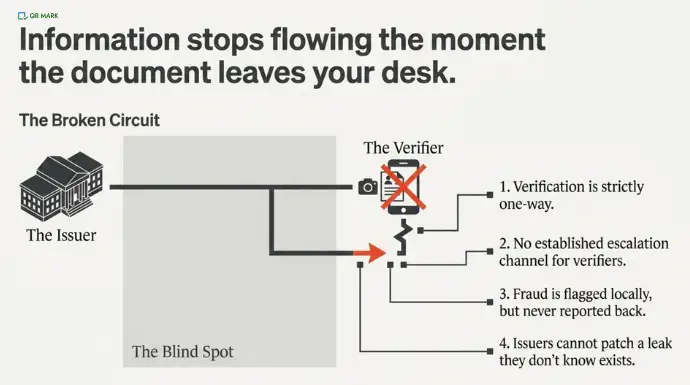
Because verification, as built today, is a one-way street. The issuer sends a document out into the world. Someone else verifies it. And the loop ends there.
Four structural gaps keep issuers in the dark:
- Verification is one-way. Once a document leaves the issuer, information stops flowing back. The verifier learns something. The issuer learns nothing.
- No feedback loop from end users. Even verifiers who notice something wrong have no obvious channel to escalate it back to the source.
- Fraud gets noticed, but not reported. A BGV firm might flag a suspicious experience letter internally, reject the candidate, and move on. The issuer is never informed.
- Issuers remain unaware of misuse. Without alerts coming back, issuers can’t track how often their documents are being copied, tampered with, edited, or faked. They can’t patch the leak because they don’t know it exists.
The result is that every issuer has a blind spot the size of their entire external audience. Someone, somewhere, has probably misused one of their documents this quarter. They’ll never know unless a reporter, a lawyer, or a very unlucky hiring manager picks up the phone.
What Is the ‘Report Fraud’ Feature in QR Mark?
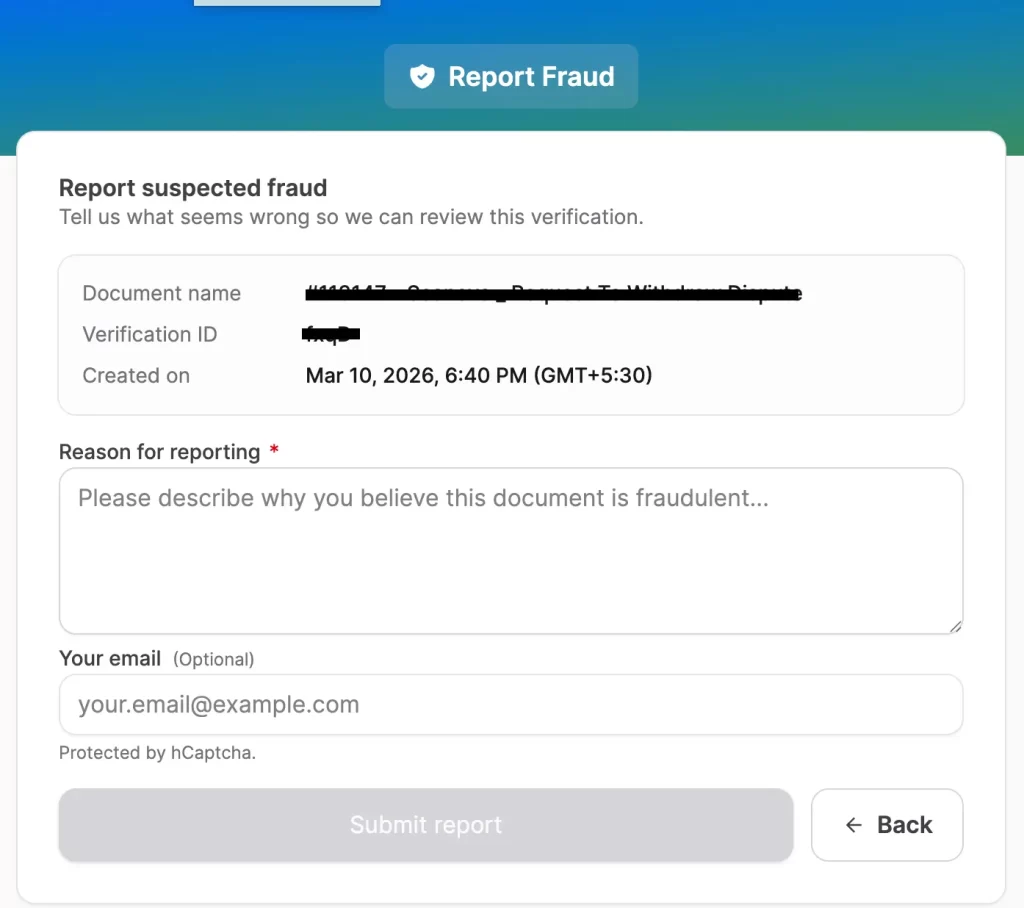
Report Fraud is a one-click fraud reporting mechanism built into every QR Mark verification page. When a verifier lands on the page and suspects the document they’re holding is counterfeit, tampered, or otherwise illegitimate, they can click “Report Fraud,” submit a short note, and the issuer receives an instant notification.
I want to be precise about what this changes. It doesn’t add a new verification layer. It adds a reporting layer on top of the existing verification flow. The Verification Image on the document already tells the verifier whether the record exists. Report Fraud tells the issuer whether the record is being abused in the wild.
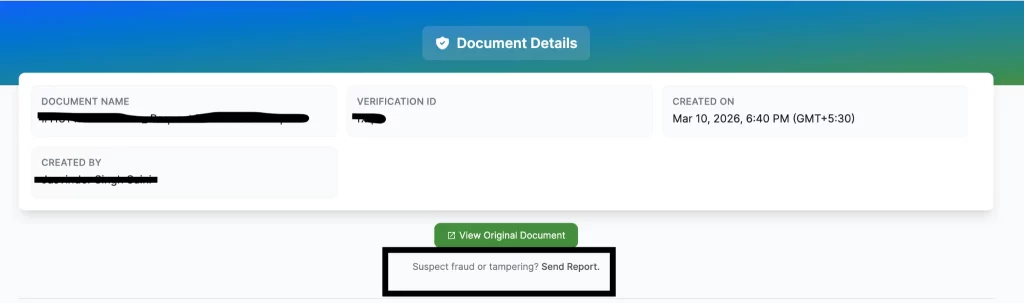
For the full configuration details, the QR Mark help centre has a dedicated article on the Report Fraud feature that I’d point any issuer to before rollout.
How Does the Report Fraud Feature Work?
The whole flow takes less time to execute than it does to describe. Three steps, one verifier, one issuer.
Step 1: Scan & Verify. The verifier (a background check officer, a new employer, a claims adjudicator, or a registrar at another university) scans the Verification Image on the document. They land on the verification page hosted on the issuer’s Custom Domain. So far, this is the standard QR Mark flow.
Step 2: Spot Suspicion. The verifier notices something off. The name on the page doesn’t match the document. The employment dates don’t line up. The certificate ID exists, but the grade on the paper doesn’t match what the verification page shows. Whatever the mismatch, the verifier now has a visible, dedicated “Report Fraud” button to click.
Step 3: Instant Alert. The verifier submits the report. The issuer gets notified in real time, usually through email or a dashboard alert. They see which document was flagged, who flagged it, and what the stated reason was. From there, they can investigate, revoke the document’s validity, or loop in legal.
That’s the whole feature. No app download. No login for the verifier. No friction added to anyone’s day.
Why Does the Report Fraud Feature Matter?
Because for the first time, it gives issuers live visibility into how their documents are behaving in the wild. And it gives verifiers a channel that doesn’t dead-end.
| For Issuers | For End Users |
|---|---|
| Real-time fraud alerts. You learn about a suspected counterfeit within minutes of a verifier spotting it, not months later through a lawsuit. | Real agency. Verifiers no longer feel like they’re shouting into a void. One click, and they know the issuer will see it. |
| Visibility into misuse. Reports accumulate in a dashboard, so you can see which documents and which time windows are being targeted most. | Trust in documents. Once end users know every QR Mark document has a live reporting channel, they treat the verification page as a genuine trust anchor. |
| Faster response time. When compliance and legal teams know quickly, they can revoke or re-issue the document before the damage compounds. | Ability to flag issues instantly. No forms to find. No helplines to track down. The button lives where it needs to live, right on the verification page. |
| Stronger document control. You stop operating blind. You start operating with a feedback loop tied to the issuer’s own domain. | A faster path to resolution. End users don’t have to chase the right government tip line. The alert goes to the issuer, who is usually the fastest to act. |
| “The biggest gap in document verification has never been the scan. It’s what happens after. An employer spots a fake experience letter, or a registrar sees a tampered transcript, and until now, none of that information reached the people who issued the document in the first place. Report Fraud turns every verifier into a sensor, and wires those sensors directly into the issuer’s dashboard.”Siddharth Pangtey, Product Manager, QR Mark |
Which Industries Benefit Most From a Report Fraud Feature?
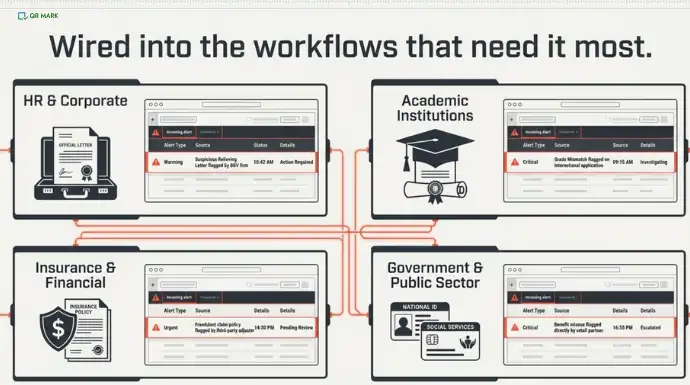
Any industry that issues high-stakes documents at volume benefits from a reporting loop. Four segments feel it the most.
1. HR & Corporate Document Issuance
Experience letters and offer letters are the two most-forged documents in the hiring economy. HR teams issue them, forget them, and never find out when they’re copied or edited. With Report Fraud wired into their QR Mark verifications, a background check firm that spots a fake experience letter can alert the issuing HR team within seconds. For a 3,000-person tech firm running Report Fraud, that can surface patterns (say, three forged relieving letters in a single quarter) that previously only showed up during lawsuit discovery.
2. Academic Institutions
Registrars at universities issue thousands of certificates per graduating class. Fakes circulate for years, often surfacing only when a student applies abroad or switches jobs. With a Report Fraud flow, a foreign university or employer scanning a transcript can flag a mismatch the moment it appears. The institution learns about misuse while the fraud is still active, not after the student has already secured the role.
3. Insurance & Financial Services
Insurance is a high-fraud category by nature. The Coalition Against Insurance Fraud estimates roughly $308.6 billion in annual fraud losses in the US alone. For insurers, Report Fraud gives claims teams and third-party adjusters a direct line back to the policy-issuing branch. If you’ve ever searched how to report insurance fraud and ended up on a state regulator’s tip line, this is the in-product, in-workflow version of that. A suspicious policy document gets flagged the moment it’s scanned, and the insurer knows before a payout is made.
4. Government & Public Sector
Benefits fraud costs public programmes billions every year. The USDA alone investigates thousands of SNAP cases annually, and anyone trying to file a food stamp fraud report typically has to navigate to a separate government website. A government-issued benefits document secured with QR Mark and paired with a Report Fraud flow gives case workers, retailers, and the public a built-in reporting mechanism. The fraud alert lands in the right inbox the first time, not after three forwarded emails.
What Happens When Fraud Finally Has Nowhere To Hide?
Document fraud doesn’t succeed because systems fail, it succeeds because feedback fails. Issuers send documents out, but never hear back when those documents are misused. That silence is where risk quietly compounds.
QR Mark’s Report Fraud feature changes that dynamic. It turns every verifier into a real-time signal and every scan into actionable intelligence. Instead of discovering fraud months later through damage control, issuers can respond in the moment, when it actually matters.
The shift is simple but powerful: from blind issuance to continuous visibility.
If you’re issuing high-stakes documents and still relying on one-way verification, you’re not just missing fraud, you’re missing the chance to stop it early.
Now the real question is:
Do you want to keep reacting to fraud after it spreads… or start catching it the moment it appears?
Frequently asked questions
How do I report fraud on a suspicious document in 2026?
If the document carries a QR Mark Verification Image, scan it, open the verification page, and click the Report Fraud button. The issuer of the document will receive an instant alert. If the document has no verification image at all, that itself is a signal worth treating with caution, and you should escalate through the issuing organisation’s official channels.
How do I report insurance fraud?
In the US, suspected insurance fraud can be reported to the Coalition Against Insurance Fraud, the National Insurance Crime Bureau, or directly to your state insurance commissioner. If the insurance document itself carries a QR Mark verification page, the fastest route is to use the Report Fraud button on that page. The insurer gets notified directly, which is often quicker than filing through an external regulator.
How do I file a food stamp fraud report?
A food stamp fraud report in the US is typically filed through the USDA’s SNAP fraud reporting portal or with the relevant state SNAP agency. Where benefits documentation is secured with QR Mark, a retailer or case worker can also submit a Report Fraud alert directly from the verification page, which routes to the issuing agency in real time.
What happens after someone reports fraud on a document I issued?
As the issuer, you receive an alert with the document reference, the time of the report, and the reason provided by the verifier. Depending on your internal workflow, that alert can trigger a compliance review, a document revocation, a legal escalation, or an internal investigation. The verifier is not expected to do anything further beyond submitting the report.
Can verifiers report document fraud anonymously via QR Mark?
Verifiers are not required to log in or create an account to submit a Report Fraud alert. The issuer sees only what the verifier chooses to share. If the verifier provides no contact information, the report is processed anonymously, although that can limit the issuer’s ability to follow up for more detail.
