

TL;DR
Immigration document verification has become essential as countries adopt digital authentication methods. From police clearance certificates to visa validation and citizenship verification, governments and employers now demand faster, more secure proof of authenticity. This guide explains what immigration document verification actually involves, why traditional methods are failing globally, and how digital solutions like QR Mark are transforming immigration verification across borders.
Immigration document verification is no longer just an operational step, it is a national security function.
Across the UNODC governments are facing a sharp rise in document fraud, from forged visas and passports to manipulated identity records used in cross-border movement. In the United States alone, reported immigration fraud cases crossed 1,000 in 2022, marking a 20% increase, with marriage fraud accounting for nearly three-quarters of these cases.
Globally, forged “breeder documents” like birth certificates continue to be used as the foundation for creating entirely new identities.
At the same time, the volume of legitimate immigration requests is growing rapidly. More applications, more jurisdictions, more document types but the same legacy verification systems.
This creates a critical imbalance. Your teams are expected to process faster, detect more sophisticated fraud, and maintain compliance all without a proportional increase in resources.
The reality is simple: traditional verification methods were not designed for today’s scale or threat landscape.
This is where immigration document verification must evolve from manual checks and visual inspection to real-time, issuer-controlled digital trust.
In this guide, I break down how immigration document verification works today, where it fails, and how rising fraud is changing the game. I’ll also explore modern approaches like QR-based verification and show how governments can move to fast, scalable, and secure systems without rebuilding everything.
What Is Immigration Document Verification?
Immigration document verification is the process of confirming that identity documents, travel credentials, employment records, and citizenship documents are genuine and issued by legitimate authorities. When you are handling immigration visa verification, citizenship verification, or police clearance certificate checks, you are performing this core function.
The scope is broader than most people realize. Immigration document verification covers: Passports and travel documents. Visas and entry permits including work visas. Police clearance certificates required for work permits and permanent residence.
Employment verification and proof of employment for immigration applications. Educational credentials including certificates and transcripts. Birth certificates, marriage licenses, and civil documents. Citizenship documents and certificates.
Here is where immigration visa verification is heading. Saudi Arabia replaced traditional passport visa stickers with digital, printable QR codes for work, visit, and residence visas across numerous countries, starting in May 2023. This shift to digital visas enhances efficiency, reduces immigration visa verification processing times, and ensures authenticity through electronic validation.
Applicants now receive their visa via email in digital format. They can print it on A4 paper for travel. The QR code contains all passenger data, enabling faster immigration document verification at checkpoints. This is exactly what modern citizenship verification and immigration visa verification should look like.
Who Actually Issues the Immigration Documents You Need to Verify?
Understanding who issues immigration documents is your first step in understanding immigration document verification. The issuer determines what verification methods are available.
Which Government Authorities and Immigration Bodies Handle Document Issuance?
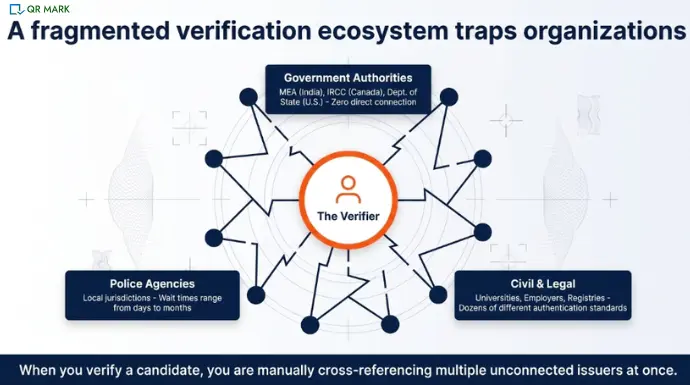
National immigration departments issue passports, visas, travel permits, and citizenship documents. In India, that is the Ministry of External Affairs (MEA) and state immigration authorities. In Canada, it is Immigration, Refugees and Citizenship Canada (IRCC). For immigration visa verification in the U.S., it is the Department of State. Each authority has its own immigration verification system, and none of them directly connect.
Police agencies issue clearance certificates for work permits and permanent immigration. The process for immigration police clearance certificate verification varies dramatically by country. In India, you apply at the local police station. In Canada, you request a police clearance certificate through local police services. The waiting periods range from days to months depending on the jurisdiction.
What Supporting Civil and Legal Documents Do You Need to Verify?
Employers issue employment verification and proof of employment for immigration applications. Schools and universities issue educational transcripts and certificates. Civil registries issue birth and marriage certificates. Each document type requires different verification approaches. The challenge: these documents come from dozens of different organizations with completely different authentication standards. When you are doing immigration document verification for Canada immigration or any jurisdiction, you are essentially verifying across multiple issuers at once.
How Do Third-Party Processing Agencies Impact the Immigration Verification Process?
Some countries use visa facilitation centers and immigration document verification agencies as intermediaries. These third-party processors collect documents, verify them locally, and submit them on behalf of applicants. This adds another layer to immigration document verification but often creates bottlenecks rather than improving speed.
What Actually Happens During the Immigration Document Verification Process?
Immigration document verification is not one single check. It is a combination of overlapping verification methods, all designed to answer one question: Is this document genuine and issued by the claimed authority?
How Does Document Authentication and Legalization Work Across Borders?
When a document crosses borders, it often requires legalization or apostille certification. For immigration visa verification and citizenship verification, authorities validate documents with the issuing body, confirm notarization, and authenticate through the Ministry of Foreign Affairs. This is the formal, government-backed approach to immigration document verification. The process is thorough but slow. Authentication can take weeks, especially if the issuing authority is in a different country.
How Are Police Certificates and Background Clearance Verification Conducted?
A police clearance certificate for work permit applications is required for individuals 16 or older who have lived in their home country or abroad for over 6 months. The immigration police clearance certificate verification process involves police checking criminal records and issuing an official certificate. The problem: each jurisdiction has different procedures. There is no unified database. Verification requires contacting the specific police authority where the applicant lived.
How Do Biometric Systems Enable Identity Verification at Immigration Checkpoints?
On-arrival immigration document verification happens through biometric systems. When you land at Delhi Airport, passengers present passports, visas, and boarding passes.
Foreign nationals often register biometric details including facial scans and fingerprints at automated kiosks. This real-time verification confirms you are who your documents say you are.
What Online Verification Systems and Digital Portals Are Available for Immigration Document Verification?
Modern immigration systems offer online portals for immigration document verification. The Fast Track Immigration Program (FTITTP) in India and similar portals in other countries allow users to check status, upload documents, and track applications.
Canada immigration has online verification systems. These portals represent a shift toward self-service immigration verification. The gap: most portals still require manual review at some point. Immigration document verification is not fully automated.
What Methods Are Actually Used in Immigration Document Verification?
Different verification methods have different strengths. Here is a comparison of key approaches:
| Verification Method | Feasibility | Ease of Use | Tamper Control | Verification Time |
| MRZ (Machine Readable Zone) | High | Medium | Medium | 2–5 minutes |
| NFC Chip (ePassports) | High | High | High | 1–3 minutes |
| QR Code | Very High | Very High | Very High (via custom domain validation) | Seconds |
| Manual Review | Low | Low | Low | Hours to days |
Why Do Traditional Immigration Verification Methods Still Fall Short?
Look at these methods. The best verification methods require infrastructure most countries do not have. NFC chip readers are expensive. Manual review is unreliable.
This is exactly why immigration document verification remains broken globally. Government agencies doing immigration document verification for Canada immigration or any jurisdiction face this reality: fast, secure, scalable immigration verification does not exist at most checkpoints.
Why Is Immigration Document Verification Becoming More Critical Globally?
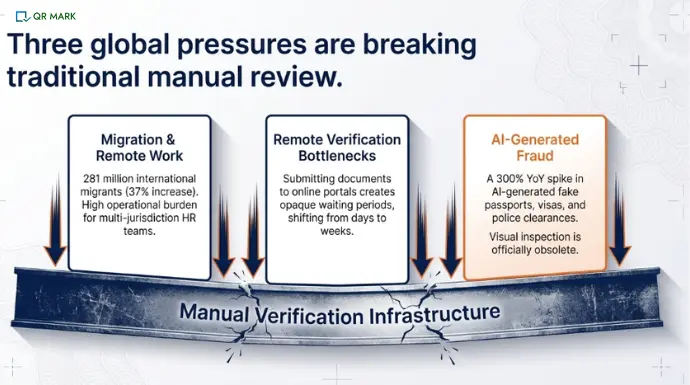
Three major trends are forcing the immigration document verification problem to the surface.
How Is Cross-Border Movement and Remote Work Increasing Verification Demands?
More people are moving. The World Bank estimates 281 million international migrants globally, a 37 percent increase from 2010. Remote work accelerated this. For government immigration processing, this means handling citizenship verification and proof of employment for immigration across multiple countries simultaneously.
Each country has different verification requirements. Each document type works differently. The operational burden of immigration police clearance certificate verification, employment verification, and immigration visa verification for multiple jurisdictions simultaneously has become a full-time function.
How Do Digital and Remote Verification Methods Create New Challenges?
You can no longer call the immigration office and have a real-time conversation. Most immigration document verification now happens through online portals, email, or automated systems. This sounds faster, but it actually creates delays. Your government is submitting documents to a system you do not control, waiting for a response that may take weeks. Remote immigration document verification has become the standard, but it has not solved the core problem: verifying authenticity at speed, at scale, across all government touchpoints.
How Is AI-Generated Fraud Changing the Immigration Document Verification Threat Landscape?
This is the emerging crisis. AI is now sophisticated enough to generate passports, visas, and police clearance certificates that look perfect to the human eye. Governments report AI-generated document fraud increasing 300 percent year-over-year. For immigration document verification, this means visual inspection alone is no longer sufficient. When your government officials are verifying immigration documents, they can no longer trust what the paper looks like. They need cryptographic proof of authenticity – something that cannot be faked.
How Are QR Codes Transforming Immigration Document Verification?
This is where immigration document verification is actually improving. QR codes are enabling a fundamentally different approach.
How Can QR Codes Enable Digital Verification Without Special Hardware?
Every government checkpoint has smartphones. Every official knows how to scan a QR code. This is why Saudi Arabia shifted to digital visas with QR codes. It removed the need for expensive visa sticker machines, special printing, and complex distribution networks. For immigration document verification, QR codes mean your government can embed verification directly into any document format. Printed visa? Scan the QR. Digital document? Tap the link. This is infrastructure-agnostic immigration document verification that works at every border crossing, airport, and processing center.
How Do QR Codes Enable Real-Time Status Validation and Tamper Detection?
A QR code links to a verification page that is controlled by the issuing authority. When your officials scan it, they are not just checking if the document looks real. They are checking the actual verification record. Has it been revoked? Is it still valid? What is the current immigration status? This is real-time immigration document verification. Not what it looked like months ago. What it actually says right now. Your government gets immediate access to the truth about every document presented.
How Does QR-Based Verification Improve Speed and Accuracy at Scale?
Manual immigration document verification took hours. Email verification took days. QR-based verification takes seconds. And the accuracy rate jumps from roughly 80 percent with manual review to nearly 100 percent with cryptographic verification. At scale, this matters enormously. A government agency processing 200 visa applications daily cannot manually verify police clearance certificates. But they can process 200 QR code scans in an afternoon. This is where government efficiency gains emerge.
How Do Global Standards Like ICAO VDS Support Cross-Border Immigration Verification?
International aviation authorities (ICAO) have set global standards for digital travel documents. These Verifiable Digital Seals (VDS) are essentially QR codes with cryptographic signatures. Countries that adopt VDS can verify documents across borders without bilateral agreements. This is the future of immigration document verification: a global standard where a QR code issued in India can be instantly verified in Canada, the U.S., or any ICAO-compliant jurisdiction. Your government stops being dependent on manual back-and-forth with foreign agencies.
Why Should Your Government Choose QR Mark for Immigration Document Verification?
As a government agency, you face a specific set of challenges: scaling verification capacity without proportionally increasing headcount, ensuring security and auditability for compliance, maintaining confidentiality of sensitive applicant data, and integrating with existing government systems.
QR Mark is purpose-built to solve these exact problems for government immigration workflows.
What Key Features Does QR Mark Provide for Government Immigration Workflows?
Custom Domain Verification: Your government issues documents from your official domain (verify.immigration.gov, for example). This is the trust anchor. Verifiers know that if the QR resolves on your actual government domain, the document is authentic. No counterfeiter can recreate that. Bulk
Verification Dashboard: Your immigration centers can generate thousands of verifications at once. Upload batch documents, position the QR code once, and QR Mark generates unique verification images for each document. This is how governments scale.
API Integration: For large-scale government operations, QR Mark connects directly to your existing immigration systems. Visas are issued with embedded verification automatically. No manual steps. No bottlenecks.
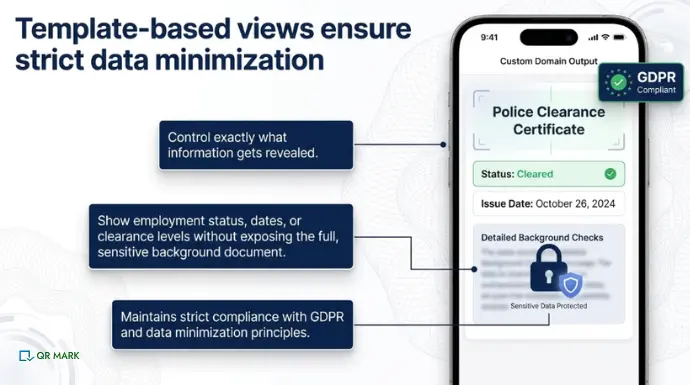
Template-Based Verification Pages: Your government controls exactly what information verifiers see. Show only the fields needed to confirm authenticity – not the entire document. This keeps sensitive applicant data confidential while proving legitimacy.
Analytics & Verification Intelligence: QR Mark doesn’t just verify documents — it shows you how they’re being used in the real world. Every scan becomes a signal. Your immigration teams can track where documents are being verified, how often they’re accessed, and detect unusual patterns that may indicate misuse. This turns verification into visibility.
Report Fraud & Feedback Loop: Verification shouldn’t stop at “valid” or “invalid.” With QR Mark, verifiers can actively report suspicious or counterfeit documents the moment they detect something off. This closes the loop. Your immigration authority gets real-time alerts from the ground, enabling faster investigation and response.
What Benefits Will Your Government Gain From QR Mark Implementation?
Immediate Speed Gains: Verification that took 3 weeks now takes 3 seconds. Your government processes the same number of applications with the same staff but no backlogs.
Auditability and Compliance: Every scan creates an audit trail. Your government has complete records of who verified what, when. This satisfies regulatory requirements and provides defensible documentation if disputes arise.
Confidentiality-First Design: Government data stays government data. Template-based pages reveal only what is necessary. Applicants know their full information is not being shared unnecessarily. GDPR and other privacy regulations are satisfied by design.
Gautam Garg, Founder of QR Mark, explains, “Government immigration agencies face an impossible equation: verification volumes are exploding, but staff budgets are frozen. Every new immigration policy creates thousands of new verification requests that your existing team cannot handle. QR Mark decouples verification capacity from headcount. Your 50-person team can suddenly process as if they were 500 people – because they are no longer doing manual verification. They are exception-handling only. That is government efficiency at scale.”
What Does This Mean for Your Immigration Processing Workflow?
Immigration document verification is fundamentally changing. The Saudi Arabia example is not a one-off. It is the direction every government is moving. Countries that adopt digital verification first gain a competitive advantage: faster processing attracts more legitimate travelers and investors. Reduced fraud improves visa reputation. Lower operational cost improves budget health. Your government does not have to wait for international standards to evolve. You can start today by embedding QR Mark verification into your immigration documents.
The tools exist right now. QR Code based verification, digital verification on custom government domains, instant authentication – these are not theoretical. They are being implemented today by governments that handle citizenship verification, immigration police clearance certificate checks, and immigration document verification for Canada immigration and beyond.
Your government can build instantly-verifiable documents. You can embed verification into documents at the point of issuance. You can make it impossible for counterfeits to succeed. Immigration document verification, historically a government bottleneck, becomes a competitive advantage.
Your citizens and visitors should travel with proof of authenticity built into their documents. Your officials should verify in seconds, not weeks. Your government should scale without hiring. That is the future of immigration verification.
FAQs
Is QR-based verification accepted by immigration authorities worldwide?
Yes, as long as the verification page is on an authenticated government domain (your official domain). Immigration authorities recognize domain-based verification as a valid authentication method. Many countries are now officially adopting QR codes for visa and travel document verification. ICAO has set VDS standards that align with this approach.
What Happens If Someone Removes or Damages the QR Code From an Official Document?
If someone removes the QR code, verification becomes impossible through that document. This is intentional – it is a deterrent against forgery. Your government can establish policy: “Official documents carry a QR verification image. If the image is missing or damaged, treat the document as suspicious.” This becomes standard operating procedure at all immigration checkpoints.
How Does Your Government Maintain Verification Access If Internet Connectivity Fails at a Border Checkpoint?
Most border checkpoints have dedicated internet access for immigration processing systems. However, QR Mark supports offline verification through document validity fields cached locally. Your government can also print verification status on the document itself (expiry, validity status) so backup verification is always available even without connectivity.
Can Someone Forge a QR Code That Links to a Fake Government Verification Page?
They can create a QR code, but they cannot make it resolve on your actual government domain. The verifier checks three things: the QR code itself, the domain it leads to, and the information on the verification page. A forged QR linking to a fake domain is immediately identifiable because the domain will not match your official government domain. This is the trust anchor that makes counterfeiting impractical.
How Does QR Mark Ensure Compliance With Privacy Regulations Like GDPR or Government Data Protection Laws?
Template-based verification pages show only the fields needed for verification. Your government does not need to expose an applicant is full document or sensitive information. For immigration police clearance certificate verification, you can show status and issue date without revealing detailed background check results. For visa documents, you show only the fields required for border verification. This keeps sensitive applicant data confidential while proving legitimacy – compliant with data minimization principles in all major privacy frameworks.
