


TL;DR
A fake STCW certificate is a seafarer credential that has been forged, altered, or issued without the required training. It puts crews, vessels, and employers at real safety, legal, and financial risk. This guide explains how these certificates get faked, why the problem is so serious, what the IMO has done about it, and why QR Code verification has become the fastest way to confirm a certificate is real.
A fake STCW certificate is dangerous because it lets someone work at sea in a role they are not trained for. That is not a paperwork issue. It is a safety issue, and port state inspectors are catching it more often.
Here is one number that frames the problem. Across 2021 and 2022, flag and port states logged 145 separate reports of fraudulent seafarer certificates, according to information the IMO’s Sub-Committee on Human Element, Training and Watchkeeping noted in 2023.
I work on document verification, so I see this from both the issuing side and the verifying side. Below I will walk through what a fake certificate actually is, how they get made, why it matters so much, the steps the IMO has taken, and how the main verification methods compare.
What Is a Fake STCW Certificate?
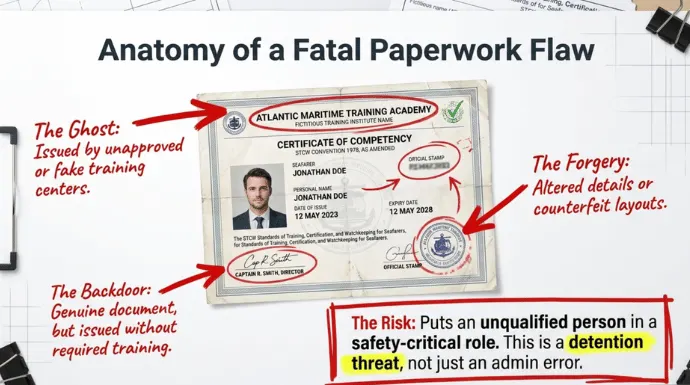
A fake STCW certificate is a Standards of Training, Certification and Watchkeeping document that has been forged, altered, or issued without the holder completing the required training.
It might be a fully counterfeit document, a genuine certificate with edited details, or a real-looking certificate from an unapproved training centre.
The risk is not theoretical. In July 2024, the West of England P&I Club described a port state inspection where officers boarded a member’s VLCC, reviewed the crew’s STCW papers, and found that the Master was not qualified for his role and was carrying fraudulent documentation.
The club warned this created an immediate detention threat with serious legal and financial fallout, and urged members to verify where certification was issued and to check with the flag state before a new crew member joins.
Marcus Winchester, a loss prevention officer at the West of England P&I Club, advised members to “exercise proper due diligence” when checking the certification of the seafarers they employ (West of England P&I Club, 2024).
How Are STCW Certificates Faked?
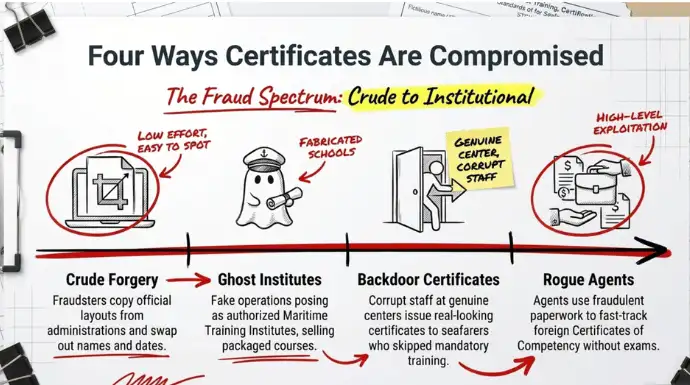
STCW certificates get faked in four main ways, from crude photo editing to insider corruption at otherwise legitimate training centres. Here is what each one looks like.
1. Straightforward forgery and digital manipulation. This is the most basic form. Fraudsters copy official layouts, stamps, and signatures from real maritime administrations such as Panama, Liberia, or India, then swap in the buyer’s name, date of birth, and validity dates.
2. Ghost or unapproved training institutes. Fake operations pose as authorised Maritime Training Institutes. They sell packaged STCW courses and print certificates using names of non-existent institutes or fake accreditation numbers.
3. Certificates issued without attendance (backdoor certificates). Corrupt staff at a genuine approved centre issue real-looking certificates to people who never completed the mandatory training hours, drills, or exit exams. These are hard to catch because the issuing centre is legitimate.
4. Fast-tracked foreign CoCs and CoPs through rogue crewing agents. Agents promise to convert basic papers into advanced foreign Certificates of Competency or Proficiency without exams. They use fraudulent paperwork to push less-regulated administrations into issuing credentials, or simply manufacture fake foreign papers.
Why Is a Fake STCW Certificate Such a Serious Problem?
Because a fake STCW certificate puts an unqualified person in a safety-critical role, and the fallout lands on the crew, the vessel, and the employer at the same time. The scale and the consequences are both well documented.
- Scale, historical. A 2001 IMO study carried out by the Seafarers International Research Centre found 12,635 detected cases of certificate of competency forgery. The IMO noted at the time that 12,000 of those came from a single administration in South East Asia, so the figure needs that context.
- Scale, recent. The IMO’s HTW Sub-Committee noted 145 reports of fraudulent seafarer certificates detected across 2021 and 2022 (HTW 9/INF.2, 2023).
- Real detention risk. In the 2024 West of England case above, a fraudulent Master’s certificate exposed the vessel to immediate detention by the port state authority, which carries direct legal and financial cost.
- Inspection pressure. The Paris MoU’s 2023 Annual Report put the overall port state control detention rate at 3.81%, down from 4.25% in 2022 but still above pre-pandemic levels, and documentation problems remain among the issues inspectors flag.
- Administrative drag. Even genuine certificates cause delays when they are lost in transit or damaged during a voyage. Verification can hold up a vessel not for lacking a qualified crew, but for missing the paperwork that proves competency.
What Has the IMO Done to Counter Fake STCW Certificates and Speed Up Verification?
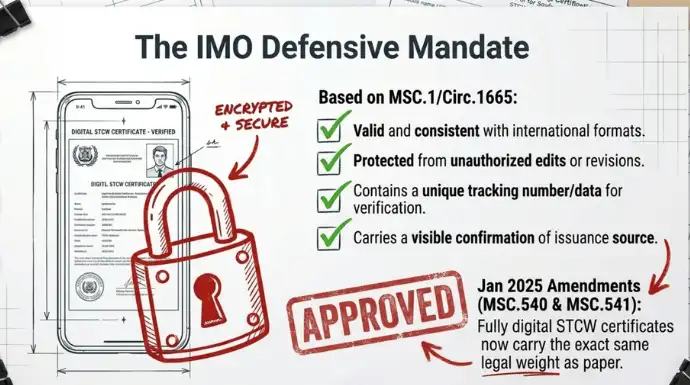
The IMO’s biggest move has been to back electronic certificates with verification built in. At its 107th session, held from 31 May to 9 June 2023, the Maritime Safety Committee approved guidelines on the use of electronic certificates of seafarers, issued as MSC.1/Circ.1665.
Under those guidelines, an electronic certificate should carry these features:
- Validity and consistency in line with the format and content required by the relevant international regulations.
- Protection from edits, modifications, or revisions other than those authorised by the administration.
- A unique tracking number and other data used for verification.
- A visible confirmation of the source of issuance.
The guidelines then let an administration choose one or a combination of these verification methods, so that port state control or an employer can check a certificate:
- An approved unique tracking number (UTN).
- An approved seafarer identification number.
- A Quick Response (QR) Code.
- A dedicated verification mobile application.
- Any other method deemed suitable and approved by the administration.
The direction of travel is clear. Since January 2025, amendments MSC.540(107) and MSC.541(107) have given fully digital STCW certificates the same legal weight as paper, so verification-ready electronic credentials are now the standard the industry is moving toward.
How Do the IMO’s STCW Verification Methods Compare?
All five approved methods confirm authenticity, but they differ a lot in how easy they are for a verifier to use on the spot. Here is how they stack up.
| Method | How verification works | Strength | Limitation |
|---|---|---|---|
| Unique tracking number (UTN) | Verifier types the number into the administration’s portal. | Hard to guess; tied to a single record. | Manual entry; needs the right portal and an internet connection. |
| Seafarer identification number | Verifier looks up the seafarer’s ID in an approved system. | Links the document to the person. | Requires access to the right database; still manual. |
| QR code | Verifier scans with any phone camera and lands on a verification page. | Instant, no typing, no special app; works on print and PDF. | Verifier must still check the page and match the details. |
| Dedicated mobile app | Verifier installs the administration’s app and checks the certificate. | Can bundle extra checks. | Download, install, and learn a new app before verifying. |
| Other approved method | Whatever the administration defines and approves. | Flexible. | Inconsistent across flag states; verifiers must learn each one. |
Why Do QR Codes Stand Out for STCW Certificate Verification?
QR Codes stand out because anyone can verify in seconds with a phone they already own. No app to download, no login, no tracking number to type by hand. That low friction is the whole point, because a verification step only works if people actually do it.
The principle behind a good QR Code verification is simple. The QR Code is just the access mechanism. The trust comes from where it leads and what it shows. This is the model my team works on at QR Mark.
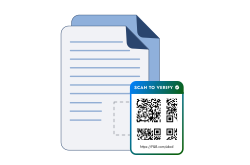
Here is how that looks for a training centre issuing STCW course certificates. With a tool like QR Mark, you add a verification image, which is a QR ode plus a verification URL, to the certificate. When someone scans it, they land on a verification page hosted on your own custom domain, so the verifier can confirm the page belongs to you and not a lookalike. That domain match is the real trust anchor.
You can also use a template-based verification page that shows only the fields that matter, such as the seafarer’s name, the certificate number, the issuing authority, and the validity dates, without exposing the full document. The verifier scans, checks the domain, and matches those fields against the certificate in hand.
I want to be honest about the limits, because over-claiming helps no one. QR Code verification does not make a certificate impossible to forge. A fraudster can copy a QR Code image onto a fake document. What it does is make a copied QR Code easy to catch, because the details on the verification page will not match the fake. It is a strong deterrent that makes detection instant when the verifier checks the domain and matches the fields.
The Bottom Line on Fake STCW Certificates
Fake STCW certificates are common enough that port states log them by the hundreds, and serious enough to detain a vessel and expose an employer to legal cost. The good news is that verification has caught up. The IMO now backs electronic certificates with built-in verification, and of the approved methods, QR Codes give verifiers the fastest, lowest-friction way to confirm a certificate is real.
If you issue maritime training certificates, the practical question is no longer whether to make them verifiable, but how.
Frequently Asked Questions About Fake STCW Certificates
How can I spot a fake STCW certificate?
Check the issuing training centre against the flag state’s list of approved institutes, confirm the certificate number with the issuer or administration, and look for a working verification method such as a QR Code or tracking number. A certificate from an unlisted centre, or one with no way to verify it, is the clearest red flag.
How do I verify an STCW certificate is real?
Verify it through the method the issuer provides: scan the QR Code, enter the unique tracking number in the official portal, or check the seafarer identification number in an approved system. For QR-based certificates, also confirm the verification page sits on the issuer’s real domain and that its details match the document in hand.
Are fake STCW certificates sold online?
Yes. Some operations pose as approved Maritime Training Institutes and sell packaged courses with certificates, while others sell purely counterfeit documents. This is why checking the training centre’s approval status and verifying the certificate directly with the issuer matters more than how official the document looks.
What is the difference between a fake STCW certificate and a fake certificate of competency?
A certificate of competency (CoC) is a specific type of STCW credential that proves a seafarer is qualified for a rank, such as Master or officer of the watch. A fake certificate of competency is therefore one category of fake STCW certificate, and it is among the most dangerous because it places an unqualified person in a senior, safety-critical role.
Does a QR code make an STCW certificate impossible to fake?
No. A QR Code is a strong deterrent, not a guarantee. Someone can copy a QR image onto a fake certificate, but the verification page details will not match the forged document, so a verifier who checks the domain and matches the fields can catch it quickly. The QR makes fraud easier to detect, not impossible to attempt.
