

TL;DR
- A Certificate of Authenticity (COA) for Artwork proves that a piece is genuine and created by the artist it’s attributed to
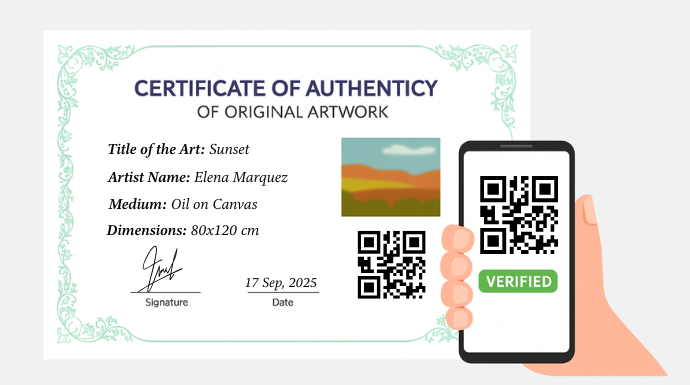
- A reliable COA should include the artist’s name, the title of the art piece, year, medium, dimensions, image, statement of authenticity, date of issue, and signature.
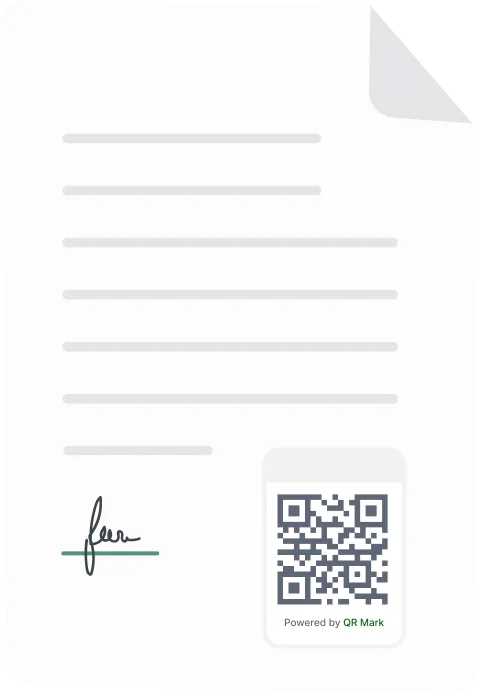
- To make it unforgeable, artists and galleries can secure their COAs with a QR Code linked to a unique digital record. This allows anyone with a phone camera to instantly confirm authenticity, protecting both the artwork’s value and the artist’s legacy
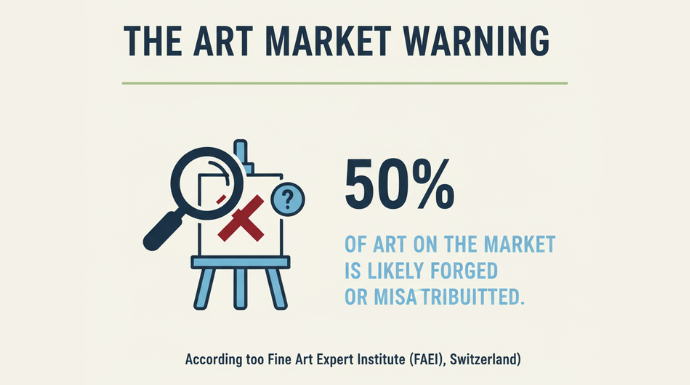
It’s hard to imagine, but several art dealers once told ARTnews that as many as 95% of paintings in circulation may not be legitimate. Even if that number feels inflated, it shows just how real the problem of forgery is in the art world.
That’s where a Certificate of Authenticity, or COA, comes in. At its core, a COA is a document that confirms an artwork is genuine and created by the artist it claims. For buyers, it’s proof they’re investing in something real. For artists, it’s a way to protect their name, legacy, and market value.
In this guide, I’ll break down what a proper artist COA should contain, how to create one that stands up to scrutiny, and why no artwork should change hands without it.
A. What is a Certificate of Authenticity for Artwork?
A Certificate of Authenticity (COA) for artwork is an official document that confirms a piece is genuine and created by the artist it is attributed to.
It serves as proof of authorship and originality, usually carrying the artist’s or an authorized party’s signature along with essential details about the work.
One of the best examples comes from Banksy, an artist whose works are among the most forged in the world. To protect both himself and collectors, he created Pest Control, his own authentication body.
Every legitimate Banksy piece comes with a Pest Control COA, and without it, auction houses and serious collectors will not accept the work. Over time, this system has become the gold standard for safeguarding both the artist’s identity and the buyer’s investment.
B. What Information Should a Certificate of Authenticity for Art Include in 2025?
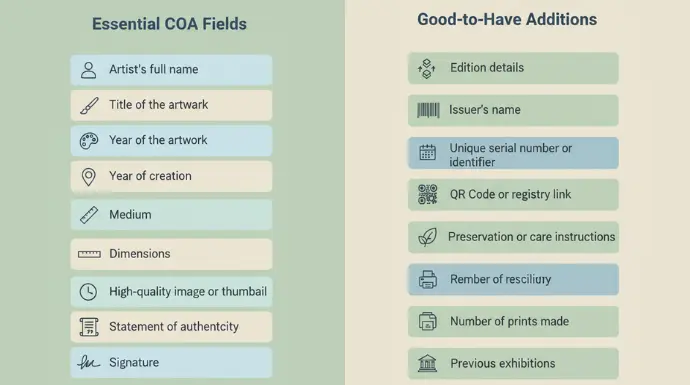
A Certificate of Authenticity is only useful if it contains the right information. The more complete it is, the easier it becomes to verify and the more valuable it is to artists, collectors, and the market.
In 2025, the art world expects a COA to be detailed, standardized, and easy to check.
Here are the fields you must include on every COA:
-
Artist’s full name
Write the legal, full name of the artist. Avoid initials or nicknames that could cause confusion, especially if other artists share a similar name. -
Issuer’s name
If the certificate is issued by someone other than the artist, for example, a gallery, dealer, or the artist’s estate, clearly state their name and role. This shows who is vouching for the authenticity. -
Title of the artwork
Mention the exact title given by the artist. If the work is untitled, you can write “Untitled” followed by a short description in brackets (e.g., Untitled [Blue Composition]). -
Year of creation
Note the year the work was completed. This helps place the artwork in the artist’s timeline and can affect its value. -
Location of creation
State the city and country where the artwork was created. This adds context for provenance and history. -
Medium
Describe the materials used, such as “oil on canvas,” “bronze sculpture,” or “archival pigment print.” The medium helps distinguish the work from reproductions. -
Dimensions
Record the height, width, and depth (if applicable) in standard units (cm or inches). Example: Height: 120 cm, Width: 80 cm. Accurate dimensions ensure the work cannot be confused with a different piece. -
Date of issue
Write the date the COA itself was created and signed. This gives a clear reference point for when authenticity was confirmed. -
High-quality image or thumbnail
Include a printed image of the artwork on the certificate. This prevents swaps or errors and makes it easy to match the certificate with the physical work. -
Statement of authenticity
Add a direct declaration such as: “I hereby certify that this artwork is an original creation by [Artist’s Name].” Keep it simple and unambiguous. -
Signature
The artist should sign the COA by hand whenever possible. If the artist cannot, an authorized gallery or estate representative can sign. The signature remains the most trusted mark of authenticity.
This is the essential information you should never skip. If you want to create a richer record, here are good-to-have additions:
-
Edition details
If the artwork is part of a limited edition, write the edition number (for example, 3/50), the total edition size, and note any artist’s proofs (AP) or printer’s proofs (PP). This clarifies how rare the work is. -
Unique serial number or identifier
Assign a one-of-a-kind code to each COA. This prevents duplicates and allows for easy tracking in a registry or database. -
QR Code or registry link
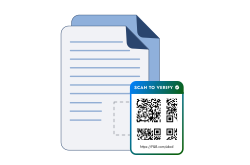
A QR Code that links to a secure digital record makes it easy for collectors and auction houses to verify authenticity instantly. -
Preservation or care instructions
Provide basic guidance on how the artwork should be stored or displayed (e.g., “Avoid direct sunlight” or “Frame under UV-protected glass”). This helps preserve the work long-term. -
Number of prints made
For print-based works, specify the total number of prints produced. This is essential when the artwork is part of a limited edition, as it confirms scarcity and protects the value of each piece. -
Previous exhibitions
List important shows or exhibitions where the artwork has been displayed. This enriches its provenance and can add market value.
C. How to Get a Certificate of Authenticity for Artwork That Cannot Be Forged
Whether you’re the original artist, a gallery, or an art dealer, the process of creating a Certificate of Authenticity is similar. You need to choose a certificate generator that allows verification in some form. It could be QR Code, Digital Signatures or any other method.
Step 1: Create a Program
In the QR Mark dashboard, open the Certificates tab and click Create Program.
A Program organizes certificates by course, event, cohort, collection, or any other category. For example, if you’re issuing Certificates of Authenticity for an art collection, you can create a separate Program for each collection or exhibition. This makes it easy to manage, search, and track every certificate you issue.
Step 2: Design Your Certificate Template
Go to Templates and click Create Template.
Design your Certificate of Authenticity by adding your branding, logo, signature, artwork details, and any dynamic fields you want to personalize, such as:
- Artwork title
- Artist name
- Medium
- Dimensions
- Year created
- Certificate ID
- Issue date
Finally, drag the QR Mark Verification Image onto the certificate where you want the QR Code to appear. Save your template once it’s ready.
Step 3: Generate the Certificate
Open Certificates and click Create Certificates.
Select the template you just created, then choose whether you want to generate:
- A single Certificate of Authenticity, or
- Multiple certificates in bulk.
Enter the artwork information and recipient details, choose the Program, and select your verified custom domain for certificate verification.
When you click Generate, QR Mark automatically creates a unique Certificate ID and embeds a unique verification QR Code into every certificate.
Step 4: Download and Share
After generation, download the finished Certificate of Authenticity as a PDF.
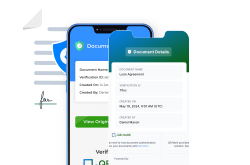
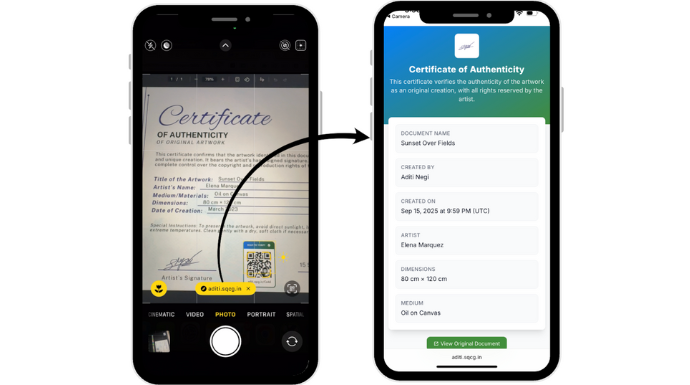
Every certificate now contains its own verification QR Code. Anyone can scan it using a regular smartphone camera to open your branded verification page and instantly confirm the certificate’s authenticity. No special app or manual verification is required.
Once this is done, anyone who scans the QR Code from the original certificate can instantly confirm the certificate’s authenticity digitally.
No special scanner is required, a regular phone camera will do. This step turns your COA from just a piece of paper or PDF into a secure and verifiable record.
Still wondering how adding a QR Code to COA avoids forgery?
The answer is simple. Each QR Code is tied to your custom subdomain and given a unique ID (like coa.yourwebsite.com/qYsT). That code can’t be replicated without access to your QR Mark dashboard.
On top of that, the landing page includes a “View Original Document” button that links back to the original COA you uploaded. Even if someone tries to paste your QR Code onto a fake certificate, you can always compare it with the authentic version online.
Step 3: Distribute and store the COA properly
After securing your certificate, decide how it will be shared:
- For the buyer/collector: Provide a printed copy with the artwork. Use quality paper that matches the seriousness of the document.
- For digital records: Keep a PDF version stored safely, and if possible, share a copy with the buyer via email. This way, they always have a backup.
-
For the buyer/collector: Provide a printed copy of the artwork. Use durable, professional-grade paper such as 200–300 gsm archival or certificate paper. A heavier stock not only feels official but also lasts longer, reducing the risk of wear or damage over time.
D. Why Every Artwork Should Have an Authenticity Certificate
You might think a Certificate of Authenticity is only necessary if you’re a big-name artist selling at auctions. But that’s not the case.
Even if you’re just starting out, a COA sets the right foundation for your career. And if your work is already going into the hands of collectors, galleries, or the public, it becomes essential. Here’s why:
1. It builds trust
Buyers want reassurance that what they’re purchasing is genuine. A COA or letter of authenticity for artwork shows that you’re serious about your work and willing to stand behind it.
That trust makes collectors more comfortable investing in you, even if you’re at the beginning of your journey.
2. It protects your legacy
Every COA you issue becomes part of the permanent record of your art. Ten years from now, when someone is reselling or exhibiting your piece, they’ll have proof of origin that connects directly back to you.
Without it, the link between you and your work can get lost.
3. It adds market and resale value
Auction houses, galleries, and serious buyers often refuse to handle artworks without COAs. Even for smaller pieces, having one makes them easier to insure, sell, and eventually resell.
In other words, you might not feel the need to create one now, but if you’re planning to put your work in public or sell it down the line, it’s smart to start early.
4. It guards against forgery
Art forgery isn’t just a problem for Picasso or Banksy; even emerging artists can be copied.
A QR verifiable COA makes it much harder for anyone to pass off a fake under your name, protecting both your reputation and your collectors.
To give you an idea of how serious the problem is, in November 2024, Italian authorities uncovered more than 2,100 forged artworks attributed to Banksy, Andy Warhol, and Pablo Picasso. Thirty-eight people were arrested, and the forgeries carried an estimated market value of €200 million (£165m; $213m).
5. It supports insurance and legal claims
If your work is ever stolen, damaged, or disputed, a COA can save you headaches. It acts as proof of authorship and originality, which insurers and courts rely on to process claims or resolve disputes.
E. Frequently Asked Questions
1. How to verify the authenticity of a painting?
Start with the Certificate of Authenticity (COA). Check the artist’s name, title, year, medium, and signature. If the COA includes a QR Code or serial number, scan or look it up to confirm it matches the original record.
2. What is the difference between a COA, provenance, appraisal, and receipt?
- A COA is a direct statement confirming an artwork is genuine.
- Provenance is the ownership history of the piece.
- An appraisal is an estimate of its market value.
- A receipt is proof of purchase.
Each has its role, but only the COA certifies authenticity.
3. What information must a certificate of authenticity for artwork include?
A proper COA should have the artist’s full name, issuer’s name, title of the artwork, year of creation, medium, dimensions, location, date of issue, a high-quality image, a clear statement of authenticity, and the artist’s signature.
4. Is a COA legally binding?
No. A COA is a declaration of authenticity, not a legal guarantee. However, if someone knowingly issues a false COA, it can be considered fraud or misrepresentation.
5. Can a COA be forged?
Yes. Paper-only COAs are often forged, which is why adding digital verification, like a QR Code linked to a secure registry, makes them much harder to fake.
6. Who can issue a COA?
Ideally, the artist issues it. In some cases, a gallery, dealer, or the artist’s estate can do so. For deceased artists, trusted family members or official foundations may also issue COAs if they are recognized authorities.
7. How do I verify a COA?
Compare the details on the COA with the artwork itself — title, year, medium, dimensions, and signature. If the COA has a QR Code or serial number, scan it or check it online to confirm it against the original digital certificate.
Conclusion
A Certificate of Authenticity is only as strong as the trust it carries. A simple template can be copied, but a certificate secured with a QR Code becomes far harder to fake.
By linking each COA to a unique digital record, artists and galleries give collectors a quick, reliable way to confirm authenticity with nothing more than a phone camera.
If you’re creating or selling art, treat the COA as part of the work itself. It’s the document that will travel with your piece for years to come, shaping its value and reputation.
Making that certificate verifiable with QR technology is the step that ensures your art is not only original today, but trusted tomorrow.
