

TL;DR
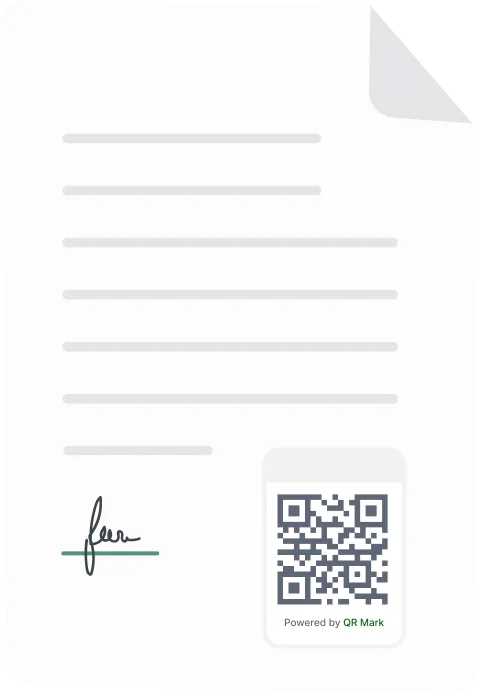
To verify a diploma online, use one of five trusted routes: scan the QR code on the document, check the school’s official online verification portal, request an official transcript, use a background-check or third-party verification service, or confirm the institution’s accreditation. The fastest, most reliable route is a QR Code that resolves to the issuer’s own verified domain. It confirms a diploma in seconds, no phone calls or emails required.
Employers and universities check diplomas to confirm if education claims are real. Fake diplomas mills are on rise. Therefore knowing how to verify diploma online is no longer optional.
Online diploma verification helps organizations check credentials faster. It also lowers hiring risks and helps prevent fake documents.
In this guide, you’ll learn:
- What online diploma verification means
- Who verifies diplomas and why it matters
- How anyone can verify diploma online using simple, trusted methods
Whether you’re an employer, a university, or an organization handling education checks, this guide breaks it down.
What Is Online Diploma Verification?
Online diploma verification means checking if a diploma is real using the internet. It does not use paper records. Schools, employers, and organizations use online databases, QR codes, or trusted services to confirm education details quickly. This helps make sure the diploma is real, accepted, and not fake.
Why Verify Diploma?
Diploma verification helps organizations confirm that a person’s education claim is real. Employers rely on diplomas to decide who is qualified for a role, and mistakes at this stage can lead to serious problems later.
Every year, around 50,000 PhD degrees are sold by diploma mills, while only about 5,000 are genuinely earned. When fake diplomas circulate, unqualified people can end up in jobs they are not trained for. This is especially risky in fields like healthcare, education, and engineering.
Online diploma verification helps employers catch these issues early. It makes education checks faster, reduces hiring errors, and protects the value of real academic qualifications. It also lowers the risk of document fraud by confirming records directly with trusted sources.
That’s why background checks have become a normal part of hiring processes. The facts below show why verifying education is important.
I. Education misrepresentation is not rare
Many people give wrong education details.
-
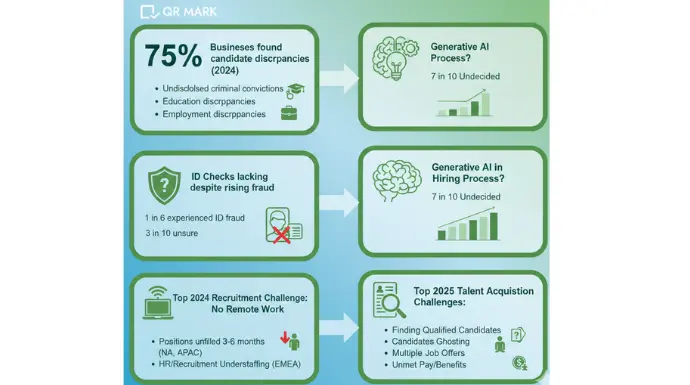
An ADP study of 2.6 million background checks found:
- 41% lied about education
- 23% used fake credentials or licenses
- HireRight (2025) found that over three-quarters of businesses found mistakes in candidate information in one year
Bottom Line: Education is one of the most common areas where people give wrong information.
II. Small mistakes become big problems
HireRight also found:
- 2 in 5 employers found at least 1 problem for every 20 people hired
- 13% of employers found 1 problem for every 5 people
This means, If a company hires 100 people a year, it may face 5 or more bad hires every year.
III. Education is a top risk area
HireRight reports education is one of the most common problem areas. In EMEA regions, 47% of employers said education causes the most issues.
Bottom line: Checking education gives big value with little effort.
IV. Bad hires are expensive
HR research shows bad hires cost a lot of money. SHRM shared examples where costs went up to $240,000 due to rehiring and lost time.
Simple truth: It is cheaper to verify than to fix a bad hire.
V. Verification helps honest people too
Modern tools verify education 24/7, reduce paperwork, and speed up hiring.
Result: Honest people get hired faster.
How to verify Diploma Online? (US, UK, EU, and India Practices)
Online diploma verification means checking if a diploma is real using the internet. The goal is to make sure the school really issued the diploma and that the details are correct.
This method is safe and reliable. Companies use official websites, databases, or QR codes instead of emails or paper files. These tools protect personal information, reduce mistakes, and make checks faster. Employers like them because they are quick and secure.
Many systems also follow important safety rules, such as privacy and security standards.
companies also choose systems that follow:
- GDPR privacy rules,
- ISO security standards, and
- AICPA SOC controls.
Tools like QR Mark use QR codes that link diplomas to official school records, not editable files. This makes it harder to fake or change a diploma and helps organizations verify diplomas safely across the US, UK, EU, and India.
But before You Start, Have This Information Ready
- Full name used at graduation
- Name of the school or university
- Year of graduation
- Diploma or certificate ID (if available)
Having correct details helps avoid delays or errors.
1.What are the different Ways to Verify Diploma?
I. Use the School’s Official Online System
Most schools have in-built verification systems that help people verify credentials like,
- United States: Most schools offer online tools run by the registrar’s office or approved websites. Employers can check graduation status and dates.
- United Kingdom: Many universities support digital checks or secure requests from employers. Some use shared verification systems.
- European Union: Schools use digital credentials, national databases, and systems that work across countries, especially for jobs and higher education.
- India: Many schools and boards provide –
- Online verification portals
- Digital certificates from government platforms
- Verification through registrar portals or emails
Schools may ask for roll numbers or certificate numbers. Response time depends on the institution.
II. Verify Using QR Codes on Diplomas
Many modern diplomas include a QR code, either on paper or in a digital file.
When someone scans the QR code, it opens a secure page from the school or an approved system. This page shows verified details like:
- Student name
- Type of diploma
- Graduation status
The QR code does not store editable data. If someone alters the document, the QR verification will not match the official record.
Employers trust QR codes because they:
- Connect to official records
- Reduce email and phone checks
- Create a clear digital record
QR-based checks are growing in India and are already common in the US, UK, and EU.
Platforms like QR Mark help institutions issue and verify diplomas using secure QR Codes linked to official records. When a school or institution issues a diploma with QR Mark, the scan opens an issuer-controlled verification page hosted on the school’s own verified domain.
The verifier then matches the key fields (name, credential, year) against what’s shown. Because the issuer controls the page, they can also use a template to show only the essential fields instead of exposing the whole document useful for privacy-sensitive records.
III. Request an Official Transcript
A diploma alone is often not enough.
Employers may ask for official transcripts sent directly by the school.
Transcripts show:
- Courses taken
- Grades
- Graduation status
They are one of the most trusted proofs of education.
IV. Use a Trusted Third-Party Service
If a school does not offer online checks, third-party services can help. They contact schools, check secure databases, and provide verification reports. These services are often used in background checks.
V. Check If the School Is Real
Verification also means making sure the school is approved.
A diploma may be rejected if:
- The school is not accredited
- The school is a diploma mill
- The school cannot confirm records
Always confirm that the institution is officially recognized.
Example
A medium-sized company was hiring engineers. Instead of checking diplomas by email, they used QR codes to verify them online. This reduced the process from weeks to a few days and helped catch wrong records early.
Quick Tip ⚡
Online diploma verification works best when records are digital and information is accurate. When done right, verification can take minutes instead of weeks.
How to Verify a High School Diploma Online?
Here are simple ways to verify high school diploma online:
1.By Using QR Codes
Many diplomas now have QR codes. Scan the code and match the details with the diploma.
2.Contact the School or School District
High schools or school boards usually confirm graduation details through registrars or district offices.
3.Third-Party Verification Services
Many schools in the US and UK share records through centralized databases. These checks are fast and reliable.
4. Official Transcripts
This is the safest proof. The school sends it to the employer or organization.
Helpful tip💡
Share your:
- Full school name
- Graduation year
- Name used at graduation
How Diploma Fraud Spreads Into Other Industries
Fraudulent diplomas don’t stay in one place. They move through hiring, government services, professional certifications, and education itself leading to poor work quality, safety hazards, unqualified public servants, weakened academic standards, and regulatory violations.
1.Risks Across Different Areas
I.Hiring and HR
People without the right skills may get hired or promoted. This can lead to poor work, safety problems, and higher costs for rehiring or legal issues.
II.Government and Public Services
Fake diplomas may be used for visas or licenses. Unqualified people can enter important public roles, and fixing mistakes can take a lot of time and money.
III.Professional Certifications
Certificates may be given without proper education. This weakens trust in licensed jobs and can put the public at risk.
IV.Education and Schools
Fake diplomas lower academic standards. Schools may accept students or transfers based on false records, which lowers trust in real qualifications.
Because people use diplomas in many places, organizations check them more than once. Different organizations verify the diplomas at each step.
Who Verifies a Diploma?
Many people check diplomas to make sure they are real.
1.Colleges and universities
They check diplomas when someone wants to study more. For example, a college checks a high school diploma before letting a student join.
2.Government and licensing offices
They check diplomas for jobs that need special rules, like doctors or teachers.
3.Background check companies
They check diplomas for employers by contacting schools or using safe databases.
4.Individuals
People may check their own diplomas if they lose them or need proof.
Since, these checks are time-sensitive and high-volume, organizations rely on online verification methods.
Difference between online and manual diploma verification
| Aspect | Online Diploma Verification | Manual Diploma Verification |
| Definition | Uses online databases, portals, or QR codes to verify diplomas | Verification done via phone, email, or mail with the institution |
| Speed | Instant to a few hours | Several days to weeks |
| Process | Enter details or scan QR/ID linked to official records | Submit documents and wait for manual confirmation |
| Availability | 24/7 access | Limited to office hours |
| Accuracy | High, due to automated record matching | Prone to human error or missing records |
| Cost & Scale | Cost-effective and scalable for bulk checks | Expensive and hard to scale |
Diploma vs Degree vs Transcript: What’s the Difference?
|
Item |
What It Is | What It Shows | When You Get It | Used for Verification? |
| Diploma | A certificate that shows you finished school | Proof that you graduated from high school | After you meet all graduation requirements | Not usually by itself |
| Degree | A certificate from a college or university | Proof that you completed a college program (associate, bachelor’s, etc.) | After finishing a college program | Not usually by itself |
| Transcript | An official school record | Classes taken, grades earned, credits, and graduation date | During or after school | Yes — this is the main document |
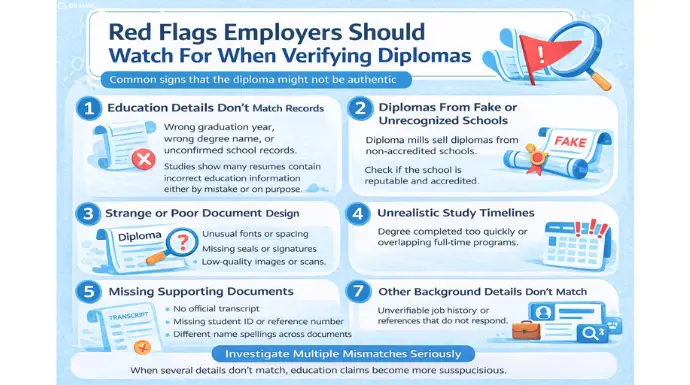
What are the Red Flags Employers Should Watch For?
Red Flags are those things while verifying diplomas that give the authenticity of the document. When you verify diplomas, they look for these signs.
Below are the most common red flags that will make your job easier.
1. Education Details Don’t Match Records
One of the biggest red flags is when a person’s education details do not match official school records. This can include the wrong graduation year, wrong degree name, or a school that does not confirm the claim. Studies show that many resumes contain incorrect education information, either by mistake or on purpose.
2. Diplomas From Fake or Unrecognized Schools
Some diplomas come from schools that are not real or not approved. These are often called diploma mills. They sell diplomas without real classes or exams. Employers should check if the school is accredited and officially recognized. If it is not, treat it as a risk.
3. Strange or Poor Document Design
Fake or altered diplomas often look different from real ones. Employers should watch for:
- Unusual fonts or spacing
- Missing seals or signatures
- Low-quality images or scans
These issues do not always mean fraud, but they raise concern.
4. Unrealistic Study Timelines
Another warning sign is when education timelines do not make sense. For example:
- A degree completed too quickly
- Two full-time programs during the same time period
These cases may be real, but they need extra checking.
5. Missing Supporting Documents
Employers expect more than just a diploma.
Red flags include:
- No official transcript
- Missing student ID or reference number
- Different name spellings across documents
Incomplete records slow down or stop verification.
6. Schools That Cannot Be Contacted
If an employer cannot reach the school to confirm records, it becomes a problem.
Delay can be caused by:
- Closed schools,
- Outdated contact details, or
- No response from the institution or blocked verification.
7. Other Background Details Don’t Match
Sometimes education issues appear along with other problems, such as:
- Job history that cannot be confirmed
- References that do not respond
When multiple details don’t match, employers take education claims more seriously.
Final Thoughts
Diploma verification helps make sure education claims are true and fair. It protects schools, employers, and people who worked hard to earn their diplomas. By checking diplomas the right way, everyone can trust education records and make better decisions.
If your organization handles education verification at scale, using a secure online system can save time and reduce risk.
FAQS
- How long does education verification take?
Education verification usually takes 1 to 5 business days. If the school uses online databases or third-party services, it can be instant or same day. Delays happen when schools respond slowly or records are old.
- Does background check show education?
Yes, a background check can show education details. It can be done but only after the candidate gives permission.
- How to Verify a Diploma Certificate from Alison?
To verify an Alison diploma:
- Log in to your Alison account
- Use the certificate verification link or ID on the diploma
- Share the verification URL with employers
Employers can confirm the certificate through Alison’s online system.
- Is Online Diploma Verification Safe?
Yes, online diploma verification is safe. You can verify it by contacting the institution or scan the qr code present in the diploma. You can also use other third party services for verification.
- How do employers verify that job applicants have the degree(s) they claim?
Employers do not rely only on trust. They verify degrees using school records, official transcripts, online portals, or background check services. This usually happens after the candidate gives permission.
