

TL;DR
How to verify someone’s degree, in short: confirm it at the source, not on paper. Check the credential directly with the issuing school or an approved system by scanning a verification QR Code, contacting the university records office, or using a national database rather than trusting a scan, a seal, or a résumé. This guide covers each method, how fakes are made, and the fast red-flag checks a verifier can run today.
For years, how to verify someone’s degree was treated as a simple checklist item. A certificate that looked official, a university seal, and a convincing résumé were often enough to move a candidate forward.
That approach no longer works.
Today, fake degrees are faster, cheaper, and more sophisticated than ever. AI design tools, ready-made templates, and fake university websites allow fraudulent credentials to pass visual inspection in minutes.
Relying on appearances is now risky and the damage caused by fake degrees is far greater than most institutions expect.
This guide breaks down:
- What degree verification really involves,
- Why it matters,
- How institutions verify credentials today, and
- How to spot fraud before it causes damage.
What Is Degree Verification?
Degree verification is the process of checking if a person has earned a degree from a real and approved school.
It means confirming details such as:
- School name
- Type of degree
- Subject studied
- Graduation date
These details are checked using official records.
Degree verification does not depend on resumes or scanned certificates. Instead, it checks the information directly from the source. This helps make sure the details are correct and up to date.
Why Is Degree Verification Necessary?
Degree verification is important because fake documents are common and can cause serious problems for institutions.
Key Reasons Degree Verification Matters
| Reason | Why It Matters |
| Legal compliance | Many jobs require a real degree. Skipping checks can lead to fines, audits, or loss of licenses. |
| Financial protection | Helps avoid wasting money on hiring, training, and replacing unqualified people. |
| Reputation protection | Prevents public embarrassment, legal problems, and loss of trust. |
| Quality assurance | Make sure people have the skills and knowledge their job needs. |
The impact of fake degrees differs by sector, but the risk is serious in every case. Now, I will make it more clear for you with sector-wise breakdown.
I.For Employers
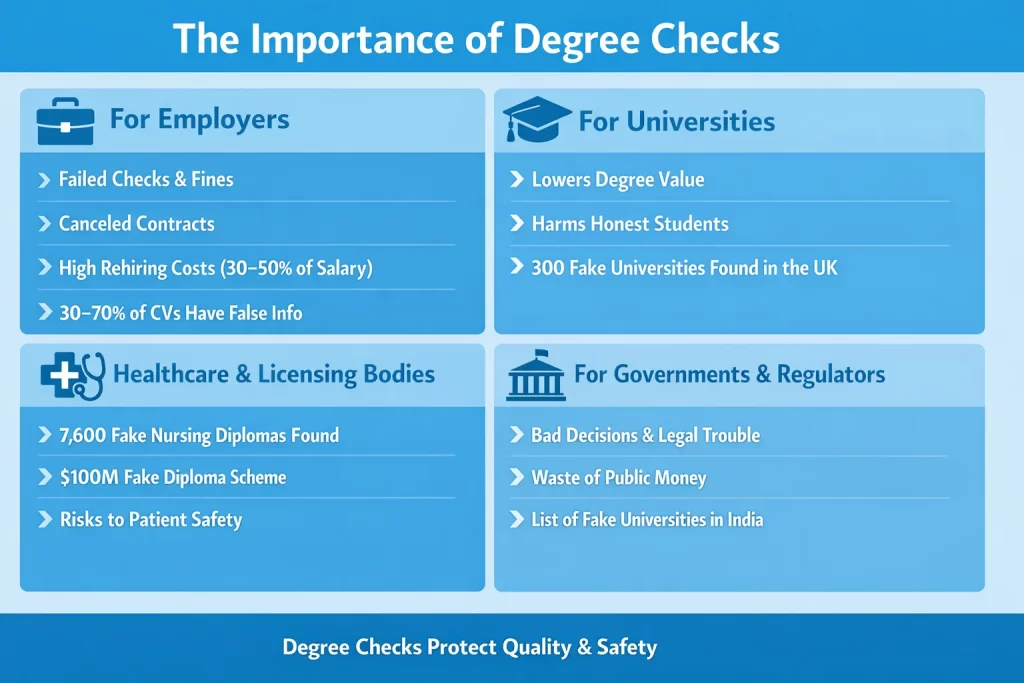
For employers, checking degrees helps prevent problems before they happen. Many jobs require a real degree, especially in healthcare, finance, engineering, and education.
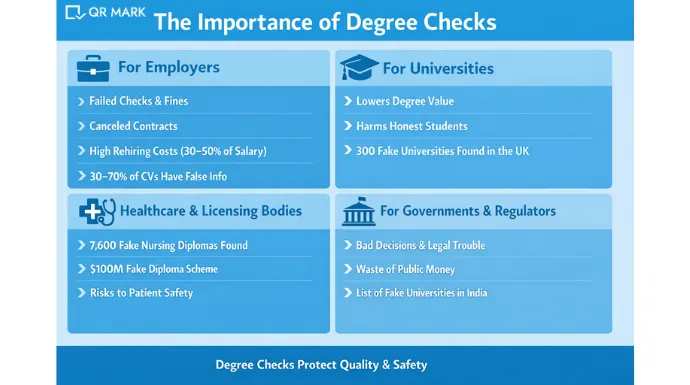
Studies show that 30–70% of CVs contain false information, with education among the most common lies.
Hiring someone with a fake degree can cause:
- failed checks
- canceled contracts
- fines
- high rehiring costs, often 30–50% of a yearly salary
II. For Universities
Universities check degrees to protect quality and fairness. When students apply for higher studies, schools expect their earlier degrees to be real.
If a fake degree is accepted, it:
- lowers the credibility of the degree
- Demoralize honest students
- harms the university’s reputation
In the UK, official checks have found 300 fake universities after reviewing thousands of degrees. This shows how common fake degrees are.
Once an unqualified student is admitted, the results can directly affect your reputation.
III. For Healthcare and Licensing Bodies
In healthcare, degree checks protect people’s safety. Doctors and nurses must have real training to care for patients.
Officials found out about a plan where thousands of fake nursing diplomas were made. This plan brought in more than $100 million. People with these false papers were even able to pass the tests needed for a license and then worked in real hospitals.
In 2023, a major case in Florida found over 7,600 fake nursing diplomas. These fake papers helped people get nursing licenses and jobs.
This caused patient harm, legal problems, and loss of trust. That is why licensing bodies now check degrees very carefully.
IV. For Governments and Regulators
Governments use degree checks to keep systems fair and safe. Public jobs, visas, and licenses all depend on real qualifications.
In India, the education authority keeps a list of fake universities and updates it every year.
Using fake or unchecked degrees can lead to:
- bad decisions
- legal trouble
- waste of public money
Regular degree checks help stop problems early. Because these risks affect many areas, different authorities check degrees based on the situation.
How to verify a fake degree certificate? (4 Proven Methods)
There are a few trusted ways to verify degree is real. All methods confirm the degree at the source, but they differ in speed, cost, and coverage. The best choice depends on the country, the level of risk, and how fast the result is needed.
1. How to Verify Someones degree using QR Code?
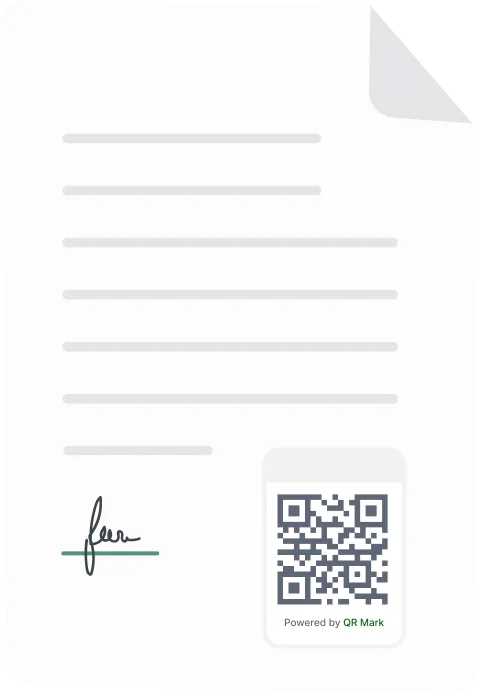
Some universities issue digital degrees with a QR code or secure link. This code connects directly to the school’s official records. This helps to verify degree using QR Codes.
Using QR Code for degree verification, protects your document from being counterfeited and help build credibility of your university.
Steps:
- Ask for the degree
- Scan the QR code in the degree with a phone or scanner
- Open the official verification page
- Check the degree details
- Confirm the degree is valid
Time: Instant Cost: Free or very low
2. How to verify degree certificate from university?
To verify a degree from university contact the university’s records office.
Steps:
- Get written permission from the candidate
- Contact the university records office
- Share degree details and ID information
- The university checks its records
- Receive confirmation or a mismatch notice
Important notes:
- Written consent is required by law such as GDPR and FERPA.
- Older degrees may take longer to check
- Universities keep records even if names have changed
Time: 5–15 business days Cost: £10–£30
3. How to verify degree using National Degree Verification Services?
Some countries have official databases that store degree records from many universities.
Steps:
- Open the official verification website
- Enter degree details
- Upload consent if needed
- Submit the request
- Review the result
Time: Instant to 5 business days Cost: £5–£15
Examples include:
Note: This works only if the university is part of the system.
4. How to verify degree using official documents?
This method uses official documents sent directly by the university when digital checks are not available.
Documents to request:
- Official degree certificate
- Official transcripts
- Graduation letter (if available)
Steps:
- Ask the university to send documents directly
- Check seals, signatures, or digital proof
- Match details with known records
- Store documents safely
Important notes:
- Do not trust documents sent only by the candidate
- Sealed or official documents are most reliable
- International documents may need translation
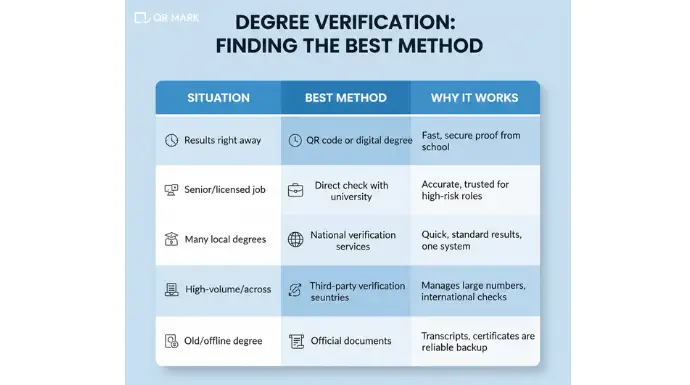
Time: 1–4 weeks Cost: £0–£50 (more for international cases)
Understanding how degrees are forged helps explain why source-level verification is no longer optional.
| Method | Speed | Cost | Best for / limitation |
|---|---|---|---|
| QR code / verifiable credential | Instant | Free–very low | Best for: modern, digitally-issued degrees. Limit: only if the school issued it with verification built in. |
| University records office | 5–15 business days | £10–£30 | Best for: any accredited school. Limit: needs written consent; older records take longer. |
| National degree database | Instant–5 business days | £5–£15 | Best for: member institutions. Limit: only works if the school participates. |
| Official documents direct from school | 1–4 weeks | £0–£50+ | Best for: when digital checks aren’t available. Limit: slow; international cases may need translation. |
Who Verifies a Degree?
Different professionals handle degree verification based on the purpose of the check. They confirm that a degree is real before making hiring, admission, licensing, or approval decisions.
I.HR Managers, Hiring Teams, and Compliance Staff
They check degrees when someone is hired, starts a job, or gets promoted.
II.University Registrars and Admissions Staff
They verify degrees for college admissions, transfers, and student progress.
III.Government Hiring Officers and Immigration Staff
They review degrees for government jobs, visas, and legal requirements.
IV.Licensing Officers and Review Committees
They confirm degrees for jobs that need special licenses. Examples include healthcare, finance, etc… .
V.Background Check Specialists
They handle many degree checks, especially for large companies or international candidates.
VI.Credential and Academic Review Officers
They review and confirm degrees earned in other countries.
These professionals use official systems or trusted service providers. This helps make sure the results are correct and easy to check later. It also helps protect personal data and follow privacy laws.
How do fraudsters forge a degree ?
Degree fraud is getting smarter. People no longer use just low-quality fake certificates. Many now use professional tools that make fake degrees look real at first glance.
Understanding how these fake degrees are made helps organizations spot red flags early and act before problems happen.
How are fake college degrees made today?
I. DIY (Do-It-Yourself) Fake Documents
Some people create fake degrees using common tools like Microsoft Office, Google Docs, or Photoshop.
They make things like:
- College and university degree certificates
- Master’s and PhD certificates
- Transcripts and mark sheets
- Documents that claim to be from famous schools
- Degrees from fake schools
Some of these fakes are easy to spot. Others look very real and can slip through if no one checks the degree directly with the school.
II. Template-Based Fakes
In this method, fraudsters design a fake certificate once and reuse it many times.
They usually:
- Copy real layouts, fonts, and seals
- Use the same design for many people
- Change names, courses, and dates
These fake documents often miss real ID numbers or secure checks, so they can be caught when proper verification is done.
III. Fake System-Generated Records
Some fake degrees look like they came from an official system, but they did not.
Common warning signs include:
- Fake websites that look official
- Verification pages not linked to real schools
- Extra fake papers, like admission or internship letters
How to check if a degree certificate is fake or not? (4 Key Checks)
Fake degrees certificates often look real at first glance. That is why employers should look for a few early warning signs before moving forward.
1. Check the University Website Carefully
Fake universities often copy real ones. Some fake universities use websites ending in “.ac” to look official. Real universities always use “.ac.country_name”.
Also check the university name closely.
If the website lists a campus address, search it on Google Maps. If the location is fake or unclear, that is a red flag.
2. Confirm the Institution is Properly Accredited
If a university is real, it should be listed by a recognized regulator or accrediting body.
If you are unsure about an accrediting agency, check the official list maintained by the Council for Higher Education Accreditation. If the institution or accreditor is missing from official records, do not proceed.
Unlisted institutions are one of the most common signs of diploma mills.
3. Be Cautious of Scans, Screenshots, and Missing Details
A real degree should have:
- A document ID or reference number
- A clear issuing authority
- A way to verify it at the source
If a candidate shares only a scan or screenshot and cannot provide any verification trail, pause the process. Visual checks alone are no longer reliable.
4. Watch for Resistance to Verification
One of the strongest red flags is hesitation.
If a candidate:
- Refuses written consent
- Delays verification requests
- Pushes back on source checks
That is a signal to stop and verify more deeply. Legitimate candidates rarely resist standard verification.
Best Practices to Avoid Fake Degree Certificates in your institution
Spotting fake degrees is important. But the real goal is to avoid the problem altogether, i.e., document fraud.
The best for you is to not rely on gut feeling. Follow these simple, repeatable practices that reduce risk every time.
1. Make Degree Verification a Standard Step
Do not verify degrees only when something feels wrong.
Make verification a mandatory step for:
- Hiring
- Admissions
- Promotions
- Licensing approvals
When verification is standard, fraud has fewer places to hide.
2. Verify Degrees Before Final Decisions
Always verify degrees before:
- Issuing offer letters
- Confirming admissions
- Granting licenses or approvals
Fixing a mistake later is harder and more expensive than checking early.
3. Assign Clear Responsibility
Degree verification should not be “everyone’s job.”
Assign clear ownership to:
- HR or compliance teams
- Admissions or registrar offices
- Licensing or credential review teams
Clear responsibility prevents gaps and delays.
4. Use the Right Method for the Right Case
Not all degrees need the same level of checking.
- Use QR codes or databases for fast, low-risk cases
- Contact universities directly for high-risk roles
- Use professionals for bulk or international checks
Matching the method to the risk saves time and money.
5. Keep Records and Audit Trails
Always document:
- What was verified
- When it was verified
- How it was verified
Good records protect you during audits, disputes, or legal reviews.
6. Escalate When Something Feels Unclear
If records do not match or details are missing:
- Pause the process
- Escalate the case
- Verify again at the source
Rushing past uncertainty is how fraud slips through.
Final Takeaway
Degree fraud is real. It happens a lot, in many countries, and people make money from it.
As schools move from paper records to digital ones, organizations must change too. Therefore, knowing how to verify someone’s degree is crucial. They should stop trusting documents and start checking degrees with schools. Using only resumes, or how a document looks can cause legal trouble and harm trust.
Good degree checks mean using the right method and getting proper permission. They also involve keeping clear records and checking degrees before decisions are made.
Organizations that improve how they check degrees do more than lower risk. They support fairness, build trust, and make sure degrees mean what they should every time.
If you also want to know how to verify diploma online, read it here.
FAQs
1.How to find out if someone is lying about their degree?
To Check the degree you can contact the college or university. You can also verify it using the school’s official website or records office. If it cannot be confirmed, then the degree is likely fake.
2.What is the punishment for a fake degree certificate?
The punishment for a fake degree certificate varies from country to country. For example, in the US the punishment for a fake degree certificate is jail term up to 5 years (in case of state case)and up to 20 years(in case of federal case). The fine can range from $5,000 to $250,000+.
3.Can employers verify college degree?
Yes, employers can verify college degree. They mostly do this when someone is confirmed to join their company. This is done to ensure that the qualification of the persons is legit
4. How to verify college degree for free?
To verify a college degree for free, you scan the QR Code present in the degree certificate. It takes you to an authorised page, if the details are correct the degree you have is legit.
5. How common are Fake Degrees?
Fake degrees are more common than many people think. Online “diploma mills” and AI tools make them easy to create. Studies suggest 1 in 5 job seekers lie about having a degree. Fake degrees cause real damage. They lead to bad hires, money loss, and broken trust. In some cases, they can even result in criminal charges. This is why employers must verify education carefully. Strong verification protects businesses, honest candidates, and real qualifications.
