

TL;DR
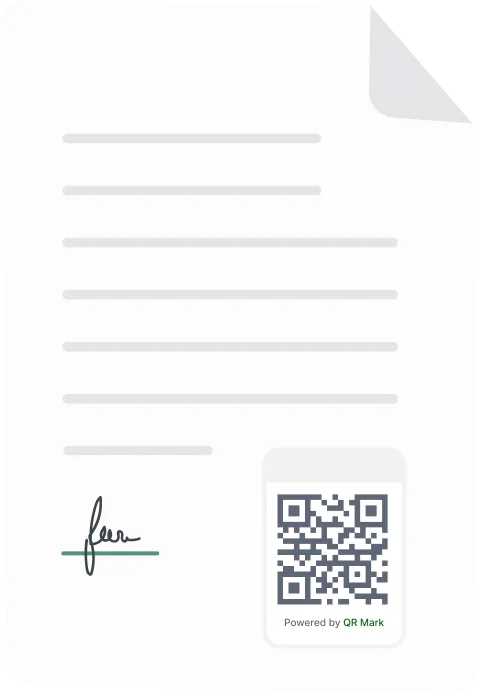
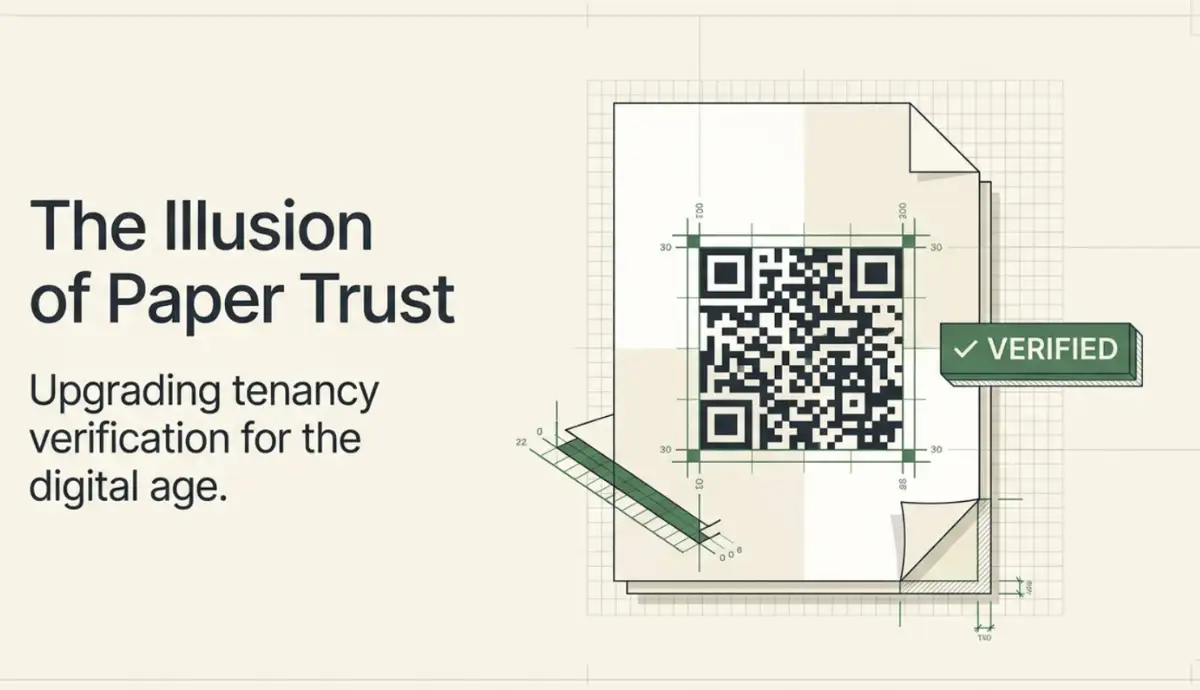
Tenancy letter verification is the process of confirming that a tenancy letter, and the residential tenancy agreement behind it, is genuine and was issued by the real landlord or agent. Most verifiers still rely on phone calls, email follow-ups, and paper cross-checks that are slow and easy to game. This article explains why those methods fall short and shows how QR Mark lets anyone verify a tenancy letter in seconds by scanning one Verification Image.
A tenancy letter proves who lives at an address and under what terms. Banks, employers, and landlords often rely on it as proof of residence. But when it is just a Word or PDF file on letterhead, creating a convincing fake can be surprisingly easy.
The FBI recorded 115 real estate fraud complaints in 2025, with reported losses of around $2.7 million. Counterfeit documents, including tenancy letters and rental agreements, can play a role in these schemes.
So how as a landlord or a real estate company can you make sure the verification of tenancy letter is instant, fast and their tenancy letter is genuine? This guide will help you do exactly that.
Why Are Tenancy Letters So Easy to Fake?
Tenancy letters are easy to fake because nothing on the page proves it came from the real issuer, i.e., the real estate company or the landlord of the property. The layout, logo, signature, and rent figure can all be copied or edited, and the person receiving the letter has no fast way to check the source.
Whether the underlying agreement is a standard residential tenancy agreement, an assured shorthold tenancy, or another kind of tenancy contract, the letter is only as trustworthy as the proof behind it. A forger has three easy routes:
- Build a fully fake letter from a blank template and invent details.
- Alter a genuine letter, changing the tenant name, address, rent, or dates.
- Reuse a real letterhead and signature lifted from an earlier document.
None of these need special tools. That is why a verifier cannot trust the document itself, and why they fall back on the manual checks below.
How Do People Verify a Tenancy Letter Today, and Why Does It Fall Short?
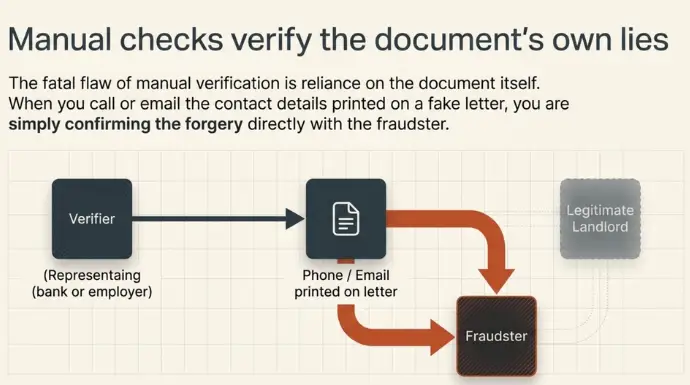
Today verification is manual. A bank, employer, or new landlord confirms the letter one of four ways, and each one costs time and still leaves a gap a determined forger can slip through.
Phone or email follow-up
The verifier contacts the property manager or landlord using the details printed on the letter, and asks them to confirm it verbally. The weakness is obvious: the contact details on a fake letter are the forger’s own, so the verifier often ends up confirming the fake with the fraudster.
Lease agreement cross-reference
The verifier asks the tenant to produce the original registered lease so they can match signatures, rent, and dates against the letter. This is slower, depends on the tenant handing over a private contract, and still relies on a human spotting a skilled edit.
Rent payment proof
The verifier requests three to six months of bank statements or rent receipts to confirm the financial picture in the letter. Statements and receipts can themselves be edited, and asking for months of banking history is intrusive and slow.
Official portals (government or police)
For safety or compliance checks, such as local police tenant verification, authorities cross-check the submitted details against government identity records. This is reliable but limited to official use, varies by country, and is not available to a bank or employer who just needs a quick answer.
Here is how the four methods compare, with QR Mark verification shown for contrast.
| Method | How it works | Speed | Effort | Where it falls short |
|---|---|---|---|---|
| Phone / email follow-up | Call or email the contact on the letter to confirm it | Hours to days | Manual | Fake letters list the forger’s own contact details |
| Lease cross-reference | Match the letter against the original registered lease | Days | High | Needs a private contract; skilled edits still pass |
| Rent payment proof | Check 3 to 6 months of statements or receipts | Days | High | Statements can be edited; intrusive for the tenant |
| Official portals | Cross-check details against government ID records | Varies | Restricted | Official use only; not open to banks or employers |
What Should a Genuine Tenancy Letter Verification Solution Actually Do?
Real verification should let anyone confirm a tenancy letter in seconds, without phone calls or back-and-forth with the landlord or agent, while giving the issuer proof and control. If you are choosing a way to protect the letters you send or accept, hold it against these six requirements.
-
Instant verification
A genuine verification solution should let someone confirm a tenancy letter within seconds by checking it against a record created by the issuer. There should be no need to call the landlord, send emails, or wait for someone to manually confirm the document.
QR Mark does this by adding a unique QR Code to the tenancy letter. When scanned, it takes the verifier to the corresponding verification record, where they can compare the document with the information issued by the organisation.
-
Trust building
Verification should establish more than whether a document exists. It should help the recipient determine whether the tenancy letter was actually issued by the stated landlord, property manager, or agent.
QR Mark connects each document to an issuer-controlled verification record, allowing recipients to check the letter’s details against the original record rather than relying solely on the document they received.
-
Branding
A verification page should make it clear who is standing behind the document. Sending recipients to an unfamiliar third-party website can create doubt, even when the document is legitimate.
QR Mark supports custom domains, allowing organisations to host their verification pages on a domain they control, such as verify.companyname.com. This keeps the verification experience connected to the issuer’s own brand and identity.
-
Compliant
A verification system should prove authenticity without unnecessarily exposing sensitive tenancy information. Issuers should be able to decide which information a verifier actually needs to see.
QR Mark supports template-based verification, allowing issuers to control the information displayed on the verification page instead of exposing the entire tenancy letter. QR Mark also states that its platform is ISO 27001:2022, SOC 2, and GDPR compliant, helping organisations incorporate verification with security and compliance requirements in mind. -
Verification analytics
Issuers should have visibility into what happens after a tenancy letter is issued. Knowing when documents are being checked and how frequently they are accessed can help organisations understand document usage and identify unusual activity.
QR Mark provides verification analytics, including information such as scans, views, fraud reports, and activity trends, giving issuers visibility into how their documents are being verified.
-
Fraud reporting
A verification solution should give recipients a clear way to flag a document when something does not look right. If the details on a tenancy letter do not match the issuer’s records, the verifier should not have to figure out how to contact the organisation independently.
QR Mark provides a fraud-reporting mechanism that allows suspicious documents to be flagged, giving the issuer a direct way to receive and investigate potential cases of document fraud.
The Bottom Line on Verifying a Tenancy Letter
Manual checks were built for a world where forging a letter was hard. It is not hard anymore. Phone calls confirm the forger’s own number, cross-references need private contracts, and payment proof is slow and intrusive.
Verification that works has to be instant, tied to the real issuer, and easy for anyone to run. That is what a scannable Verification Image on the issuer’s own domain gives you.
Frequently Asked Questions
1. What information should a tenancy letter contain?
A tenancy letter should typically include the tenant’s name, property address, tenancy dates, rent amount, and the name and contact details of the landlord or property manager. The exact information can vary depending on why the letter is being requested.
2. Who can issue a tenancy letter?
A tenancy letter is generally issued by the landlord, property owner, letting agent, or property management company responsible for the tenancy. It should come from someone who can legitimately confirm the tenant’s occupancy and tenancy terms.
3. Is a tenancy letter the same as a tenancy agreement?
No. A tenancy agreement is the formal contract between the landlord and tenant, while a tenancy letter is usually a confirmation of the tenancy and its key details. A tenancy letter may summarise information from the underlying agreement but does not necessarily replace it.
4. When do you need to provide a tenancy letter?
A tenancy letter may be requested when proof of residence or tenancy is required. Common situations include applying for financial services, employment relocation, immigration or administrative processes, and securing another rental property.
5. Can a landlord refuse to provide a tenancy letter?
Whether a landlord must provide one depends on the local laws, tenancy agreement, and purpose of the request. In many cases, the landlord or agent can provide a confirmation letter if they are willing and have the authority to verify the tenancy.
6. How long is a tenancy letter valid?
There is no universal validity period. It usually remains useful while the information it confirms—such as the tenant, property, and tenancy dates—is accurate. An organisation requesting the letter may also specify how recent it needs to be.
7. Can a tenancy letter be verified without sharing the full rental agreement?
Yes. A verification system can confirm the key details of a tenancy letter without requiring the tenant to share their entire rental agreement. This reduces the amount of private information that needs to be disclosed.
QR Mark supports this approach by allowing issuers to create verification records containing the information needed to confirm the document, rather than requiring the verifier to access the complete underlying agreement.
8. Can a verification system show only selected tenancy details?
Yes. A verification page does not necessarily need to reproduce the entire tenancy letter. Issuers can choose which information a verifier needs to see to establish authenticity.
QR Mark supports template-based verification, allowing organisations to control which fields appear on the verification page. This can help balance document verification with privacy and data-minimisation requirements.
