

TL;DR
A digital identity QR Code turns a static ID or document into a scannable proof of authenticity. Anyone can verify it in seconds, with no apps and no manual back-and-forth. In this guide I walk through what digital identity actually means in 2026, how QR Codes work, where traditional verification breaks down, and which tools are worth evaluating. By the end, you will know how to move from static identity to verifiable identity.
Every one of us has a digital identity now. It is stitched together from government IDs, employer letters, university certificates, bank statements, medical records, and dozens of smaller digital traces that prove we are who we say we are.
The problem is that most of that identity still lives on paper or in PDFs that anyone with a half-decent design tool can forge.
For the person on the receiving end, an employer, a hospital, a university registrar, there is rarely a fast way to confirm what is real.
A digital identity QR Code changes that equation. Instead of asking “is this document genuine?” and then sending an email, making a phone call, or waiting two weeks for a background check, a verifier scans once and gets an answer. I will walk through how it works, why it matters in 2026, and what to look for when evaluating a solution.
What Does Digital Identity Mean, and How Do QR Codes Fit In?
Your digital identity is the set of attributes that prove who you are across digital and physical contexts.
What Is A Digital Identity in 2026?
A digital identity is the digital collection of attributes that prove who you are: government-issued IDs, employment records, academic credentials, healthcare data, and the documents that tie them all together.
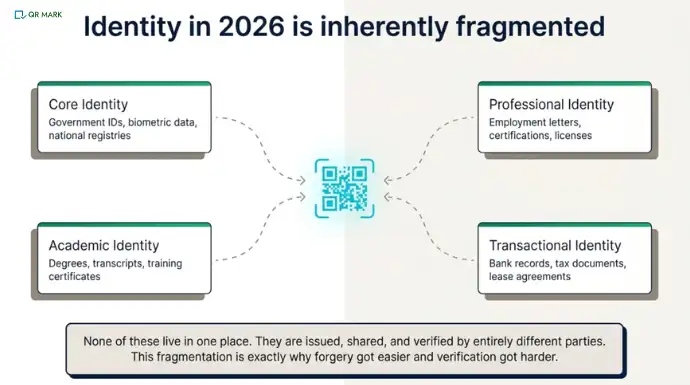
In 2026, digital identity is not one thing. It is layered:
- Core identity: government IDs, biometric data
- Professional identity: employment letters, certifications, licenses
- Academic identity: degrees, transcripts, training certificates
- Transactional identity: bank records, tax documents, lease agreements
None of these live in one place. They are issued by different organizations, shared across different channels, and verified by yet another set of parties. That fragmentation is exactly why forgery got easier and verification got harder.
What Is A Digital Identity QR Code And How Are They Used Today?
A digital identity QR Code is a scannable link that connects a document or ID to a verification record maintained by the issuer.
You have probably already interacted with an identity QR Code without thinking about it:
- Boarding passes at airports
- Vaccination certificates during the pandemic
- Student ID cards at universities
- Verification stamps on government documents in India, Singapore, and the UAE
How Is Digital Identity Being Manipulated In 2026?
Digital identity fraud is scaling faster than the verification systems meant to stop it. Forgery tools have caught up to issuance tools, which means every document category now faces real risk.
The Rise Of Document Forgery And Identity Fraud
Identity fraud is not slowing down. According to Javelin Strategy and Research’s 2024 Identity Fraud Study, identity fraud losses in the U.S. totaled approximately $43 billion in 2023.
That is what is measured. A lot of document-based fraud never hits those reports because it gets absorbed as a “bad hiring decision” or a “failed background check.”
How PDFs And Digital IDs Are Easily Altered?
What makes 2026 different is that the tools to forge have caught up to the tools to issue. Five years ago, editing a PDF convincingly required real skill.
Today, free online editors, AI-powered image tools, and cheap template marketplaces make it trivial.
Watermarks, signatures, and embossed logos used to be trust signals. They are all replicable now. Visual security on its own no longer holds up.
What Are The Real-world Risks Of Unverifiable Identity?
When unverifiable identity gets through, the costs are spread across everyone. Employers can hire based on fake credentials.
The asymmetry is what makes this painful. Verifiers spend time and money doing checks, while issuers (companies, universities, governments) bear the reputational damage when a fake slips through carrying their name.
What Documents Actually Define Your Digital Identity?
Your digital identity is anchored by a small set of documents. Understanding which ones do the heavy lifting matters for choosing where to add verification first.
Government-Issued Identity Documents
These are the anchor documents: passports, national IDs, driver’s licenses, voter IDs, tax identification documents, and social security cards. They are the most frequently forged because they carry the most weight.
Supporting Documents Used In Verification
Around those core IDs sit the documents that give your identity context:
- Employment letters (offer letters, experience letters, salary slips)
- Academic credentials (degrees, transcripts, training certificates)
- Financial documents (bank statements, Form 16, tax returns)
- Legal agreements (rental agreements, property titles, notarized contracts)
- Healthcare records (prescriptions, medical certificates, diagnostic reports)
Each carries verification value in its own context. A bank statement confirms financial identity. An experience letter confirms professional identity. A university certificate confirms academic identity.
Where Does Document-Based Identity Verification Break Down?
Most identity verification today is visual, slow, or both. Here is where the current model consistently fails.
1. The Lack Of Tamper-Resistant Mechanisms
Most documents rely on visual trust. A logo, a signature, a stamp, maybe a hologram. None of these are actually tamper-proof in a world where Photoshop, AI image tools, and template marketplaces exist. Visual cues signal authenticity but they do not prove it.
2. No Real-Time Verification
When someone hands me a document, my options are limited. I can email the issuer and wait 24 to 48 hours. I can call and hope someone picks up. I can run a background check that takes 2 to 5 business days domestically and 2 to 4 weeks internationally, according to verification industry benchmarks. Or I can skip verification entirely and hope for the best.
None of those options scale. Hiring teams processing 50 candidates a week cannot wait two days per verification. University registrars handling 2,000 end-of-term certificates cannot manually respond to every employer that calls.
3. No Visibility Into When and Where Documents Are Being Verified
Issuers rarely know when their documents are being verified. If a former employer issues me an experience letter today, they have no visibility into whether that letter gets scanned five times by five different employers over the next two years. That is a missed signal, both for fraud detection and for understanding how credentials actually move.
How To Choose A Digital Identity QR Code Solution?
All the documents I mentioned above become substantially more secure when they carry a digital identity QR Code.
The idea is simple: attach a scannable link to a document, and behind that link, maintain a verification record that only the issuer can update.
1. Linking Identity Data To QR Codes
When an issuer creates a digital id QR Code, they are doing three things at once:
- Generating a unique verification record in a database
- Creating a QR Code that points to that record’s verification URL
- Embedding the QR Code (called a Verification Image in QR Mark’s case) on the document itself
2. The Verification Flow: Scan, Validate, Trust
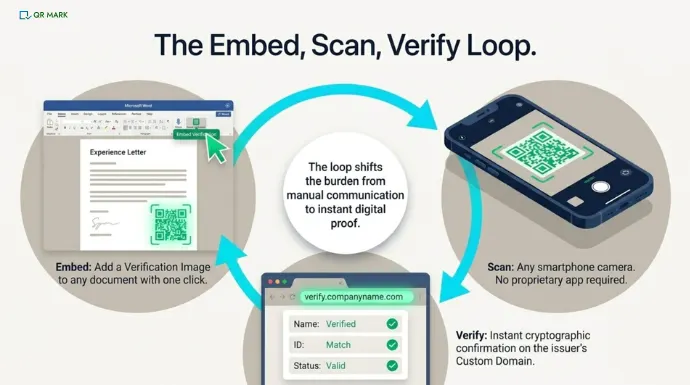
Here is what actually happens when a verifier scans a QR Code on Identity card:
- Scan: The verifier uses any smartphone camera. No app required.
- Land on a verification page: The QR resolves to a URL hosted on the issuer’s own Custom Domain (for example, verify.companyname.com).
- Match details: The page displays the key verification fields. Name, ID number, issue date, validity. The verifier compares these to the document in hand.
- Trust: If the domain is correct and the fields match, the document is authentic. If anything is off, the document is suspicious.
“Anyone can generate a QR Code. What they cannot do is host the verification page on your brand’s verified domain. That is the part fraudsters cannot replicate, and that is why domain matching is the decisive trust cue in any digital identity QR Code system.” – Siddharth Pangtey, Product Manager, QR Mark
3. Bulk Verification Capability
If you issue identity documents at scale, bulk capability is critical.
A strong solution should allow you to:
- Upload large volumes of records at once
- Generate unique QR Codes for each document
- Maintain consistency across all issued identities
Without bulk workflows, issuing QR-secured identities becomes slow and impractical.
4. Branding and Trust Signals
Trust is not only technical. It is also visual and contextual.
The solution should allow:
- Custom domain usage (yourbrand.com, not a third-party link)
- Branded verification pages
- Consistent visual identity across documents
When a verifier sees your domain and branding, confidence increases instantly.
5. Cost Effectiveness at Scale
A good Digital Identity QR Code solution should scale without increasing operational burden.
Look for:
- Pricing based on number of documents (not scans)
- Unlimited verification checks
- Flexible plans for ongoing or bulk issuance
The goal is to make verification sustainable, not expensive.
What Are The Best Digital Identity QR Code Solutions?
I have evaluated several tools in this space. Three stand out, each optimizing for something different.
QR Mark: verifiable identity with real-time validation
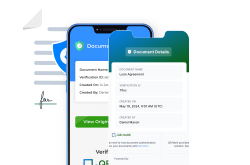
QR Mark is built for document authenticity and identity verification. It adds a Verification Image (a combined QR Code plus verification URL) to documents, and recipients confirm authenticity by scanning.
What stands out about QR Mark:
- Custom Domain verification: Verification pages live on the issuer’s own domain (for example, verify.yourcompany.com), which makes domain matching a real trust signal. Custom Domain is mandatory for production use, which filters out low-commitment adopters.
- Template-based verification pages: Issuers choose exactly which fields appear (name, employment period, designation, ID number), without exposing the full document. Important for healthcare digital identity examples, HR records, and any confidential context.
- Workflow coverage: A Microsoft Word Add-in for HR letters created in Word, a Google Workspace Add-on for Google Docs, Bulk Verification through a dashboard for batches like end-of-term certificates, an API for automated issuance from HRIS or internal systems, and single-document Upload for ad-hoc needs.
- Any-scanner verification: Verifiers use their phone’s built-in camera. No proprietary app to install.
Qryptal
Qryptal positions around cryptography and blockchain-backed document signing. It is a security-forward approach, usually sold through vendor-led implementation.
What stands out:
- Custom domain support
- Template-based pages (with a one-time setup fee, typically around $250 per template)
- Strong cryptographic narrative for buyers who specifically want that story
Where it falls short:
- Verification often requires an in-house validator or a specific app rather than any smartphone camera
- No native import from Google Drive, OneDrive, or Dropbox
- Higher price at scale (annual API pricing can reach $8,000 per month or more at 1,000 documents per month)
ProofEasy
ProofEasy is another blockchain-backed document protection tool. It combines QR Codes with blockchain hashing to mark documents as tamper-evident.
What stands out:
- Blockchain hashing narrative
- Lower entry price for small volumes (plans start at roughly $19 per month for 10 documents)
- Uses any scanner for verification
Where it falls short:
- No custom domain support, which weakens the domain-matching trust anchor
- No template-based verification pages, so verifiers typically see the full original document, which limits confidential use cases
- No native import from common cloud storage
| Feature | QR Mark | Qryptal | ProofEasy |
| Custom domain | Yes | Yes | No |
| Template-based pages | Yes | Yes ( costly setup fee) | No |
| Any-scanner verification | Yes | No (in-house validator) | Yes |
| Drive / OneDrive / Dropbox import | Yes | No | No |
| Microsoft Word Add-in | Yes | Limited | Limited |
| API integration | Yes | Yes | Yes |
| Bulk dashboard | Yes | Yes | Limited |
Where Are Digital Identity QR Codes Used In The Real World?
Digital identity QR Codes are showing up in five verticals where verification load is highest and fraud risk is real.
Healthcare Digital Identity (patients, prescriptions)
Healthcare is one of the highest-stakes use cases. Patient records, prescriptions, diagnostic reports, medical certificates. All need to be verifiable without exposing the full medical record to everyone who checks.
Common healthcare digital identity examples include:
- Prescription QR Codes that let pharmacies verify a script is real without calling the doctor’s office
- Diagnostic reports with scannable verification so insurance companies can confirm the lab issued the document
- Medical certificates for employment that employers can verify without seeing the diagnosis itself
The template-based verification page matters most here. A hospital can expose only “document issued on [date] by [doctor name]” without revealing the underlying diagnosis.
Educational Certificates And Credentials
Universities and training institutes face massive verification loads. India alone produces 2 to 2.5 million graduates annually. Each might need a certificate verified 5 to 10 times across their career. Manual verification does not scale.
An QR Code on a degree certificate or transcript lets employers, background verification firms, and other universities confirm authenticity in seconds. The issuing institution does not need to respond to every verification email. The Verification Image handles it.
Employee And Corporate ID Verification
Experience letters, offer letters, employment verification letters, and corporate IDs are among the most frequently forged documents. HR teams spend hours each week responding to verification requests from new employers and background check firms.
Adding a QR Code to these documents shifts verification from “email and wait 48 hours” to “scan and done in 10 seconds.” For teams creating HR documents inside Word or Google Docs, the Microsoft Word Add-in or Google Workspace Add-on embeds the Verification Image in one click, inside the existing authoring workflow.
Government-Issued IDs
Governments in India, Singapore, the UAE, and parts of the EU already use QR Codes on national IDs, driving licenses, and tax documents. The Aadhaar-linked QR in India is one of the largest deployments in the world.
These implementations often fold in additional security (cryptographic signatures, biometric linkage), but the core concept is the same. A scannable link that confirms the document was issued by the government entity claiming it.
Legal And Compliance Documentation
Contracts, agreements, notarized documents, and compliance certificates all benefit from scannable verification. Real estate agreements are a particularly strong case. Buyers, sellers, banks, and lawyers all need to confirm the same document is authentic, often across months or years of a transaction.
A QR Code on an agreement lets any party verify authenticity without contacting the issuing notary or law firm directly.
At QR Mark, we already see real estate customers like Romell Group using this workflow to take the back-and-forth out of contract handoffs.
Are You Still Going to Just Issue Identity… Or Actually Make It Verifiable?
At its core, this isn’t just about QR Codes, it’s about shifting from assumption-based trust to proof-based verification.
In a world where PDFs can be edited in minutes and credentials can be replicated at scale, relying on visual cues or manual checks is no longer enough. The cost of getting it wrong—bad hires, compliance risks, reputational damage is simply too high.
Digital identity QR Codes change the game by making verification instant, scalable, and reliable. Instead of chasing emails or waiting days for confirmation, a single scan gives you clarity. More importantly, it puts control back in the hands of issuers while giving verifiers a simple, universal way to trust what they see.
The real question now isn’t whether this technology works. It’s whether you’re ready to stop guessing and start verifying.
FAQs
What Is A Digital Identity QR Code?
A digital identity QR Code is a scannable code embedded on a document or ID that links to a verification page hosted by the issuer. When scanned, it confirms the document is authentic and displays the key details a verifier can match against the physical copy in hand.
Are Digital Identity QR Codes Secure?
They are secure when the verification page is hosted on the issuer’s custom domain and shows matching fields. Domain matching is the trust anchor: a fraudster can copy the QR image but cannot host a fake verification page on the issuer’s verified domain. Security also depends on verifier behavior. Always check the domain and match fields before trusting a document.
What Is The Difference Between Static And Dynamic Digital Identity QR Codes?
A static QR Code is a fixed link that cannot change after printing. A dynamic QR Code resolves to a verification record the issuer can update over time, which allows for revoking documents, updating validity dates, or changing which fields appear on the verification page. Most modern identity verification systems use dynamic QR Codes.
Can A Digital Identity QR Code Be Copied?
A fraudster can copy the image of a QR Code, but the verification page behind it still belongs to the issuer’s domain. When the verifier compares the fields on the verification page against the document in hand, mismatches reveal the forgery. The QR is the access mechanism. The trust comes from the verification record and the Custom Domain.
Which Industries Use Digital Identity QR Codes Most?
Healthcare (patient records, prescriptions), education (certificates, transcripts), HR (experience letters, offer letters), legal and real estate (agreements, contracts), and government (national IDs, licenses) are the largest adopters. Any sector where documents are frequently verified by third parties benefits.
