

TL;DR
Universities issue over 2 million degrees annually in India alone. Yet around 10-13% of educational discrepancies in background verification checks involve fraudulent or altered credentials. Manual verification is slow, expensive, and error-prone. Here’s how you can make university degree certificate verification instant with secure QR Code, and create verifiable digital credentials that protect institutional reputation while speeding up the entire hiring process.
It’s Tuesday morning at a mid-sized tech company. A recruiter pulls up the candidate’s file. Everything looked perfect in the interview.
Then it came to verify degree certificate, the verifier flags something: the degree from a well-known university doesn’t check out. A quick call to the university confirms it — the degree is fake.
This scenario is not rare. According to credential fraud research compiled across Indian background verification firms, approximately 10-13% of educational discrepancies found during BGV checks involve fraudulent or altered credentials.
For universities, the problem is clear: their degrees are targets for counterfeiting, and their current university degree certificate verification process is not keeping up with the sophistication of the fraud. In this blog, I will tell how to make the degrees you issue can be made instantly verifiable.
What Is University Degree Certificate Verification?
University degree certificate verification is a process that confirms a diploma or degree is genuine and was issued by the claimed university.
It confirms the specific credential they claim to hold: the degree type, graduation year, honors classification, and institution name.
Here’s a practical example. An employer reviewing a candidate’s resume sees a degree from a prestigious university. Before making an offer, they need to verify degree certificate. In the old process, they sent an email to the university’s registrar asking to verify degree certificate. The registrar’s office manually searches records, drafts a response email, and sends it back.
Turnaround: 3-5 business days if the university is responsive, often longer.
With instant verification, the employer would scan a QR Code on the candidate’s degree certificate, land on the university’s official verification page, and confirm the degree is legitimate in under 5 seconds.
The difference between these two workflows is not just speed. It’s the difference between fraud being caught after hiring delays occur and fraud being caught before anyone wastes time.
How Is University Degree Certificate Verification Changing With Fraud Cases Growing?
Fraud is forcing universities to move degree certificate verification from “trust but verify later” to “verify immediately.” The sophistication of document fraud has accelerated in the past 5 years, and traditional university degree verification methods cannot keep pace.
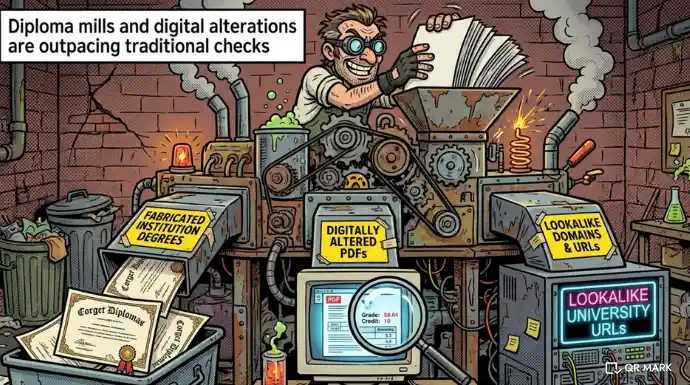
Credential fraud takes several forms. Some counterfeits are completely fabricated, i.e., certificates issued by non-existent institutions or diploma mills designed to look legitimate.
Others are more harmful: genuine degree certificates that have been digitally altered to show higher grades, different completion dates, or inflated credentials.
Lookalike institution names designed to confuse verifiers are another common tactic. And illegitimate institutions operating under false accreditation claims continue to pump out thousands of fake credentials annually.
For universities, the impact is twofold.
- First, reputational damage. When a fake degree linked to your institution’s name circulates in a hiring process, it erodes trust with employers.
- Second, operational overhead. Universities already dealing with limited administrative resources find themselves fielding verification requests from employers, background verification firms, and educational institutions.
The root cause is simple: manual, email-based verification does not scale, and it does not deter fraud. If a degree certificate comes in with no verification mechanism attached, it looks the same whether it is real or fake.
What Are the Current Methods Universities Use for Degree Verification?
Universities currently offer several degree verification methods to employers and third parties. Each has limitations that prevent them from fully addressing the fraud problem.
Request to Inspect Original by Mail
Some universities require verifiers to formally request an original degree certificate be mailed. This approach has obvious friction:
Turnaround: 7-14 days for domestic requests, often 3-4 weeks for international
Cost: Involves mailing fees, registry certification, and administrative overhead
Scalability: Impossible to handle high-volume verification during peak hiring seasons
Trust signal: Manual inspection, no standardization in what verifiers check
Check With the University Directly (Email-Based Manual)
A verification request is sent via email, and the response is provided manually by a human in the registrar’s office. Example: Harvard Business School offers email-based verification. This method is common but has significant limitations:
Turnaround: 3-5 business days if responsive; often longer during busy periods
Bottleneck: When hiring ramps up, admin teams get overwhelmed
No auditability: Difficult to log and track verification requests systematically
Geographic variability: International universities often take 2-3 weeks
Engage Third-Party Verification Agencies
Some universities contract with background verification firms or credential verification services who handle bulk verification requests. This removes the load from the university but introduces a middleman:
Cost: Employers pay the BGV firm, which adds expense
Trust signal: Relies on third-party reputation, not the university’s official domain
Scalability: Better than email, but still limited by the BGV firm’s capacity
University Web Service (Manual or Limited Automation)
A small percentage of universities offer web-based verification portals where verifiers create an account, submit information, and wait for a manual response.
Manual web portal examples:
IIT Kharagpur and Delhi University (India) require applicants to fill out online forms
Turnaround: 5-10 business days
Cost: Often requires bank drafts or processing fees
Scalability: Better than email, but still manual at backend
Automated web services (rare):
Some universities have started offering instant digital verification systems, but these are uncommon outside developed countries.
Most universities have no standardized, fast verification process. If a degree cannot be verified quickly, employers either skip the verification step entirely or accept whatever documentation is provided. Counterfeits slip through.
| Method | Turnaround | Cost to University | Scalability | Trust Signal |
| Request original by mail | 7-14 days | High (postage, staff time) | Poor | Manual inspection only |
| Email-based manual | 3-5 days | Medium (staff time) | Poor | Email confirmation only |
| Third-party BGV firm | 2-3 days | Medium (outsourcing fees) | Medium | Third-party reputation |
| University web portal | 5-10 days | Low-medium | Medium | Web form submission |
| QR Mark | Seconds | Very low | Excellent | Official domain |
What Steps Can Universities Take to Counter Degree Fraud?
Universities need a fundamentally different approach. Rather than asking employers to contact the university for verification, universities should make their degrees instantly verifiable directly from the certificate itself.
This requires two things: a stronger verification layer that is issuer-controlled and impossible to fake, and a verification process that takes seconds, not days.
Build an Official, Instant Verification Layer
Instead of leaving verification in the hands of manual processes or third parties, universities should own the verification mechanism. The degree verification should be tied directly to the university’s official domain, making it impossible for a counterfeiter to replicate.
When an employer verifies a degree, they should confirm two things:
(1) the verification link is on the university’s official domain, and
(2) the information displayed matches the credential being presented.
This is the difference between a degree certificate that just looks official and a degree certificate that proves it is official.
Speed Is the Second Lever
Degrees should be verifiable in seconds, not 5-10 business days. When verification is instant like with QR Codes, three things happen simultaneously:
- Fraud is caught before hiring delays occur
- Employers complete credential checks faster, speeding the entire hiring pipeline
- Students and graduates benefit from faster hiring cycles
Choose a Platform That Handles Scale
When evaluating a degree verification solution, universities should prioritize these capabilities:
Real-time verification for instant results
Not email-based, not manual. Verifiers should get an answer in seconds by scanning or clicking a link.
Secure data storage protecting student privacy
Universities cannot expose student PII in the university degree verification process. The platform should allow universities to show only the essential verification fields: student name, degree type, graduation year, honors classification if applicable.
Integration with existing student databases
Universities should not need to manually re-enter degree information. So to verify a degree the solution should be directly pulled from the university’s existing records.
Built-in reporting and analytics to spot fraud patterns
Universities should be able to log every verification request, see verification trends, and identify suspicious activity.
Branding customization so verification stays on the university’s domain.
Verification cannot happen on a third-party platform. It must happen on the university’s official domain (e.g., verify.university.edu).
Bulk issuance capability.
Universities issue hundreds of degrees at the end of each semester. The solution must handle end-of-term certificate batches efficiently.
Works on printed documents and digital PDFs.
Universities issue degrees on printed paper. The verification mechanism must work on printed copies and digital copies alike.
How QR Mark Helps Universities Make Degree Verification Instant and Reliable
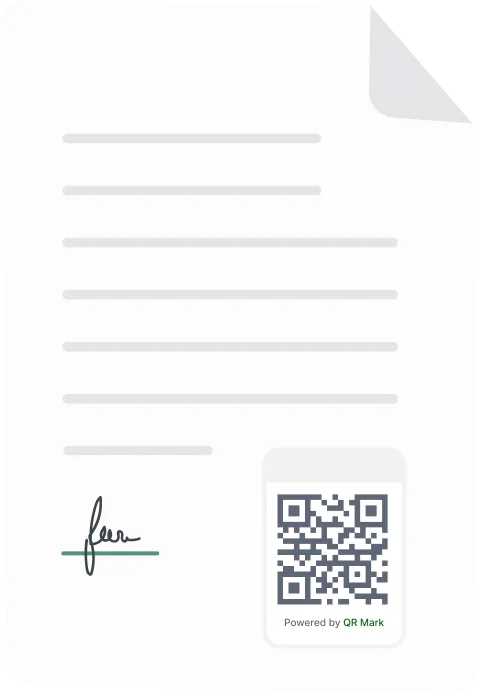
QR Mark solves the core problem by embedding a Verification Image directly on every degree certificate during verification. A Verification Image is a combined QR Code and verification URL. When an employer or recruiter scans it, they land on the university’s official verification page and can confirm the degree is legitimate in under 5 seconds.
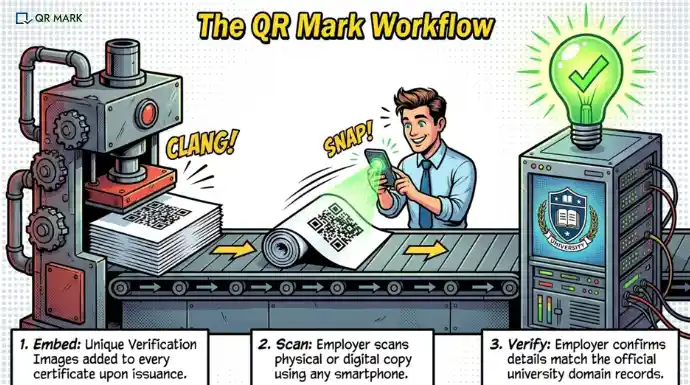
The Three-Step Loop: Embed, Scan, Verify
Step 1: Embed.
The university generates degrees using QR Mark’s Bulk Verification feature. When degrees are issued at the end of the semester, QR Mark adds a unique Verification Image to each certificate—one QR Code per student. This ensures every single degree carries the verification mechanism.
Step 2: Scan.
A recruiter or employer receives a candidate’s degree certificate. They scan the QR Code using any smartphone camera. No special app required. The QR Code directs them to the university’s official verification page.
Step 3: Verify.
The verification page displays the essential degree information: student name, degree type, graduation year, and institution name. The employer checks that these details match the degree certificate in front of them. If they match, the degree is confirmed as authentic. If they do not match, the degree is flagged as counterfeit or altered.
Key Features That Make This Work
Bulk Verification via Dashboard.
Universities can secure hundreds of degree certificates at once. Instead of processing degrees individually, registrars upload the degree batch, set the placement of the Verification Image once, and QR Mark generates unique verification images for each student. Distribute the degrees immediately. No waiting.
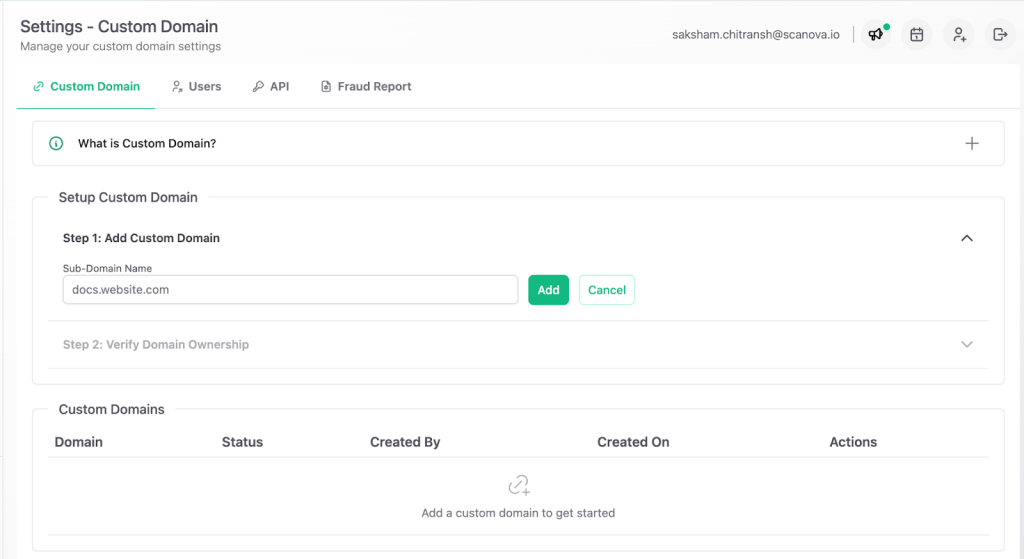
Custom Domain.
This is the trust anchor. The verification page is hosted on the university’s official domain—not a third-party platform. When an employer navigates to verify.university.edu, they know they are on the university’s official site. A counterfeiter cannot replicate this.
Template-Based Verification Pages.
Universities choose what information is visible on the verification page. For example, a university can display student name, degree type, graduation year, and honors classification, but intentionally exclude the original certificate link. This protects student privacy while still enabling full verification.
API Integration for Existing Systems.
Universities with existing digital credential systems or HRIS platforms can integrate QR Mark via API. Degrees are created, Verification Images are generated, and verification records are logged—all programmatically, with zero manual steps.
What Are the Secondary Benefits of Instant Verification?
Beyond instant verification, universities gain three critical secondary benefits:
Reduced fraud impact
Counterfeiters cannot replicate a QR Code without access to the university’s database. A copied QR Code embedded onto a fake degree is instantly caught because the details do not match. The verification mechanism becomes a fraud deterrent, not just a verification tool.
Faster hiring for employers and graduates
Employers complete credential verification in seconds rather than days. This speeds the entire hiring pipeline, which is especially valuable during peak recruitment seasons. Graduates benefit too—they spend less time waiting for their degrees to be verified by potential employers.
Compliance and auditability
Every verification request is logged. Universities can produce audit trails showing when degrees were issued and when they were verified. This supports accreditation requirements and provides defensible records in case of disputes.
Conclusion: From Manual to Instant
Universities are caught between two pressures. Fraud is becoming more sophisticated, but hiring timelines are becoming shorter. Employers cannot wait 5-10 days for degree verification. Candidates cannot wait that long either. And your registrar team is already stretched thin.
The answer is not to hire more administrative staff to respond to verification emails one by one. The answer is to shift the burden entirely. Build a verification layer that employers can use instantly and independently, without contacting your team at all.
That is what instant degree certificate verification does. It protects your institution’s reputation by making counterfeiting harder and fraud detection instant. It speeds hiring for employers and your graduates. And it removes the operational headache of fielding thousands of verification requests every year.
I have seen universities hold onto email-based verification because it feels safe and familiar. But familiar is also slow, and slow is what allows fraud to slip through. The future of degree verification is instant, automated, and issuer-controlled. Your degrees should prove themselves.
Frequently Asked Questions
How long does degree verification take with QR Mark?
Seconds. An employer scans the QR Code, the verification page loads, and they can confirm the degree is authentic immediately.
Can we use QR Mark on printed degrees as well as digital copies?
Yes. The Verification Image works on both printed paper and digital PDFs. A recruiter can scan a physical degree or click a verification link in a digital document.
What if a graduate loses their degree and requests a replacement?
Universities issue a new degree with a new Verification Image. The old verification record can be marked as archived. QR Mark logs track which verification image corresponds to which degree.
How do universities prevent duplicate or replacement degrees from being issued fraudulently?
Issuing permissions are controlled within QR Mark. Only authorized registrars can create new degrees or replacements. Access controls and audit logs ensure accountability.
Do employers need special software or apps to verify a degree?
No. A standard smartphone camera reads the QR Code. Any mobile browser opens the verification page. No special apps or software required.
Can we customize what information appears on the verification page?
Yes. Universities configure which fields appear: student name, degree type, graduation year, honors classification, etc. Universities can also choose to exclude the original certificate link, protecting privacy.
What if someone copies the QR Code?
A copied QR Code can be pasted onto a fake degree, but it is instantly caught. The verification page displays specific degree details. If those details do not match the document being presented, the QR Code is flagged as copied or mismatched. The verification mechanism is not foolproof, but it is a powerful deterrent.
What about privacy compliance like GDPR or local data protection laws?
QR Mark does not store student data. Verification records are logged on the university’s own custom domain. All data handling is controlled by the university, not a third party. This aligns with privacy regulations.
