

TL;DR
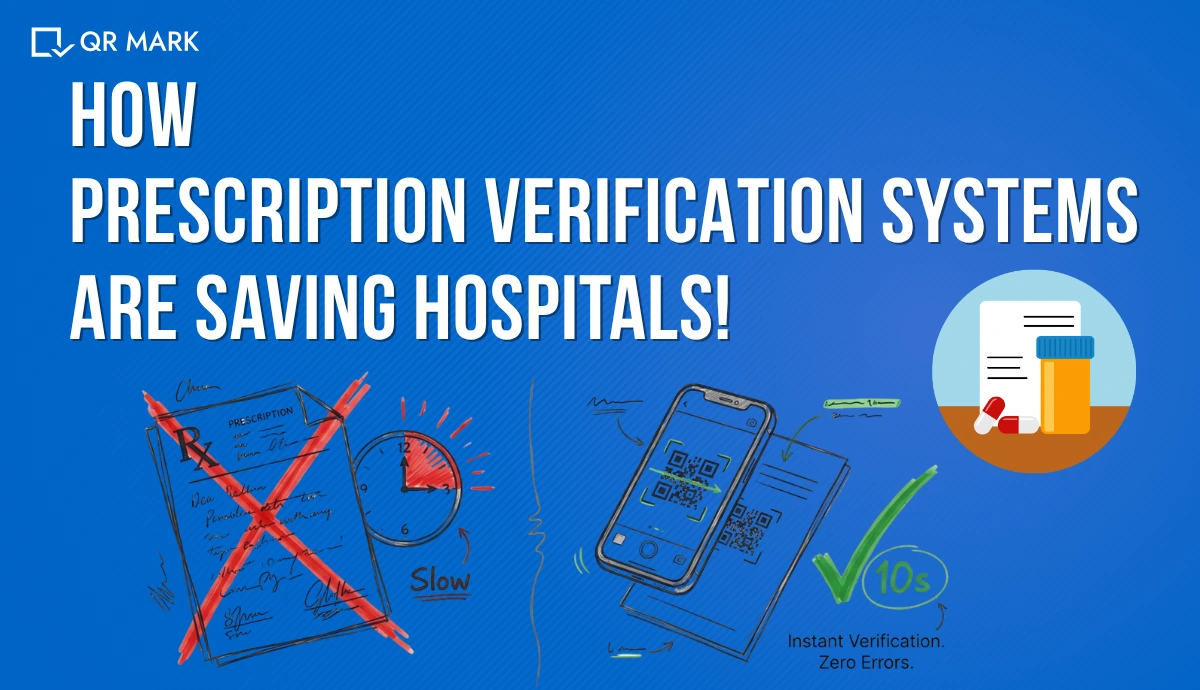
A prescription verification system is a digital method that confirms a prescription was genuinely issued by a licensed doctor and hasn’t been altered. Instead of relying on signatures and logos that anyone can forge, modern systems generate unique, tamper-resistant QR Codes for each prescription. Pharmacy staff and patients can scan these codes instantly to validate authenticity, preventing counterfeit prescriptions and reducing medication abuse across the board.
According to an article from National Library of Medicine, Large-scale prescription data-screening studies identified high volumes of prescriptions flagged as suspicious; one automated detection study found 77.6% of 47,827,160 prescriptions had records flagged as suspected of fraud using a risk-threshold method (this reflects algorithmic flags, not confirmed fraud cases).
The question isn’t whether you need a better way to verify prescriptions. The question is: why are we still using handwritten signatures and phone calls in 2026?
What is a Prescription Verification System?
A prescription verification system is a digital tool that confirms a prescription was genuinely issued by a licensed doctor and that its contents haven’t been modified. It works by generating a unique, cryptographically secure code for each prescription, usually in the form of a QR Code, that links to a verification record stored on a secure server.
When a pharmacy staff member or patient scans the QR Code on prescription, the system validates four critical things in seconds:
- Did a real, licensed doctor issue this? The system checks the doctor’s credentials against a registration database (like the NMC registry in India).
- Is the prescription still valid? It confirms the prescription hasn’t expired.
- Has anyone altered it? The system detects if the dosage, medicine, or patient details have been changed after issuance.
- Has it already been dispensed? It prevents the same prescription from being used multiple times.
That’s the core loop: Doctor issues → System generates unique code → Pharmacy scans → Server validates instantly.
No phone calls. No guessing. No signatures that might be forged.
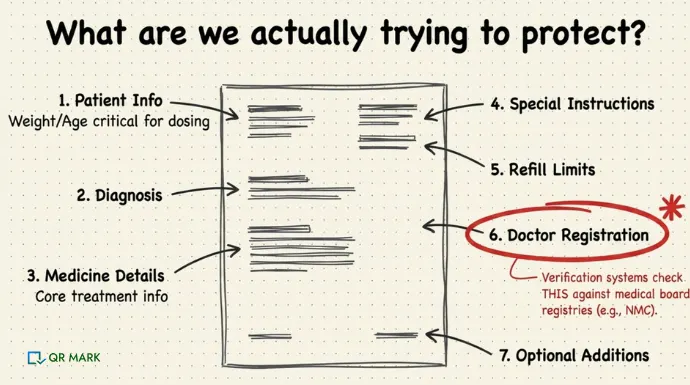
What Elements Belong in a Real Prescription?
Before we talk about how to verify a prescription, let’s be clear about what a legitimate prescription should contain. If a prescription is missing any of these core elements, that’s your first red flag.
1. Patient Information
Full name, age or date of birth, gender, and weight (especially critical for children, since drug doses scale with weight). The prescription should also show the date of consultation.
Example: Name: John Matthias; Age: 24 years; Date: 21 May 2026
2. Diagnosis or Chief Complaint
Not always mandatory, but essential for context. What is the doctor actually treating? Examples: Viral fever, hypertension, gastritis, allergic rhinitis.
3. Medicine Details
This is the core of the prescription. For each medicine, you need the medicine name, strength, dosage form, dose and frequency, route of administration, and duration.
4. Special Instructions
These prevent medication errors and dangerous combinations. Examples: Take after meals, avoid alcohol, complete the full antibiotic course, do not drive after taking, drink plenty of water.
5. Refills (if applicable)
For long-term medications, how many times can the prescription be refilled? Example: Repeat x2, no refills.
6. Doctor Information
A valid prescription must show: Doctor’s name, Qualification (MBBS, MD, etc.), Registration or license number (crucial, this is what verification systems check against), Clinic or hospital name, Contact details, and Signature and/or stamp.
7. Optional But Useful Additions
Known allergies (life-saving information), Follow-up date (when to return for review), Investigations or tests advised, Emergency instructions.
What Are the Types of Prescription Fraud?
Prescription fraud takes several forms. Understanding how it happens is the first step to stopping it.
Fully Forged Prescriptions from Scratch
Someone creates a prescription from nothing. They find a doctor’s letterhead online, use high-quality printing or copying equipment, fill in patient and medicine details, forge a signature, even glue the top edge of the prescription slip to make it look like it was ripped from a real pad.
The prescription looks authentic. The pharmacist sees a professional-looking document with a doctor’s name, clinic details, and what appears to be an official signature.
It was never actually issued by anyone with medical credentials. The equipment cost is no longer a barrier. High-quality color printing is cheap. Anyone with access to a printer can produce a convincing forgery.
Altering Legitimate Prescriptions
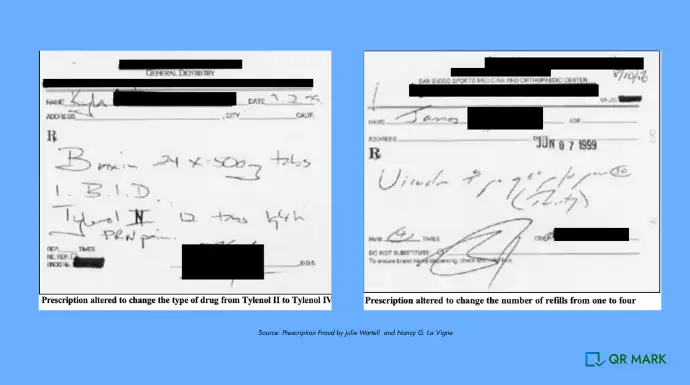
A real prescription for a painkiller or low-value drug becomes the template for fraud. The original patient legally received a prescription for Paracetamol 650 mg, 1 tablet daily for 5 days. A fraudster uses a scanner and photo editor to change it.
The quantity increases (1 tablet becomes 10 tablets per day). The medicine type changes (Paracetamol becomes Alprazolam, a controlled substance). The dosage gets bumped up dramatically.
The patient’s name gets swapped to someone else. The refill count increases from 0 to 3 or more. Or the same legitimate prescription gets photocopied and reused multiple times at different pharmacies.
All of this requires only access to a photocopy machine and basic photo editing software.
Doctor Shopping: Visiting Multiple Doctors to Build a Drug Supply
A person goes to Doctor A claiming severe migraine headaches and gets a prescription for Tramadol. Three days later, they visit Doctor B at a different clinic, claiming dental pain, and get another opioid prescription.
A week later, they hit an emergency room claiming acute back injury and get a third prescription. Each doctor sees a different patient ID number or name variation, so no red flags appear in any single system.
Common feigned complaints include migraines, toothaches, and psychiatric conditions. Some drug-seeking patients even deliberately injure themselves to justify emergency room visits where they can request pain medication. Others claim to be from out of town and say they forgot their regular medications, or claim to have lost drugs from a legitimate prescription.
Calling in False Prescriptions While Impersonating Doctor’s Office Staff
A fraudster calls a pharmacy claiming to be an employee of a doctor’s office. ‘Hi, this is Sarah from Dr. Smith’s clinic. I have a prescription for a patient. His name is…’
The call typically comes in the evening or on weekends when the doctor’s office is closed. If the pharmacist tries to verify by calling back, the fraudster has already provided their own phone number, answered Dr. Smith’s office, and confirmed the prescription is legitimate.
These fraudsters often have legitimate access to the doctor they’re impersonating, meaning they’re either current patients or employees of the clinic. They know the office procedures, speak the language of medical staff, and sound authoritative on the phone.
Pharmacists hear a professional voice, doctor’s office name, and plausible patient scenario and dispense without realizing they’ve been deceived.
Stealing Prescription Pads and Writing Prescriptions
Someone steals blank prescription forms directly from a doctor’s office. Doctors, clinics, and hospitals typically keep prescription pads in accessible areas, stacked near reception desks or in examination rooms.
Once a fraudster has the blank pads, they write prescriptions for either themselves or fictitious patients. They’ll often change the office phone number printed on the pad so that when pharmacists call to verify, they or an accomplice answer by posing as the clinic.
Copying QR Codes on prescription and Reusing Them on Different Documents
With digital prescriptions, someone scans a legitimate QR Code from a real prescription, copies it, and pastes it onto a completely fake prescription document. To the untrained eye, the document looks official and the QR Code on prescription looks authentic. If the verification system only checks, does the QR Code scan, without verifying that the details on the document match what’s in the system, the fraud goes undetected.
Multiple Uses of the Same Prescription Across Different Pharmacies
A prescription is legitimately filled at Pharmacy A. The patient receives their medication. But the prescription document is then used again at Pharmacy B the next day. Then at Pharmacy C across town. Each time, a different pharmacist sees what appears to be a legitimate prescription from a doctor.
Without a real-time database that flags if this prescription was already dispensed, each pharmacy has no way of knowing the same prescription is being used multiple times.
The Real Scale of This Problem
According to a 2024 analysis from the Journal of Pharmacy Practice, prescription fraud costs the Indian healthcare system approximately 8,000-10,000 crores annually through counterfeit medicines and abuse of legitimate prescriptions.
In the US, the DEA estimates that misused opioid prescriptions alone cost the system over 78 billion dollars per year in direct and indirect costs. This isn’t theoretical. These tactics are actively used every single day.
The reason this happens? Current verification methods don’t scale. Phone calls are slow. Signatures are easy to fake. There’s no real-time database checking. And there’s no permanent audit trail, so if something goes wrong, you can’t trace who dispensed what, when, or to whom.
This is exactly where a strong and reliable prescription verification system changes the game.
How Do You Set Up a Prescription Verification System? (the right way)
Let’s walk through how a modern prescription verification system actually works, from the doctor’s side to the pharmacy’s side.
Step 1: Doctor Creates and Issues the Prescription
The doctor sees a patient, diagnoses them, and creates a prescription. This can happen in a simple text or PDF form they draft themselves, in a hospital’s electronic health record (EHR) system, in a clinic management software, or in dedicated prescription software like DRiefcase or similar apps.
Step 2: System Generates a Unique ID
This is where the verification system kicks in. As soon as the prescription is created, the system assigns a unique prescription ID (never repeating).
Step 3: A QR Code is Generated and Attached
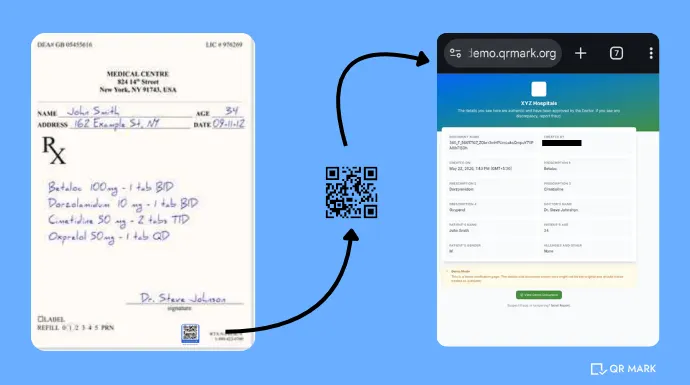
The system creates a QR Code on prescription that encodes the unique prescription ID, the verification server URL (ideally the clinic’s or hospital’s own domain, not a third-party URL), and a secure token that expires after a set time.
Tools like QR MARK work best here. Instead of embedding the prescription data inside the QR Code itself (which anyone can copy and fake), the QR Code simply points to our verification record on a custom domain. A pharmacy scans it and gets routed to a verification page showing only the fields the doctor wants visible, patient name, medicines, dosage, doctor credentials, without exposing the full prescription or sensitive data.
Step 4: Prescription is Shared
The doctor shares the prescription with the patient however they normally would, email, printed copy, digital link, WhatsApp, or directly to the pharmacy’s system.
Step 5: Pharmacy Scans the QR Code
The pharmacist receives the prescription. Instead of making a phone call or scrutinizing a signature, they simply scan the QR Code on prescription with their phone’s camera.
Step 6: Server Validates Instantly
Is the prescription still valid by checking the expiry date? Has it been tampered with by comparing the cryptographic hash, if even one character of the prescription changed, the hash won’t match? Has it been used already by checking a usage counter to prevent the same prescription from being dispensed multiple times?
With a tool like QR Mark, you can set-up expiry control so that anyone scanning the QR Code can instantly know the prescription isn’t valid.
Step 7: Verified or Rejected
Within seconds, the pharmacy sees either “Verified – Safe to dispense” or “Verification failed – Call the clinic.” If it’s verified, the pharmacy can dispense with confidence. If it fails, they know to contact the doctor or reject the prescription entirely.
This entire process, from scan to verification result, takes less than 10 seconds.
Common Mistakes When Building a Verification System
We’ve worked with clinics and pharmacies of all sizes, and we’ve seen the same mistakes repeated. Here are the pitfalls to avoid when setting up verification.
Mistake 1: Using Static QR Codes
This is the most common error. A system generates a QR Code, embeds the entire prescription data inside it, and calls it secure. It’s not. Anyone can copy the static QR Code, reuse it for a different patient, screenshot it, print duplicates, or share it online.
A better approach: Use dynamic QR Code on prescription that point to a verification server, not the data itself. The QR Code is just a pointer. The actual security lives on the server.
Mistake 2: Ignoring Pharmacy Workflow Reality
This is where beautiful systems fail in the real world. If verification takes too many clicks, a required app download, slow servers, repeated logins, or manual entry of prescription details, pharmacists stop using it. They’ll go back to phone calls because that’s faster.
The golden rule: Verification should take under 10 seconds, require zero typing, and work mobile-first. Fast trust wins. Always.
Mistake 3: Exposing Patient Data Publicly
A huge compliance risk. Bad systems expose diagnosis information, phone numbers, medication history, home addresses, and insurance details through a publicly scannable QR Code link.
Better approach: Show only what’s necessary for verification, doctor identity, patient name, medicines, dosage, doctor credentials. Require authentication to see anything beyond that. At QR Mark, we use template-based verification pages that let clinics choose exactly what information is visible to a scanner.
Mistake 4: No Expiry or Reuse Control
A prescription shouldn’t live forever. Without expiry logic, old prescriptions get reused years later, controlled substances can be abused repeatedly, and duplicates go completely undetected.
Include validity windows (typically 3-6 months for most prescriptions, shorter for controlled drugs), usage counters (track how many times a prescription has been dispensed), refill tracking (distinguish between the original and authorized refills), and “already dispensed” status (block double-dispensing). This is especially critical for narcotics, psychiatric medications, and antibiotics where misuse creates serious harm.
Mistake 5: Treating PDFs as Security
Watermarks don’t stop fraud. Neither do logos, fancy templates, or locked PDFs. People can recreate layouts in software, forge signatures and watermarks, edit screenshots, and scan and edit PDFs.
Security must be cryptographic and server-verifiable. The PDF itself is just a container. The actual security lives in the code running on the backend.
Mistake 6: No Audit Logs
If something goes wrong, you need a complete trail of who did what, when, and from where. Track who issued the prescription, who viewed it, who verified it, when it was accessed, IP addresses and device information, and any modifications.
Without logs, fraud investigations become impossible and compliance becomes risky. You have no defense if something goes sideways.
Mistake 7: Ignoring Regulatory Compliance Early
Healthcare systems become compliance-heavy very fast. Mistakes here destroy adoption later. In India, consider early ABDM/NDHM compatibility, IT Act requirements, data localization rules, and DISHA standards. In the US: HIPAA, state pharmacy regulations, DEA rules for controlled substances. In EU: GDPR.
Don’t bolt on compliance later. Build it in from day one.
Mistake 8: Not Planning for Scale
Verification systems often start small in a single clinic. Then suddenly they need to handle millions of scans per day, integration with hospital EHR systems, concurrent traffic from hundreds of pharmacies, and real-time database queries.
What Actually Makes a Prescription Verification System Work?
We’ve talked about the mistakes. Now let’s talk about what success looks like.
Speed that Doesn’t Sacrifice Security
A pharmacist should be able to verify a prescription in under 10 seconds. If it takes longer, they’ll abandon it. The best solution to go for in this case is to choose QR Code based document verification tools (like QR Mark.)
Patient Confidentiality Protected
A verification page doesn’t need to show the full prescription. Template-based pages show only what’s necessary: Is this the right patient? Is this the right medicine and dosage? Is it from a real doctor? Is it still valid? That’s enough for a pharmacist to make a dispensing decision. The detailed diagnosis, comorbidities, and other sensitive data stay private.
Doctor Verification Linked to License Databases
Every prescription is checked against the actual medical board registry. A fake doctor can’t pass this check. A suspended practitioner can’t pass this check. This is non-negotiable.
Audit Trails for Compliance and Investigation
Every scan, every verification, every access is logged. If there’s an issue later, you have proof of what happened and when. This is especially important for controlled substances where regulatory scrutiny is high.
Compliance-First Design
ABDM compatibility in India, HIPAA compliance in the US, GDPR compliance in Europe. Not bolted on. Built in from the start.
Human Behavior Matched to Workflow
The system gets out of the way. It doesn’t create extra work. It doesn’t require training. It doesn’t slow down the pharmacy. It reduces friction, not increases it.
The Bottom Line
Prescription fraud is a 78 billion dollar problem globally. Verification is happening, but it’s manual, slow, and ineffective. Digital verification systems that check doctor credentials, detect tampering, and prevent reuse are the future of safe prescribing.
The mistakes we’ve outlined, static QR Codes, ignoring pharmacy workflow, exposing patient data, no audit logs, are the reason many verification attempts fail. The systems that work are the ones built around human behavior, pharmacy reality, and compliance from day one.
If you’re a clinic or pharmacy manager, you have a choice: keep doing 15-minute verification calls, or switch to 10-second scans. Keep risking counterfeit prescriptions, or verify every one in real-time. Keep guessing whether a prescription is real, or have proof.
At QR Mark, we’ve built this specifically for you. Verification Image generates a unique QR for each prescription. Pharmacies scan it. Our servers validate the doctor, check for tampering, and flag duplicates. The entire process takes under 10 seconds and requires zero training.
FAQ: The Questions We Hear Most
Do patients need an app to verify a prescription?
No. Patients and pharmacists use their existing phone camera to scan the QR Code. No app, no download, no login. They’re routed directly to the verification page in the browser.
What if a pharmacist copies the QR Code and uses it on a fake prescription?
If the QR Code is from a real prescription, the pharmacist can scan it. But when they do, they’ll see the original patient’s name, the original dosage, the original date. If those don’t match the fake document in their hand, the fraud is obvious. That’s why verification systems require field matching. A copied QR fails instantly because the details don’t line up.
What happens to the prescription after it’s verified?
That depends on the system. At QR Mark, clinics can set expiry dates (typically 3-6 months, shorter for controlled drugs). They can also set refill counts. A prescription might be valid for one dispensing or up to three refills, depending on what the doctor specifies. Once the expiry passes or refills are exhausted, the verification system blocks further use.
Is this compliant with ABDM in India?
We’re building toward full ABDM compatibility. At minimum, our system aligns with the principles of ABDM, decentralized storage, patient control over data, doctor authentication. We’re working with compliance experts to ensure full integration as ABDM standards solidify.
What if a doctor’s license is suspended or revoked?
Our system checks the NMC registry in real-time. If a doctor’s license is suspended or revoked after they issued a prescription, new prescriptions from that doctor will fail verification. Existing prescriptions issued before the suspension remain valid (unless the clinic decides to retroactively invalidate them), but they’ll be flagged as issued by a now-inactive doctor.
How do patients access their own prescription records?
The clinic controls this. Some clinics allow patients to log in and see their verified prescriptions. Others restrict access to pharmacies only. Templates can be customized to show patients only what the clinic wants them to see. Privacy is controlled entirely by the clinic.
What if the internet goes down at a pharmacy?
Our system provides offline verification tokens. Pharmacists can pre-download tokens for recent prescriptions. If the internet fails, they can manually verify using the token. It’s not as fast as a real-time lookup, but it’s far better than having no verification at all.
Can this work for international prescriptions?
With limitations. Our current system checks against medical registries in India (NMC), the US (state medical boards), and is expanding to other countries. If you’re dispensing a prescription issued in another country, the doctor verification step may be manual rather than automated. But the QR scanning, tampering detection, and usage tracking still work.
