

TL;DR
Marksheet verification is the process of confirming a marksheet is genuine and issued by the institution named on it. Most schools and colleges still rely on holograms, seals, or manual email checks, all of which forgers copy easily. This article explains how marksheets are verified today, where each method breaks down, and why a QR Code linked to your own verification page is the fastest way to make every marksheet you issue checkable in seconds.
A registrar at a mid-sized college gets the same email a few times a week. An employer or a background-screening firm has a marksheet in hand and wants one thing confirmed: did you actually issue this, and are the marks on it real? Someone on the records team digs through old files, matches a roll number, and writes back. It takes a day, sometimes longer.
Now multiply that by a graduating batch of two thousand, plus alumni from a decade ago, and you have a verification queue that never empties.
The cost is bigger than a slow inbox. In 2021, a special investigation team found that Manav Bharti University in Himachal Pradesh had issued around 41,000 degrees, of which only about 5,000 were genuine and roughly 36,000 were fake, as reported by The Tribune. When fake credentials circulate at that scale, every honest institution pays for it in lost trust.
What Is Marksheet Verification?
It is the process of confirming that a marksheet is authentic, unaltered, and issued by the institution named on it.
For example, when a graduate applies for a job, the employer checks that the student name, roll number, and marks on the document match the institution’s official records before trusting it.
How Does Marksheet Fraud Impact Your School or College?
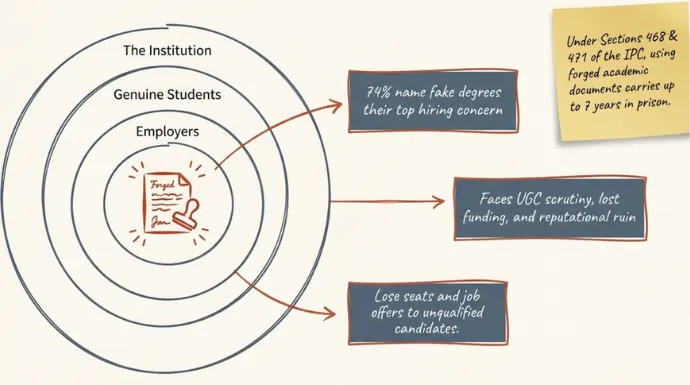
Loss of Reputation and Trust
The value of any marksheet or degree depends on trust. If forged or altered academic records become associated with your institution, students, employers, and regulators may begin questioning the credibility of all credentials you issue.
This is not a theoretical risk. In 2026, the UGC identified 32 fake universities operating across India, warning that their degrees were invalid for employment and higher education. Cases like these erode public confidence in the education system as a whole.
Risk to Accreditation and Funding
Educational institutions are expected to maintain proper controls over academic records and admissions. If an institution repeatedly fails to detect fraudulent credentials or is found negligent in addressing academic fraud, it may face regulatory scrutiny, accreditation reviews, or restrictions from governing bodies.
Regulators take these issues seriously because academic credentials directly affect admissions, professional licensing, and employment decisions.
Genuine Students Lose Opportunities
Every seat secured using a fake marksheet is a seat unavailable to a deserving candidate. Whether the competition is for admissions, scholarships, or limited academic programs, credential fraud undermines merit-based selection and disadvantages students who have earned their qualifications honestly.
The impact extends beyond admissions. Fraudulent credentials can also affect internships, placements, and postgraduate opportunities that were intended for qualified candidates.
Legal and Police Investigations
Accepting fraudulent educational documents can trigger investigations involving educational boards, universities, and law enforcement agencies.
Research conducted by the London School of Professional Management (LSPM) in the UK in 2022 estimated that organizations lose an average of $50,000 per employee hired with a fake degree
Under Indian law, forging or using fake educational documents can result in criminal charges, police investigations, and legal proceedings. Institutions may also be required to cooperate with inquiries and provide records related to admissions or verification processes.
Wasted Administrative Time and Resources
Every suspected case of marksheet fraud requires time and money to investigate. Staff may need to verify records, communicate with issuing institutions, respond to complaints, cooperate with law enforcement, and review admission decisions.
Resources spent handling fraud are resources that cannot be invested in improving academics, student services, faculty development, or institutional growth.
Reduced Confidence Among Employers
Employers rely on educational institutions to issue trustworthy credentials. As concerns around credential fraud increase, organizations are investing more heavily in verification.
What Are the Ways Marksheets Are Verified Today?
1. Digital Record Repositories
Digital record repositories store academic credentials directly from issuing institutions, allowing authorized parties to access verified records from the source rather than relying on copies provided by students.
In India, the most prominent examples are the National Academic Depository (NAD) and DigiLocker. Universities and boards upload academic records to these platforms, where students can access and share them with employers or educational institutions.
In the United States, the National Student Clearinghouse serves a similar role. It maintains enrollment and degree records from thousands of colleges and universities, enabling employers and institutions to verify academic credentials directly.
Across Europe, countries increasingly use national education databases and the Europass framework, which supports the issuance and verification of digital educational credentials across borders.
2. Institutional Verification Portals
Many educational institutions and examination boards provide dedicated online portals where a verifier can confirm the authenticity of a marksheet or transcript.
Examples include the Central Board of Secondary Education document verification services, various state board verification portals, and university-specific systems offered by institutions such as University of Mumbai and Delhi University.
In the United States, universities often provide transcript verification through registrar offices or platforms integrated with the National Student Clearinghouse. In Europe, many universities offer graduate verification services through institutional portals, often connected to national education databases.
The verifier typically enters details such as a certificate number, roll number, registration number, or graduate ID. The system then confirms whether the record matches the institution’s database.
3. Direct Verification with the Issuing Institution
Direct verification remains one of the most trusted methods, especially for older records that may not exist in digital systems.
In this process, an employer, university, or verification agency contacts the issuing school, college, university, or examination board directly. The institution checks its records and confirms whether the marksheet was issued, whether the candidate attended, and whether the grades or qualification details are accurate.
While highly reliable, this method can take days or even weeks, particularly when records must be retrieved manually.
4. QR Code-Based Verification
Many educational institutions now place QR Codes on marksheets, transcripts, certificates, and degree documents.
When scanned, the QR Code directs the verifier to an official verification page or digital record maintained by the issuing institution. The verifier can compare the information displayed online with the information printed on the document. Tools like QR Mark, Qryptal and Proofeasy are the enablers of QR Code based marksheet verification.
The main advantage is that verification can often be completed within seconds without contacting the institution directly.
5. Background Verification Firms
Organizations frequently outsource academic verification to specialist screening providers that verify credentials on their behalf.
Examples include First Advantage, HireRight, Sterling, Accurate Background, and Kroll.
These firms typically combine multiple verification methods, including direct institution contact, database checks, repository access, and document reviews. The result is a verification report that employers can use during hiring or compliance processes.
6. Physical Security Checks
Before digital verification became widespread, institutions relied heavily on physical security features to make documents difficult to reproduce. These features are still used today and remain an important first line of defense against counterfeit documents.
Watermarks are patterns embedded into the paper during manufacturing. They are visible when the document is held against light and are difficult to replicate accurately using standard printers or scanners.
Security paper textures use specialized paper that feels different from ordinary office paper. The texture, weight, and composition help distinguish genuine documents from simple photocopies or home-printed versions.
Reactive inks change appearance when exposed to ultraviolet light, heat, or other conditions. Institutions use these inks to create marks, logos, or seals that are difficult to duplicate with conventional printing methods.
Embossed seals and raised stamps create a physical impression on the paper that can be felt by touch. These features are intended to show that the document originated from an authorized issuer.
How Can Schools and Colleges Choose the Right Way to Verify Marksheets?
Pick the method that meets four tests at once: it should be hard to copy, easy for anyone to verify without special tools, able to fit your current way of issuing documents, and affordable to run at your volume. A method that wins on one test but fails the others will not survive a real graduating batch.
Tamper-resistant: a forger should not be able to recreate it with a printer and a scanner.
Easy to verify: the person checking should not need an app, a login, or a phone call.
Fits your workflow: it should work with how you already produce marksheets, whether that is Word, Google Docs, or bulk PDFs.
Cost-effective: the price should hold up when you are issuing thousands of documents a year, not three.
Here is how the five methods compare against those tests:
| Method | Hard to copy? | Easy for verifier? | Fits your issuing workflow? | Cost at scale |
|---|---|---|---|---|
| QR Code linked to your own domain | High | High (any phone camera) | High (Word, Docs, bulk PDF, API) | Low |
| Hologram | Low (photographed, reprinted) | Low (needs a trained eye) | Low (special printing) | High |
| Embossed seal / signature | Low (scanned and copied) | Low (subjective) | Low (manual) | Medium |
| Digital platform (DigiLocker / NAD) | High | Medium (needs portal access and consent) | Medium (depends on board integration) | Low to medium |
| Third-party screener | Medium | Low (paid per check, takes days) | Verifier-side only | High (per-check fees) |
Why are QR Codes the best possible way to ?
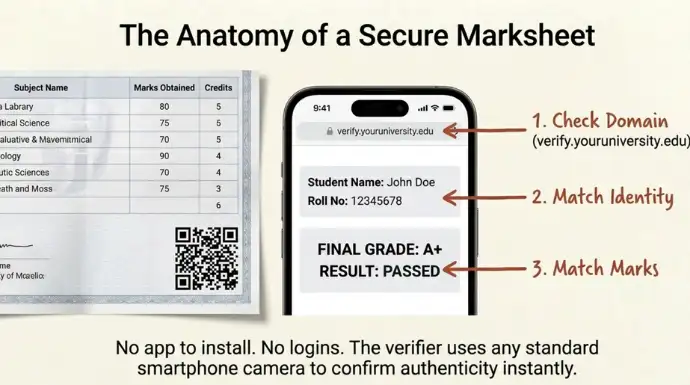
A QR Code solves the problem when it points to a verification page hosted on the institution’s own web domain, not just any URL. The verifier scans with a normal phone camera, lands on your page, and matches the student name, roll number, and marks against the document in front of them. No app, no login, no phone call.
This is the part QR Mark was built for. We add a Verification Image (a QR Code combined with a verification link) to each marksheet. When someone scans it, they land on a page that confirms the document is genuine and shows the fields you chose to display.
The copied-QR flaw is where the Custom Domain feature matters. Anyone can copy a QR image, but they cannot make it resolve on your domain, say verify.youruniversity.edu. So the verifier’s check becomes two simple things: is this the institution’s real domain, and do the details on the page match the document? A copied QR pasted onto a fake marksheet fails both.
Step 1: Prepare the Marksheet
Create the marksheet as you normally would in:
- Microsoft Word
- Google Docs
- PDF format
- Student management system
QR Mark works alongside your existing document process, so you don’t need to redesign your marksheet workflow.
Step 2: Create a Verification Record
Choose the workflow that best fits your institution:
Option A: Single Upload
Best for a few marksheets.
- Log in to QR Mark.
- Upload the marksheet PDF.
- Create a verification record.
- QR Mark generates a unique verification image (QR Code + verification URL).
Option B: Bulk Upload
Best for issuing hundreds or thousands of marksheets.
- Upload multiple marksheets.
- Select where the QR should appear.
- QR Mark automatically generates a unique verification image for each student document.
- Download all verified marksheets in bulk.
Option C: Add-in Workflow
For institutions creating marksheets in Microsoft 365 or Google Workspace.
- Open the document.
- Use the QR Mark add-in.
- Generate and insert the verification image directly from the document editor.
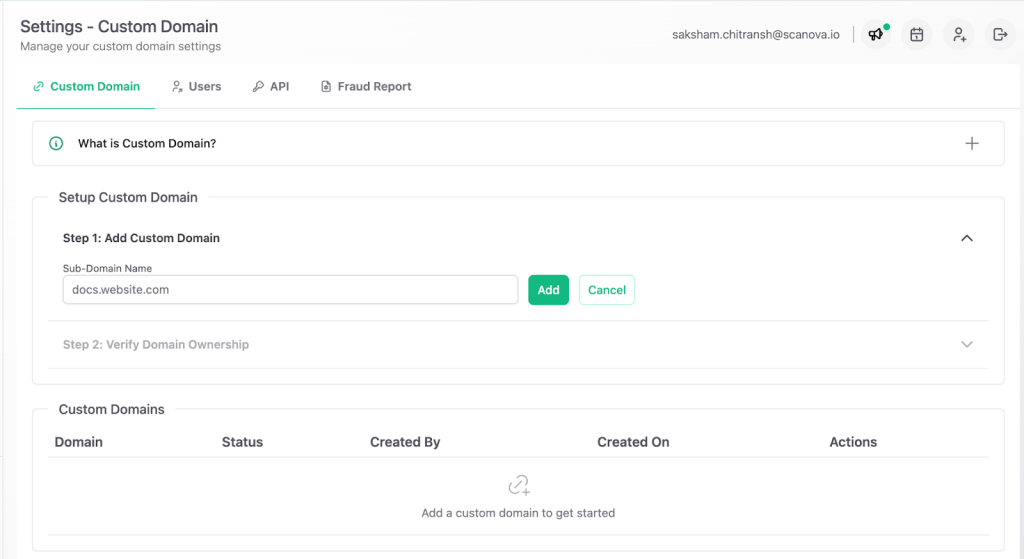
Step 3: Set-Up Using Your Institution’s Domain
QR Mark requires institutions to use their own custom verification domain for production use.
Example:
- verify.college.edu
- certificates.university.edu
This is important because the domain itself becomes a trust signal.
A verifier should always check that the verification page is hosted on the institution’s official domain.
Step 4: Configure What Verifiers Will See
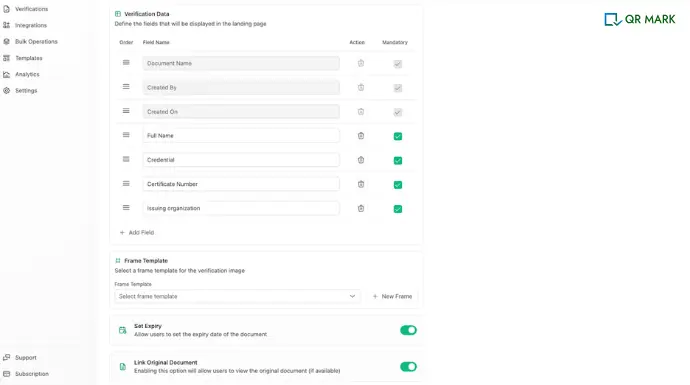
For marksheets, a Template-Based Verification Page is usually recommended because it allows verification without exposing the full document.
Example fields:
| Field | Displayed on Verification Page |
|---|---|
| Student Name | ✓ |
| Roll Number | ✓ |
| Registration Number | ✓ |
| Course Name | ✓ |
| Semester/Year | ✓ |
| Marks/Grade | ✓ |
| Institution Name | ✓ |
| Result Status | ✓ |
This allows a verifier to compare the marksheet they received with the official information stored by the institution.
Step 5: Add the QR Mark Verification Image
Place the generated QR Mark image on the marksheet.
Common locations:
- Bottom-right corner
- Footer section
- Near the registrar’s signature
- Verification section
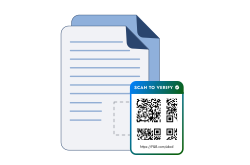
The QR image contains:
- QR Code
- Verification URL
Both lead to the same verification page.
Step 6: Issue the Marksheet
After the QR Mark image is embedded:
- Send the PDF to students.
- Print physical copies if needed.
- Share through email or student portals.
The marksheet is now verifiable.
Two practical points for institutions. First, you do not have to expose the whole marksheet. A template-based verification page shows only the fields you pick, such as name, roll number, and result, which keeps student data private while still proving the document is real. Second, the batch case is what makes this workable.
Siddharth Pangtey, who manages the product, says: “A registrar is not going to add a QR to two thousand marksheets one at a time. Bulk Verification means they place it once and the whole cohort is done.”
The outcome is concrete. A check that used to take a day, or get skipped entirely, drops to a few seconds for the verifier and near-zero ongoing effort for your records team.
So What’s the Simplest Way to Make Your Marksheets Verifiable?
Choose the method that is hard to copy, easy to check, fits how you already issue documents, and stays affordable at scale. A QR Code tied to your own domain is the only option on the list that passes all four tests at once.
Worth being honest about the limits. No method makes forgery impossible. A QR Code linked to your domain works because it shifts the check to something a forger cannot fake, your domain, and gives the verifier two clear things to confirm. It is a strong deterrent, not magic, and it only works when verifiers know to scan and match. The institutions that get value from it are the ones that make verification the standard on every document they issue.
FAQs
How can I do online verification of a marksheet?
Online verification of a marksheet usually means one of two things: scanning a QR code on the document that opens an issuer-hosted verification page, or looking the record up on a digital platform such as DigiLocker, NAD, or a state board portal. The QR route is faster for the verifier because it needs only a phone camera, no login or consent step.
Is highschool marksheet verification different from college verification?
The principle is the same, but the source differs. Highschool marksheet verification points to a school board (for example a state board or CBSE) rather than a university, and many boards now offer their own online portals or DigiLocker records. If the marksheet carries a QR code linked to the board’s domain, scanning and matching the fields is the quickest check.
How do I verify a marksheet from a specific university, like William Carey University?
Start with the issuing institution’s own channels. For any named university, including a William Carey University marksheet verification request, check the university’s official verification portal or contact its records or examination office, and confirm the institution’s recognition status on the UGC website. If the marksheet has a QR code, make sure it resolves on the university’s own domain before trusting the page it opens.
Can a QR code on a marksheet be faked?
A QR image can be copied, but a useful QR code is harder to fake than a hologram or seal. When the code resolves to a verification page on the institution’s own domain, a forger cannot recreate that page on your domain. The verifier confirms the document by checking the domain and matching the displayed fields, so a copied QR on a fake marksheet does not pass.
Does the person verifying need to install an app?
No. With a QR code linked to a verification page, the verifier scans with the standard camera on any smartphone and opens the page in a browser. There is no app to download and no account to create, which is what makes this practical for employers and screening firms checking many documents.
