

TL;DR
Sworn and certified translations are often confused, but they carry different legal weight. A sworn translation is produced by a translator officially accredited by a court or government body. A certified translation includes a signed statement from the translator attesting to accuracy. Which one you need depends on the country, the document type, and the institution receiving it. This guide explains both, when each applies, and why verifying the authenticity of any translated document matters just as much as the translation itself.
When it comes to official documents, using the wrong type of translation can lead to rejected applications, legal delays, or unnecessary costs. Yet many people don’t understand the difference between sworn translation vs certified translation, often assuming the two terms mean the same thing. They don’t.
The type of translation certificate you need depends on where your document is being submitted, who is requesting it, and the legal requirements of that country. In some jurisdictions, only a government-authorized translator can produce a legally valid translation. In others, a signed certification from a professional translator is enough.
In this guide, we’ll break down the key differences between sworn translation vs certified translation, explain when each is required, and show why verifying the authenticity of translated documents has become just as important as the translation itself in today’s digital world.
What is a sworn translation?
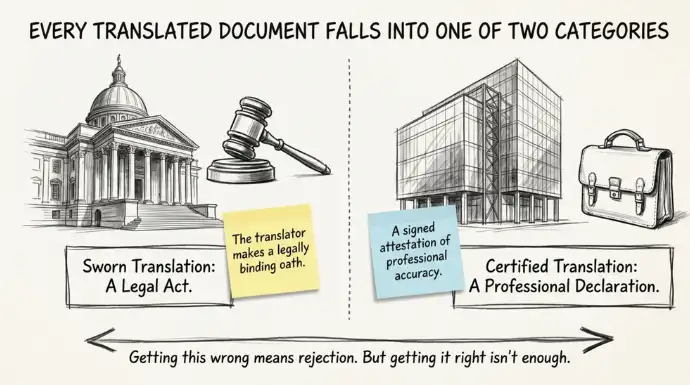
A sworn translation is produced by a translator officially appointed by a court or government body, who swears a legal oath that the translation is accurate and complete.
Think of it as a legal act, not just a professional service. When a sworn translator signs off on a document, they are making a formal declaration that carries genuine legal weight. If the translation turns out to be inaccurate, the translator faces legal liability, not just a bad review.
Who can issue one
Only translators registered or accredited with the relevant authority in their jurisdiction. Each country names this differently:
- Germany: beeidigter Übersetzer, registered with a regional court
- France: traducteur assermenté, sworn in before a court of appeal
- Spain: traductor jurado, officially appointed by the Ministry of Foreign Affairs
- Poland, Italy, Portugal, and most civil law countries maintain equivalent official registers
When you need one
- Court proceedings and legal filings in civil law jurisdictions
- Immigration applications in Germany, France, Spain, and most EU member states
- Official government submissions that require notarial acts
- Cross-border legal documents where jurisdictional authority needs to be established
What it looks like
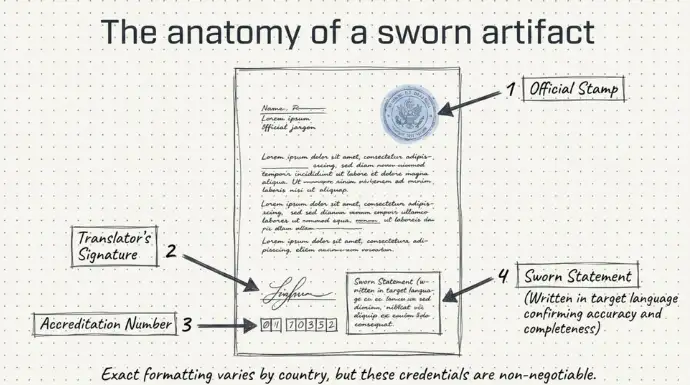
A sworn translation typically carries the translator’s official stamp, signature, accreditation number, and a sworn statement written in the target language confirming accuracy and completeness. The exact format varies by country, but the official credentials are always there.
The key limitation
Sworn translations are jurisdiction-specific. A sworn translation from a French court-accredited translator may not hold the same legal weight in Germany or Spain. Always confirm with the receiving institution whether the issuing authority is recognised in their country before you commission the translation.
What is a certified translation?
A certified translation is a professionally produced translation accompanied by a signed statement from the translator or agency confirming that the content is accurate and complete.
This is a professional declaration, not a sworn oath. The translator is not making a legally binding commitment in the formal legal sense. They are taking professional responsibility for the accuracy of their work. Most institutions in common law countries accept this without question, though it does not carry the same legal weight as a sworn translation in jurisdictions that require one.
Who can issue one
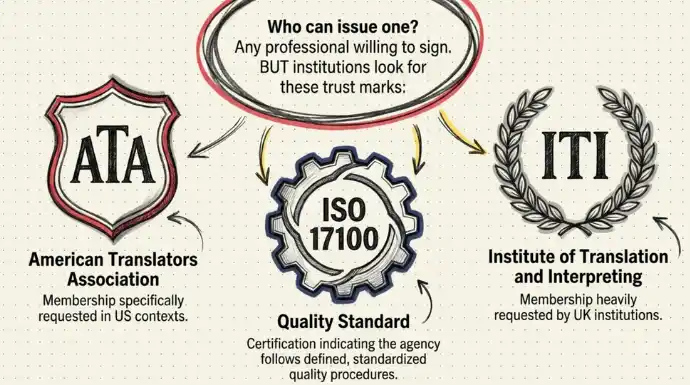
Any professional translator or agency willing to sign the certification statement. There is no universal accreditation requirement, though many institutions specify:
- ATA (American Translators Association) membership, particularly in US contexts
- ISO 17100 certification, which indicates the agency follows a defined quality standard
- ITI (Institute of Translation and Interpreting) membership, requested by some UK institutions
When it is accepted
- USCIS immigration applications in the United States
- Academic credential submissions to universities and admissions bodies
- Corporate HR onboarding for internationally hired employees
- Regulatory filings in most common law countries
What it looks like
A certified translation includes the translated document alongside a signed cover letter or certification stamp from the translator or agency. The letter names the translator, the language pair, and their attestation of accuracy.
Key features of certified translations
Here is what a certified translation actually guarantees when it comes from a qualified agency:
| Feature | What It Means |
| Accuracy Verification | Professional translators validate the precise rendering of the source text |
| Quality Assurance | Standardised procedures ensure consistent translation quality across documents |
| Professional Accountability | Translators take professional responsibility for the accuracy of their work |
| Document Integrity | Original formatting and content structure remain intact through translation |
| Universal Recognition | Widely accepted across English-speaking and common law countries |
One of the organisations we work with on this directly is THB Human Translation, a professional translation agency based in Bangladesh that handles certified translations for clients across South and Southeast Asia.
The key limitation
“Certified” is not a legally protected term in most countries. Any translator can call their work certified. Standards vary significantly between agencies, so the quality and legal standing of a certified translation depends heavily on who produced it and for which institution.
Sworn Translation vs Certified Translation: What is the actual difference?
Here is the full comparison across every factor that matters when you are deciding which one you need.
| Factor | Sworn Translation | Certified Translation |
| Issued by | Court-appointed or government-accredited translator only | Any professional translator or agency |
| Legal backing | Sworn oath — carries force of an official legal declaration | Signed professional statement of accuracy |
| Authorization | Translator takes an official oath before a court or legal authority | Professional qualifications required; no formal court appointment |
| Documentation | Official stamp/seal, unique registration number, legal declaration, court-authorized credentials | Statement of accuracy, professional credentials, agency stamp if applicable |
| Liability | Legal accountability for translation accuracy | Professional responsibility without legal implications |
| Jurisdictions | Civil law countries: Germany, France, Spain, Italy, Poland | Common law countries: US, UK, India, Canada, Australia |
| Typical use cases | Court filings, EU immigration, notarial acts, government submissions | USCIS applications, academic credentials, HR onboarding, corporate documents |
| Geographic recognition | Jurisdiction-specific; often not portable across borders | Broader acceptance across English-speaking and common law countries |
| Cost | Higher — accredited translator and legal process required | Lower to moderate |
| Turnaround | Slower | Faster |
Neither term is globally standardised. A document called “certified” in one country can be the functional equivalent of “sworn” in another. Before you commission any translation for official use, check directly with the receiving institution which type they require and whether the issuing translator’s credentials are recognised in their jurisdiction.
How do you choose between sworn and certified translation?
Choosing the right translation type is not about which sounds more official. It is about what the receiving institution will actually accept. Getting this wrong means rejections, resubmissions, and in legal contexts, missed deadlines with real consequences.
What type of translation does your document need?
Start here. Match your document type to the right translation:
- Legal proceedings or court submissions: sworn translation
- Government agencies in civil law countries: sworn translation
- Academic credentials for international use: certified translation
- USCIS immigration applications: certified translation
- Corporate HR onboarding for international hires: certified translation
What factors should you consider before choosing?
Once you know the document type, work through these before commissioning:
- What does the target country’s legal system specifically require for this document?
- Who is the receiving institution and what are their stated requirements?
- How time-sensitive is this submission?
- Does your budget justify sworn translation fees, or is certified sufficient?
- Does the institution require specific accreditation such as ATA, ITI, or ISO 17100?
Should you weigh cost against the level of recognition required?
Sworn translations cost more because the legal authentication process is more involved and the translator’s liability is higher. That cost is justified when the document is heading into a court filing or a civil law government submission.
For most HR, academic, and corporate use cases, a certified translation from a reputable accredited agency is sufficient and significantly more affordable.
The right question is not “which is better?” but “which does the receiving institution actually require?” Overpaying for sworn when certified is accepted wastes budget. Submitting certified when sworn is required causes rejections.
How do you verify translator credentials before commissioning?
Before you sign off on a translation agency, check:
- Whether the translator appears on the relevant national accreditation register for your jurisdiction
- Whether the agency holds ATA, ISO 17100, or ITI credentials if required by the receiving institution
- Turnaround times and delivery formats before committing
- That the service will provide all necessary stamps, seals, and signed statements for your jurisdiction
How are sworn and certified translation certificates authenticated?
Organisations use a mix of physical and digital methods to authenticate translated documents. Both have significant limits.
Physical authentication methods
- Comparing stamps, signatures, and formatting against known samples from the issuing authority
- Requesting the original source document alongside the translation for side-by-side review
- Contacting the translator or agency directly to confirm they issued the translation
- Checking national or court accreditation registers to verify the translator’s credentials
- Apostille verification under the Hague Convention, which confirms notarisation but not whether content was altered after notarisation
Digital authentication methods
- Checking digital signatures embedded in a PDF at the point of creation
- Verifying document hash values, which confirm the file has not changed since it was generated
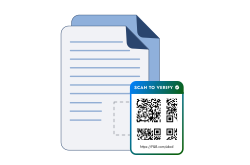
- Embedding a verification QR Code linked to a verification page on the translation document.
- Cross-referencing with an issuing organisation’s online portal or document management system
Physical methods are slow, manual, and straightforward to defeat. A fraudster with a scanner, decent editing software, and a good printer can replicate a stamp convincingly. Digital methods are faster, but only as trustworthy as the system behind them. A QR Code that points to a page the fraudster built themselves is worse than no QR Code at all. It creates false confidence.
How QR Mark adds a verification layer to translated documents?
QR Mark adds a secure QR code to the translation certificate. Anyone who receives it can confirm in seconds that the document is the original, unaltered version issued by the authorised translator or organisation.
THB Human Translation now uses QR Marks into certified translations before issuing them to clients. The receiving institution scans the code, lands on a verification page served from THB’s own domain, and gets instant confirmation that the document is genuine. No phone calls to the agency. No manual comparison of stamps.
The Verification Image is served from the organisation’s Custom Domain, so the URL is one the recipient recognises and can trust.
For teams processing large volumes of translated documents, our Bulk Verification dashboard lets you generate and manage verifications at scale without handling each document individually. HR teams and legal departments processing dozens of translated certificates monthly use it to keep verification fast without adding headcount.
The recipient does not need an app. Any phone camera works. Verification takes under 5 seconds.
Conclusion
Sworn and certified translations serve different legal purposes in different parts of the world. Knowing which one your institution requires, and confirming that the issuing translator has the right credentials, is the essential first step.
But it does not answer the second question: is the specific document in your hands the real, unaltered one that was issued? Manual authentication methods, whether phone calls, register checks, or visual comparisons, do not scale and are easy to defeat.
The agencies and teams that handle translated documents at volume have moved to QR Code certificate verification because the alternative is trusting a stamp that anyone can copy. QR Mark gives every translated document a scannable, tamper-evident verification layer that works in seconds for any recipient with a phone.
Frequently asked questions
How do I know which type of translation my document needs?
Start by asking the receiving institution directly. If the document is going to a court or government body in Germany, France, Spain, or another civil law country, you almost certainly need a sworn translation. For USCIS immigration, academic admissions, or corporate HR use cases, a certified translation from an accredited agency is typically sufficient.
Is a notarised translation the same as a sworn translation?
No. Notarisation means a notary public witnessed the translator’s signature and verified their identity. It says nothing about whether the translation is accurate. A sworn translation is produced by a translator with specific legal accreditation who has made a binding oath on the content. The two are not interchangeable.
Can I use Google Translate for official documents?
No. Machine translation is not accepted for any official, legal, or immigration purpose. Both sworn and certified translations require a human translator who takes professional or legal responsibility for the accuracy of the work.
How long is a certified translation valid?
There is no universal expiry date. Most institutions accept a certified translation indefinitely, as long as the original document it was translated from remains valid. Some immigration bodies request a translation issued within a specific time window. Check with the receiving institution for their requirements.
Does QR Mark work with any language or translation agency?
Yes. QR Mark works with any translated document in PDF or Word format, regardless of language pair or agency. The Verification Image is added by the issuing organisation or translator. Any agency that issues translated documents can use QR Mark to add a verification layer.
