


TL;DR
STCW certificate requirements include completing accredited Basic Safety Training (four core modules), passing a medical fitness exam, and holding identity documents like a passport, INDoS number, and CDC. Certificates are valid for five years and need refresher training, updated medical checks, and proof of sea service to renew. Fraudulent or unrecognised certificates are a real risk companies now solve with QR-based verification.
If you want to work on a commercial ship anywhere in the world, an STCW certificate isn’t optional—it’s the minimum qualification that proves you’re trained to handle emergencies at sea. But understanding the STCW certificate requirements isn’t always straightforward.
Between mandatory safety courses, medical fitness tests, identity documents, role-specific endorsements, and renewal rules, it’s easy to get confused about what you actually need.
This guide breaks down every requirement in plain English. You’ll learn about STCW certificate requirements, the mandatory training modules, medical and documentation requirements, how long the certificate remains valid, and what it takes to renew it.
We’ll also look at a growing challenge facing the maritime industry, i.e., fraudulent certificates and how modern verification methods are helping training institutes and employers confirm a certificate’s authenticity in seconds.
What Is an STCW Certificate and Who Issues It?
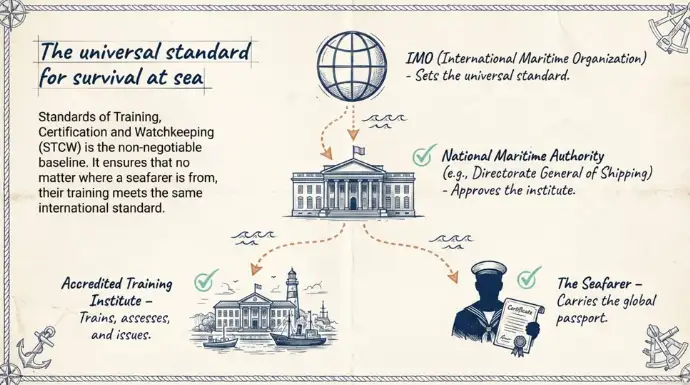
STCW stands for Standards of Training, Certification and Watchkeeping. It’s an international convention set by the International Maritime Organization (IMO), and it sets the minimum training every seafarer needs before working on a ship.
The certificate itself is issued by an accredited maritime training institute, approved by the maritime authority of the country the institute operates in. In India, that’s the Directorate General of Shipping. The institute runs the training, conducts the assessment, and issues the certificate. The seafarer then carries that certificate for the rest of their career, renewing it every five years.
What Are STCW Certificate Requirements?
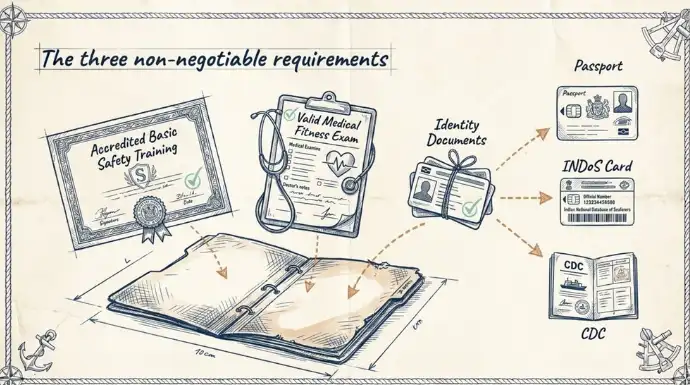
STCW certificate requirements primarily needs three things: accredited Basic Safety Training, a valid medical fitness exam, and identity documents (passport, INDoS number, and CDC in India).
The four mandatory training modules
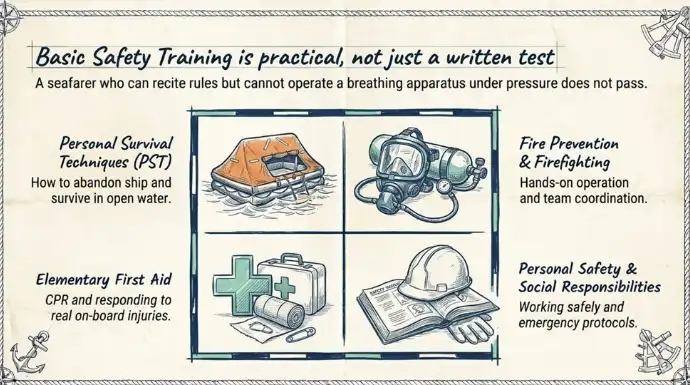
Basic Safety Training covers four modules, and every seafarer completes all four before their first day on a ship:
- Personal Survival Techniques (PST): how to abandon ship, use a lifejacket, and survive in open water.
- Fire Prevention and Firefighting: hands-on training with breathing apparatus, extinguishers, and organising a fire team.
- Elementary First Aid: CPR, wound care, and responding to the injuries that actually happen on a ship.
- Personal Safety and Social Responsibilities (PSSR): working safely on board, environmental rules, and what to do in an emergency.
Each module ends with a practical assessment, not just a written test. A seafarer who can recite fire safety rules but can’t operate a breathing apparatus under pressure doesn’t pass.
Medical fitness
Before training even starts, a seafarer needs a valid STCW Medical Certificate from an approved examiner. The exam checks vision, hearing, and speech well enough to hear alarms and communicate on a noisy deck.
It also rules out any condition or medication that would affect balance, judgment, or physical capability. This certificate has its own renewal cycle, usually two years, separate from the STCW certificate itself.
Identity documents
Alongside training and medical proof, a seafarer needs a passport, an INDoS number (Indian National Database of Seafarers), and a Continuous Discharge Certificate, or CDC, if training in India.
These documents tie the STCW certificate to a specific, verifiable person, which matters once we get to how fraud happens.
Advanced and specialised certifications by role
- Advanced Firefighting: required for officers and senior ratings, this goes past the basic module into commanding a firefighting team and coordinating a response across the whole vessel, not just extinguishing a single fire.
- Medical First Aid and Medical Care: Medical First Aid is required for officers who may need to assist a ship’s medical officer. Medical Care is a step up, required for the officer designated to take full charge of medical treatment on ships without a doctor on board.
- Ship Security Officer (SSO) or Security Awareness Training: SSO is mandatory for the officer responsible for the vessel’s security plan under the ISPS Code. Security Awareness Training is the lighter, mandatory-for-all-crew version.
- Bridge Resource Management (BRM) or Engine-room Resource Management (ERM): required for deck and engine officers respectively, covering how a bridge or engine room team communicates and shares workload under pressure, a direct response to accident investigations that found breakdowns in communication, not skill, as the root cause.
- Radar, ECDIS, and GMDSS: navigation and communication certifications required for deck officers standing watch. ECDIS (Electronic Chart Display and Information System) has become mandatory as ships move away from paper charts.
- Proficiency in Survival Craft: required for officers responsible for launching and commanding lifeboats and rescue boats during an actual emergency, beyond the general survival training every seafarer gets.
- Tanker and passenger ship endorsements: required for anyone working on tankers (oil, chemical, or gas) or passenger vessels, covering cargo-specific hazards or crowd and crisis management that a general cargo ship crew never needs.
Which of these a seafarer needs depends entirely on their rank and the vessel type they’re signing on for, which is why crewing managers cross-check a candidate’s full certificate stack against the specific vessel and role before confirming a contract, not just the basic STCW certificate.
STCW Certificate Validity and Renewal Requirements
STCW certificates are valid for five years. Renewal isn’t automatic, and it isn’t just a formality either. To revalidate, a seafarer needs to:
- Complete refresher training for specific modules, PST and Firefighting most commonly.
- Submit updated medical fitness documentation.
- Prove at least one year of approved sea service within the past five years.
Each of these works a little differently in practice.
Refresher training is shorter than the original course, usually 1 to 2 days instead of a full week, because it’s testing retention and updates to procedure, not teaching the module from scratch.
PST and Firefighting are the two modules IMO specifically requires refreshers for, since those are the skills most likely to degrade without practice and most critical in an actual emergency.
Medical fitness documentation has to come from a currently approved examiner, using the same standard as the original exam, vision, hearing, speech, and no disqualifying condition.
If a seafarer’s existing medical certificate is still valid at the time of STCW renewal, most institutes will accept it rather than requiring a fresh exam, but it’s worth confirming with the specific institute since this varies.
Proof of sea service is usually a discharge certificate or a letter from the shipping company confirming dates served, matched against the seafarer’s CDC record.
This is the requirement that trips people up most often, someone who’s been between contracts or working shore-based roles for an extended stretch can find themselves short of the one-year threshold and need to complete additional sea time before they can revalidate.
Miss any one of these and the certificate lapses, which means the seafarer can’t sign on to a new contract until it’s sorted out. Crewing managers track renewal dates closely, usually starting reminders 6 months out, because a certificate expiring mid-contract is a real operational problem, not just paperwork.
Who Needs STCW Certification?
Every seafarer working on an internationally trading vessel needs it, but the specific certificate depends on the role:
- Deck officers
- Marine engineers
- Ratings (deckhands and support crew)
- Cruise ship staff
- Offshore platform workers
- Fishing vessel crew, in jurisdictions where STCW applies
Beyond the four basic modules, roles carry additional Certificates of Proficiency (COPs) depending on what the job demands. A deck cadet and a chief engineer both start with the same four basic modules, but their certificate stacks look completely different by the time they’re senior officers.
Common Reasons STCW Certificates Become Invalid
A certificate stops being valid for reasons that fall into two very different buckets.
The first is administrative: it expired, refresher training wasn’t completed on time, or the physical document was lost.
The second is more serious: the certificate was issued by an institute not recognised by the flag state, or its outright fraudulent.
That second bucket is where crewing offices lose the most time, and where the real risk sits.
A certificate that looks legitimate on paper, correct fonts, correct seal, correct layout, can still be fake. Manual checks catch the obvious forgeries. They rarely catch the good ones.
How Can Maritime Companies Reduce the Risk of Fraudulent Certificates?
Companies typically rely on a mix of methods to reduce fraud risk: checking the issuing institute against a maritime authority’s registry, looking for digital signatures, checking for holograms or embossed seals, and, increasingly, document authentication QR Code.
Registry checks work but they’re slow, one email or phone call at a time, and they depend on someone at the institute actually responding. Holograms and seals can be replicated with enough effort. Digital signatures help, but most crewing teams don’t have the tools to verify them quickly during onboarding.
This is where a growing number of training institutes are switching to QR Code certificate verification, embedding a scannable code directly on the certificate that pulls up the original record the moment someone scans it.
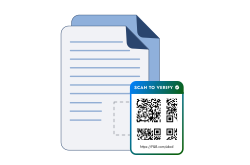
At QR Mark, we work with training institutes on exactly this problem. When an institute issues a certificate, we add a Verification Image, a QR code paired with a verification link, that sits directly on the document. Anyone checking the certificate, a crewing manager, a flag state auditor, a hiring company, scans it and lands on a page confirming the certificate is real, who issued it, and when.
The institute doesn’t need to change how it designs certificates. Using the Microsoft Word Add-in or the Upload workflow, they add the Verification Image to an existing certificate template in one step, and every certificate issued from that point carries it automatically.
For institutes issuing certificates at scale, hundreds of seafarers finishing a batch of Basic Safety Training in the same week, the Bulk Verification dashboard generates and tracks all of those Verification Images in one place, instead of one certificate at a time.
Why Go for QR Code Document Authentication?
Three things make this the practical choice over other anti-fraud methods: it’s easy to verify, it’s instant, and it doesn’t require special equipment.
A crewing manager scans the code with a phone camera, no app to download, no login required, and gets a direct answer in seconds. There’s no waiting on a registry response, no calling the institute, no comparing fonts against a sample certificate.
And because we serve every verification from the institute’s own Custom Domain rather than a generic URL, a scanner can tell immediately that the code was issued by the actual training provider, not copied from somewhere else. That’s also what stops someone from photocopying a real QR code onto a fake certificate. A copied code still points to the original record, and the original record won’t match the fake document sitting in front of them.
“Seafarer certification is one of the few places where a single forged document can put an entire crew and vessel at risk. Verification needs to take seconds, not phone calls. Auburn Institute of Maritime Training, one of the users of QR Mark, had a similar use case when they spoke to us.” says Gautam Garg, CEO, QR Mark.
IMO guidance increasingly points training providers toward digital, verifiable formats for exactly this reason. A certificate that can be authenticated in the field, without a phone call to the issuing institute, closes a gap that paper and holograms never fully closed.
Institutes using this approach have cut certificate verification time from days, waiting on registry or institute responses, down to seconds per scan, while giving employers a way to catch fraudulent documents before a seafarer ever signs on.
Before You Go
An STCW certificate is really two things: proof a seafarer knows how to survive an emergency at sea, and proof someone else can trust that training happened at all. The first part is solid, IMO’s requirements haven’t changed much in years. The second part is where most of the risk sits today.
If you’re running a training institute and certificate fraud, or the sheer time employers spend re-verifying your certificates, is a recurring problem, QR Code certificate verification is a one-time setup that fixes it going forward. Book a demo with QR Mark to see how it works with your existing certificate templates.
Frequently Asked Questions
How long does it take to get an STCW certificate?
Basic Safety Training typically takes 5 to 7 days across all four modules, followed by the medical exam. Total time from starting training to holding the certificate is usually 1 to 2 weeks, depending on the institute’s schedule.
Can an STCW certificate be renewed early?
Yes. Most institutes allow revalidation in the final year before expiry, and many seafarers renew during a break between contracts rather than waiting until the certificate lapses.
Does STCW certification transfer between countries?
Yes, as long as the issuing country is on the IMO’s STCW White List and the certificate is properly endorsed by the flag state the seafarer is working under.
What happens if a seafarer’s STCW certificate expires while on a contract?
The certificate itself doesn’t expire mid-contract for signing off. But the seafarer cannot sign on to a new contract until it’s revalidated, which is why crewing teams track expiry dates months in advance.
Is a QR code on an STCW certificate mandatory?
Not yet under IMO rules, but a growing number of national maritime authorities and training institutes are adopting QR-based verification as the practical response to certificate fraud, alongside registry checks and digital signatures.
Can employers verify an STCW certificate without contacting the training institute?
With QR-based verification, yes. Scanning the code takes the employer directly to a verification page, no call or email to the institute required. Without it, verification usually means checking the training institute’s registry manually.
Do cruise lines have different STCW requirements than cargo ships?
The core Basic Safety Training is identical. Cruise lines typically require additional passenger ship-specific courses, like Crowd Management and Crisis Management, on top of the standard four modules.
