

TL;DR
A sworn translation certificate only holds up if the authority receiving it can confirm who issued it, not just read a name on the page. This guide is for agencies and institutes issuing at volume: why printed certificates get rejected or disputed, the document types where the stakes are highest, how to issue one any authority can verify in seconds from your own domain, and the different ways to fit that into how you already produce translations.
A sworn translation certificate is an official declaration issued by a sworn translator or authorized translation agency stating that a translated document is complete and accurate.
Most sworn translations share the same core parts: a certificate of translation accuracy, the translator or agency’s identifying details, the language pair, a reference to the source document, and page numbering that ties the certificate to a fixed page count.
A sworn translation certificate is only valuable if the person receiving it can trust that it is genuine. Authorities increasingly need a quick way to confirm who issued the certificate and whether it has been altered.
Unfortunately, many agencies still rely on paper seals, signatures, or manual email verification, which are slow, easy to tamper with, and difficult to manage at scale.
If your agency issues sworn translation certificates regularly, adding built-in verification can protect your reputation, reduce verification requests, and make life easier for the organizations reviewing your documents.
In this guide, you’ll learn why verifiable sworn translation certificates matter, the different ways to make them tamper-resistant, and how to issue them individually or in bulk using QR code verification.
Why do sworn translation certificates need to be verifiable?
Sworn translation certificates are often used for immigration, education, legal proceedings, and international business, where the accuracy and authenticity of every document matters. Since these certificates carry legal and professional weight, translation certificate verification must be easy to verify and difficult to tamper with.
Here’s why verifiability is essential.
Document Fraud on the way out, tampered translations
Once a certified translation leaves the agency and sits with the client, nothing stops someone altering it before it reaches a foreign institution. A client could change a grade, a date, a name, or an amount on the translated copy and hand the altered version to an embassy or university. Most agencies have no way to catch that today.
Legal accountability
In civil-law countries like Spain, France, Germany, and Brazil, a sworn translator swears a formal oath before a court and carries real legal responsibility for accuracy. A tampered sworn translation can bring criminal penalties and the loss of the licence to practise.
If a dispute later turns on a mistranslated contract or a criminal record, a verifiable certificate lets the court trace the document back to the exact translator who stands behind it.
Financial and corporate exposure
In cross-border business, companies file sworn financial statements, patent filings, incorporation papers, and audit reports with foreign banks and registries. A sworn translation nobody can verify can freeze corporate assets or void a contract worth millions.
How do you issue a translation certificate that authorities can verify?
To issue a sworn translation certificate, that anybody can verify, there are multiple ways to do so. Some of them are:
- QR Codes
- Digital Signatures
- Holograms
- Seals
Sworn translation certificates are shared both as printed documents and digital files. That means the verification method should work in both cases.
Holograms and official seals are useful on printed certificates, but they can’t be checked on a digital copy. Digital signatures work well for electronic documents, but recipients often need special software or tools to verify them.
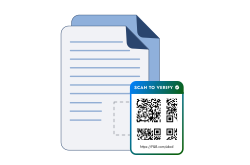
QR Codes solve both problems. A QR code works on both printed and digital certificates. Anyone can scan it with their phone’s camera to open a verification page that confirms the certificate is genuine, who issued it, and whether it has been changed. No special app or software is required.
I will tell you how to issue a sworn translation certificate with built-in QR Code verification using QR Mark.
Follow these steps to issue verifiable sworn translation certificate:
Step 1: Collect the Required Translation and Client Details
Gather all the information that needs to appear on the certificate, including the client’s name, document title, source and target languages, translation date, translator’s name, registration or license number (if applicable), and any reference or case number.
If you’re issuing multiple certificates, prepare the data in a spreadsheet for bulk generation.
Step 2: Create a Reusable Sworn Translation Certificate Template
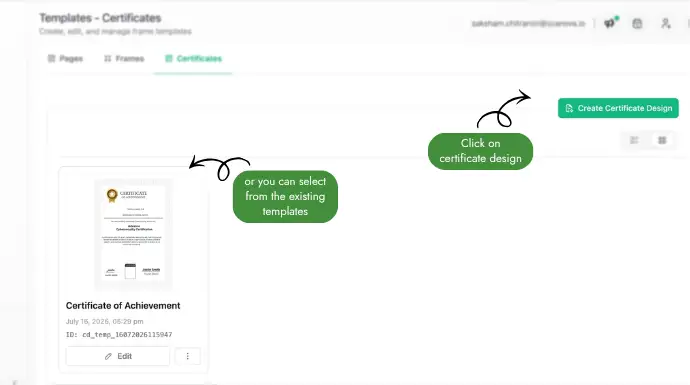
Design your certificate from scratch by adding your organization’s branding, the sworn translator’s declaration, signature, and official seal. Or you can select pre-designed templates from our database.
Include dynamic fields for details such as the client’s name, document title, translation date, certificate ID, and translator information so the template can be reused for future requests.
Pro Tip: Sworn Translation Certificates require different formats in each country. Make sure you follow the format while designing the certificate.
Step 4: Generate Certificates for Individual Clients or Bulk Requests
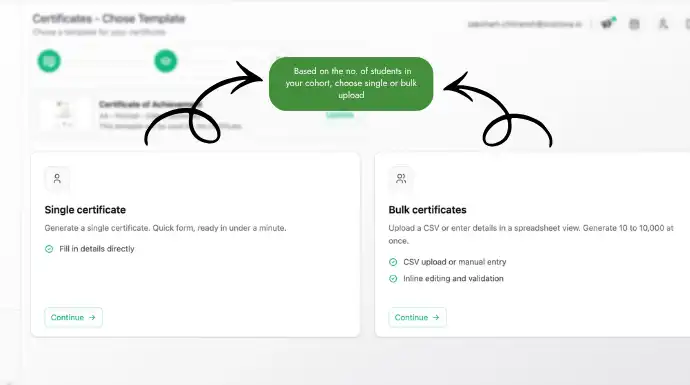
Select your certificate template and either enter the details for a single translation or upload a CSV/Excel file for multiple clients.
Review the mapped fields, correct any validation errors, and generate all certificates in one go.
Step 5: Share the Certificate and Keep It Verifiable
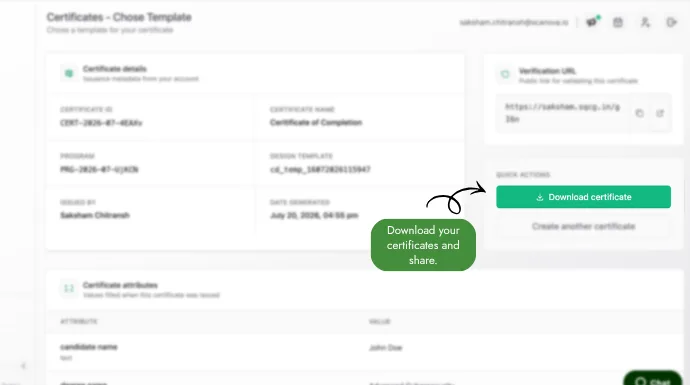
When the certificate gets generated, Deliver the certificate digitally or in print while maintaining a secure verification record.
After the certificate is generated, a unique QR Code is generated automatically on your certificate. Anyone who scans the QR code can access the verification page to confirm the translator, issuance date, and authenticity of the sworn translation certificate.
“Agencies, like The house of business, tell us the hardest part was never making the certificate. It was getting someone on the other side to trust it. Serving the check from the agency’s own domain is what finally closes that gap.”
Siddharth Pangtey, Product Manager, QR Mark.
What other ways can you create a verifiable translation certificate?
You can add verification wherever you already create the certificate, so you fit it into the tool you use now instead of moving to a new one.
Inside Word or Google Docs
If your translators finish certificates in Microsoft Word, use QR Mark’s Google/Microsoft add-ins to add secure QR Codes to your sworn translation certificates and make them instantly verifiable. To know more, on how to do this – read this.
From your translation management system.
If your certificates come out of a TMS or another internal system as finished PDFs, QR Mark’s API can add secure QR Codes to each file as part of that process, with no one placing it by hand.
What documents need a sworn translation certificate?
The ones that cross a border or carry legal weight. These are also the documents forgers target most, which is why proof of who issued it matters more here than on ordinary paperwork.
| Document type | Where it shows up | Why verification matters more |
| Civil records (birth, marriage, death) | Immigration, citizenship, spouse visas | Deadline-driven; one bounced document can stall a whole application |
| Academic records (diplomas, transcripts) | University admission, credential recognition | Heavily forged, so institutions check the source closely |
| Legal and court documents (judgments, affidavits, powers of attorney) | Litigation and cross-border cases | A case can turn on authenticity, and an altered clause is expensive |
| Immigration paperwork (police clearances, financial statements) | Visa and residence applications | Officers reject anything they can’t confirm |
| Corporate documents (agreements, incorporation papers) | Cross-border deals and tenders | A fake version in circulation creates real financial exposure |
Across all of these, the receiving side is doing the same job: working out whether the document in front of them is the one you actually issued. That is what a verification layer is for, and it’s the reason we built QR Mark the way we did.
Is QR verification worth it for your translation agency?
For any agency issuing at volume, it usually is. The cost of a single rejected filing, in missed deadlines and a frustrated client, tends to outweigh a whole year of verification.
A few things change once your certificates can be checked. Authorities confirm them on the spot, so fewer come back rejected. Your team stops fielding one-off verification calls, so issuing runs faster. If an altered copy ever surfaces, you can show exactly what you issued and what you didn’t. And clients start handing you more of their sensitive, deadline-critical work, because they trust how you protect it.
Frequently asked questions
Is a sworn translation the same as a certified translation?
Not quite, sworn translations and certified translations are different. A certified translation comes with a signed statement of accuracy from the translator or agency. A sworn translation is done by a translator officially authorised by a court or government body, which is common across much of Europe and Latin America. In the US and UK there is no sworn-translator register, so a certified statement does the same job.
Who can issue a sworn translation certificate?
It depends on where the document will be used. In countries with a sworn-translator system, such as Spain, France, Germany, and Brazil, only a translator appointed by the relevant authority can issue one. In the US, UK, Canada, and Australia, any competent translator or agency can certify a translation, sometimes backed by an accreditation like NAATI in Australia. Always check the rules of the destination country.
Is a sworn translation legally valid abroad?
Usually, as long as it meets the destination country’s rules. For US immigration, a signed statement of accuracy satisfies 8 CFR 103.2(b)(3), and notarization is generally not required. Canada’s IRCC, Australia’s NAATI, and UK bodies each set their own standard. A QR verification sits alongside these requirements as extra proof of source; it does not replace them.
Does the receiving authority need an app to verify a certificate with QR Codes?
No. They scan the QR Code on the certificate with any phone camera, or open the verification link in a browser. If you use QR Mark, scanning the QR Code takes the verifier to your verification page, where they confirm the details against the document. No app, no account, no sign-in.
Can a sworn translation certificate be modified after it is issued?
No. Once issued, the certificate should remain unchanged. If any information needs to be corrected, the translator or agency should issue a new certificate rather than editing the existing one.
Can QR code verification work with our existing translation management system (TMS)?
Yes. Many verification solutions like QR Mark offer APIs that integrate with translation management systems or internal workflows, allowing verification records and QR codes to be generated automatically as certificates are issued.
