

TL;DR
An STCW basic safety training certificate proves a seafarer has completed the four mandatory safety modules needed to work on a commercial vessel: personal survival, fire fighting, elementary first aid, and personal safety and social responsibilities. It is issued under STCW Section A-VI/1 and is a hard requirement before signing on. This guide covers what the certificate is, what it must show, how institutes issue it today, and how to make every certificate instantly verifiable.
In the maritime industry, there is no room for fake qualifications. A single forged safety certificate can put an entire vessel, its crew, cargo, and the marine environment at risk.
Every seafarer working on a commercial vessel must hold a valid STCW Basic Safety Training Certificate before signing on. The certificate proves they have completed the mandatory safety training needed to respond to emergencies at sea. But as forged certificates become increasingly sophisticated, training institutes can no longer rely on paper documents alone.
The trade of fake certificates is now a billion-dollar global industry experiencing a 2,100% growth between 2015 to 2022.
If you run a maritime institute, you are on the other side of that moment. Every certificate you issue is something a crewing manager, a port authority, or a flag state may need to trust in seconds.
What is an STCW basic safety training certificate?
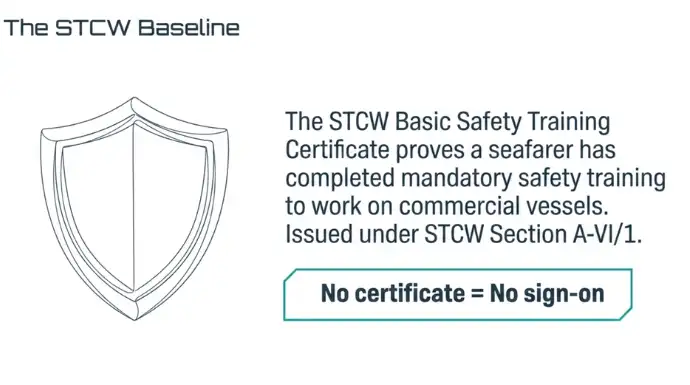
It is the document that confirms a seafarer has passed Basic Safety Training under STCW Section A-VI/1. Anyone working on a commercial vessel needs it before they can sign on.
STCW stands for the International Convention on Standards of Training, Certification and Watchkeeping for Seafarers. Section A-VI/1 sets the minimum safety training every crew member must complete, whatever their rank or role.
What are the types of basic safety training certificates?
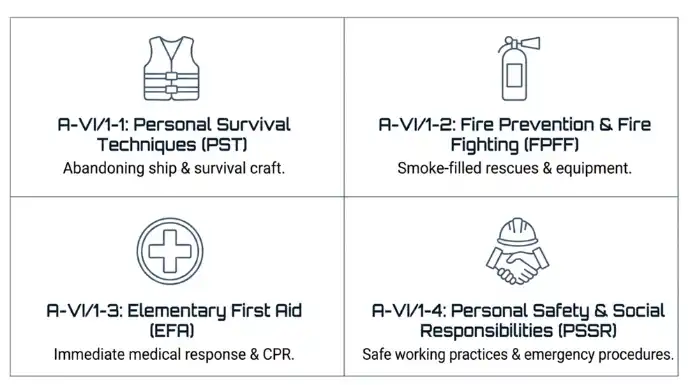
Basic Safety Training is made up of four modules, numbered A-VI/1-1 through A-VI/1-4. Most institutes issue them together as one combined certificate, though some issue module certificates separately.
- A-VI/1-1: Personal Survival Techniques (PST). Survival procedures for abandoning ship, including lifejacket use, survival craft, and distress signals.
- A-VI/1-2: Fire Prevention and Fire Fighting (FPFF). Fire prevention, use of firefighting equipment, and safe movement and rescue in smoke-filled spaces.
- A-VI/1-3: Elementary First Aid (EFA). Immediate medical response on board, including CPR and treating shock.
- A-VI/1-4: Personal Safety and Social Responsibilities (PSSR). Safe working practices, pollution prevention, emergency procedures, and living and working with a crew.
This is also the answer to a common search, the STCW95 certificate of safety training, which points to the same four-module requirement under the 1995 amendments to the convention.
Why do you need a basic safety training certificate?
You need it because it is mandatory. No seafarer can legally work on a commercial vessel covered by STCW without valid Basic Safety Training, and port state control can detain a ship carrying crew who lack it.
Beyond the rule, it keeps people alive. The four modules are the baseline for surviving an emergency at sea and not making it worse.
If you are a seafarer wondering how to get a basic safety training certificate, you take an approved five-day STCW course at a certified maritime training centre and pass the practical drills.
For an institute, the certificate is also your name. If your STCW certificates are easy to fake, your accreditation and your reputation carry the damage, not the forger.
What information should a basic safety training certificate include?
A valid certificate should clearly show the seafarer’s identity, the training completed, and the details a verifier needs to confirm it. Missing fields are one of the most common reasons a certificate gets questioned at sign-on.
At minimum, include:
- The seafarer’s full legal name and date of birth
- A unique certificate number or ID
- The STCW reference (Section A-VI/1 and the modules covered)
- The name and approval number of the issuing training institute
- Date of issue and, where it applies, the expiry or revalidation date
- An authorised signature and the institute stamp or seal
- A way to verify the certificate, such as a QR Code
That last point is where most certificates fall short. The rest of the fields describe the certificate. Only the verification method lets someone at a port thousands of miles away prove it is real.
How are basic safety training certificates generated today?
Most institutes use one of three methods, and they vary a lot in speed and reliability. Here is how each works.
1. Government e-governance portals.
In tightly regulated hubs, certificates are generated inside the national maritime authority’s own system rather than on an institute laptop. For example, In the U.S.,
The academy uploads student data and test scores, and the system issues a certificate against a central registry with a government registration number. It is reliable, but it only exists where the authority runs such a portal.
2. Training management systems (TMS).
Modern academies use dedicated software that combines student records, attendance, and exam grades.
Once an instructor marks a student as passed, the system fills an approved template and exports a signed PDF. Fast and consistent, once you are paying for the platform.
3. Manual Word and PDF templates.
Many smaller institutes still open a master safety training certificate template in Word, copy student data from a spreadsheet by hand, print, sign, stamp, scan, and email. It works, but it is slow and easy to get wrong.
The manual route is where errors and fraud creep in. A typo in a name, an inconsistent format, or a certificate with no verification method at all creates doubt at the far end, which is exactly when you cannot afford it.
Why is maritime shifting to scannable, verifiable certificates?
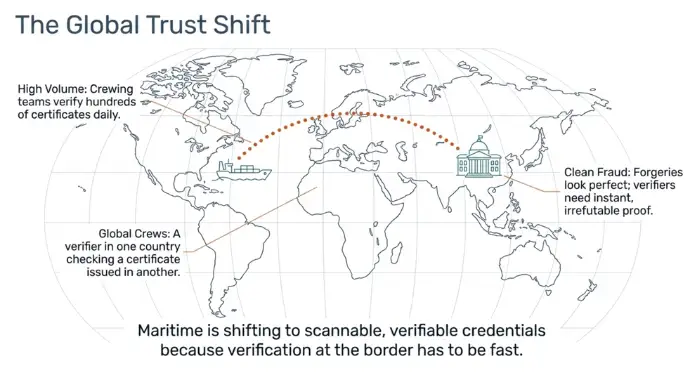
Because verification at the border has to be fast, and paper does not scale. Port authorities and crewing managers often have minutes, not days, to confirm a certificate before a crew change.
A few things are driving the shift:
- Volume: Crewing teams verify hundreds of certificates across many institutes and countries. Phone-and-email checks do not keep up.
- Fraud that looks clean: A forged certificate can look perfect. A scannable link that resolves on the issuing institute’s own domain gives a verifier something they can trust on the spot.
- Global crews: A verifier in one country needs to check a certificate issued in another without chasing a phone call across time zones.
- Regulations: In 2023, the IMO’s Maritime Safety Committee issued MSC.1/Circ.1665, encouraging electronic seafarer certificates with built-in verification. The guidelines require certificates to be secure, tamper-resistant, and uniquely identifiable, while allowing verification through methods such as QR codes, unique tracking numbers, seafarer ID numbers, verification apps, or other administration-approved systems. This helps employers and port state control verify credentials quickly and reliably.
How do you issue course completion certificates of STCW basic safety training certificates online using QR Mark?
You create a Program for your course, pick a certificate template, add your students in bulk from a spreadsheet, and generate a batch of individual PDFs, each with its own certificate ID and Verification Image. Here is the full flow.
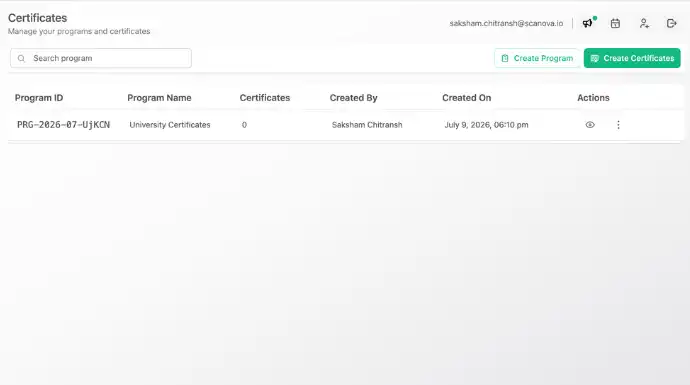
Step 1: Create a Program for your batch.
In the QR Mark dashboard, open the Certificates tab and create a Program. A Program groups certificates by course, cohort, or intake, so your March BST batch stays separate from your April one. Every certificate you issue lives inside a Program, which makes it easy to find later.
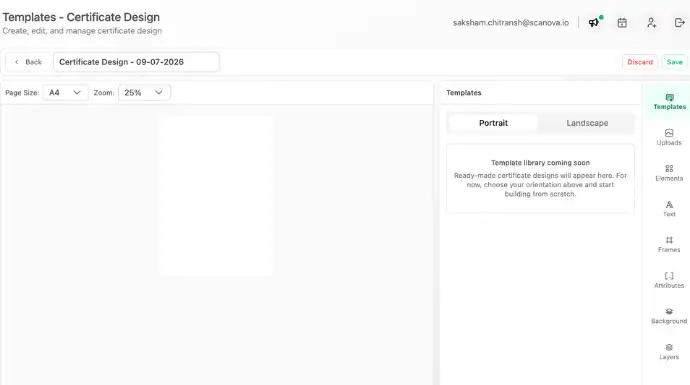
Step 2: Choose your certificate template.
Pick a template for the batch. You can start from a QR Mark system template or use one your institute has set up, with your logo, seal, signature block, and STCW fields already in place. The template also sets where the Verification Image sits on the certificate.
Step 3: Choose single or bulk issuance.
For one seafarer, use Single Certificate and fill a short form. For a whole class, choose Bulk Certificates. Most training institutes issue in batches, so bulk is the common path.
Step 4: Add your students.
For bulk, download the sample spreadsheet, fill in each seafarer’s details (name, date of birth, course, completion date, and any custom fields), and upload it as CSV, XLS, or XLSX. Or type straight into the in-app grid. QR Mark checks the data as you go and flags missing or invalid cells before anything is generated, so a blank date of birth or a duplicate entry gets caught early instead of on a printed certificate.
Step 5: Generate the batch.
Hit generate. QR Mark produces an individual PDF for every seafarer, each with a unique certificate ID and its own Verification Image linked to a hosted verification page. You download them as a ZIP, a merged PDF for printing, or individual files, and you get a records file listing every certificate and its verification link.
Step 6: Send and verify.
Email the certificates to your seafarers in bulk from the dashboard, with delivery tracking so you know what landed. From then on, anyone can scan the QR code and see a verification page with the issuer name, seafarer name, course, issue date, certificate ID, and status, branded with your logo and served from your domain. That is the whole loop: Embed, Scan, Verify.
Why should you choose QR Mark for STCW certificate issuance?
Because it turns issuing a basic safety training certificate from a manual, one-by-one chore into a batch you can verify anywhere in the world. A few things matter most for maritime training institutes.
- Bulk issuance from a spreadsheet. Generate a full cohort’s certificates from one CSV or XLSX upload, each with its own ID and Verification Image, instead of copying names by hand.
- Verification on your own domain. The verification page sits on your institute’s Custom Domain. When a crewing manager or port authority checks a certificate, the domain tells them it came from you.
- Consistent templates. A locked template means every certificate in the batch carries the same fields and format, so staff cannot drop a required field or introduce a typo.
- Instant global verification. Any smartphone camera works. No app, no login, no phone call across time zones.
- Everything archived. Certificates stay organised by Program, so when a seafarer emails two years later asking for a copy, you find it in seconds.
The bottom line for training institutes
A basic safety training certificate is only as good as a verifier’s ability to trust it. Getting the modules and fields right is step one. Making every certificate instantly verifiable is what protects your seafarers at the gangway and your institute’s name behind them.
Frequently asked questions
What are the 5 basic STCW certificates?
Basic Safety Training covers four modules under A-VI/1: Personal Survival Techniques, Fire Prevention and Fire Fighting, Elementary First Aid, and Personal Safety and Social Responsibilities. People often say “five” when they include Security Awareness (Proficiency in Security Awareness under STCW A-VI/6), which many employers ask for alongside BST.
How long is an STCW certificate valid?
Most STCW certificates are valid for five years and then need revalidation, and some modules such as survival craft and fire fighting carry refresher requirements. Always check your flag state’s current rules, as they can differ.
How much does STCW basic safety training cost?
The course fee varies by country and training centre, so there is no single price. Note that the training fee is separate from the cost of issuing and verifying the certificate itself.
Is the STCW certificate mandatory for marine engineers?
Yes. Basic Safety Training under A-VI/1 applies to all seafarers assigned shipboard duties, including marine engineers, before they sign on.
What is the purpose of the STCW convention?
STCW sets global minimum standards for seafarer training, certification, and watchkeeping so crews meet the same safety baseline worldwide.
What is the minimum course needed to renew a 2nd mate or 1600-ton licence?
Renewal requirements depend on your flag state or administration and the specific licence, and usually include current Basic Safety Training plus other refresher courses. Check directly with your maritime administration.
